Bench vice buying guide
'/%3E%3C/svg%3E)
Guide written on 6 February 2024 by:
Michael, Professional and passionate welder, Sheffield
Important features
- Vice type
- Application
- Clamping force
- Fixed or swivel base
- Jaw type
Best sellers in this category
What is a vice?
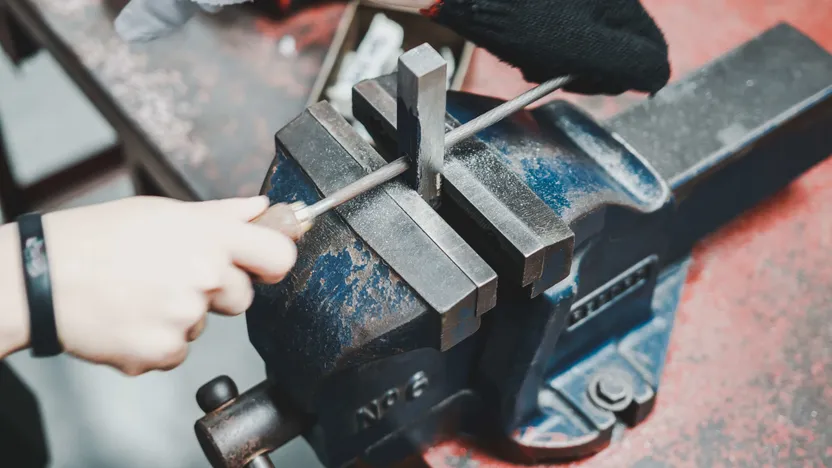
Ever attempted to hack through a curtain pole without using a vice? If you have, you'll know that it's pretty much impossible to do – at least not without a lot of swearing and hurting yourself! Bench vices are designed to fit to a workbench or any sturdy surface to hold workpieces or assemblies in place while you cut, file or dismantle them.
Vices are made up of several components.
A stationary jaw which is connected to the vice body.
A base which may be fixed or swivel and can be set up on or clamped to a workbench as required.
A sliding jaw is designed to slide away from the vice body to clamp workpieces in place.
Two jaw plates made of hardened steel. These plates are usually interchangeable.
A threaded screw which is used to open and close the jaws and should be oiled regularly.
The handle: a small crank handle is usually used to control the screw.
Clamp
How to choose a vice
Before you make your choice, you need to think about the type of impacts your vice will have to handle – will it be subject to a few light taps or repeated blows from a hammer? Secondly what do you plan on clamping – wood, metal, PVC or more fragile items?
Vices all vary in terms of:
material (e.g. cast iron, steel or wood);
the width of their jaws;
the jaw opening;
the base design (fixed or swivel);
design and features;
clamping force indicated in kg; the higher the force, the stronger the vice.
If you're looking for a general purpose vice, you can forget about old-fashioned, wooden woodworking vices which are only designed for fairly limited applications.
Similarly, you'll rarely come across solid steel blacksmith's vices which are designed to handle heavy blows. That said, you will often find vices with integrated anvils to help to divert the force from hammer blows.
Anvils
Best sellers in this category
Different types of vice
Vices with fixed bases
Made from cast iron or steel, these are the most common types of vices. The width of the jaws and the jaw opening varies between models.
Vices with swivel bases
Vices with swivel bases can be used to hold long workpieces when you don't have a lot of room to work.
Multipurpose vices
Multipurpose vices feature pivoting jaws which can be used to hold pipes and tubes. The jaws themselves feature a v-shaped groove which works really well for holding round objects. An integrated anvil tops off the features of these vices.
Table vices
Table vices can be secured quickly to any surface using an integral screw clamp located below the body. These vices are best for occasional use.
Woodworking vices
Woodworking vices feature two guide rods to ensure the jaws stay parallel.
Pipe vices
A pipe vice features an arched stationary jaw and moveable jaw made from malleable cast iron. These vices are mostly used by pipe fitters and plumbers. Designed to be clamped to the end of a workbench, pipe vices are ideal for cutting threads into pipes.
Angle vices
Angle vices are designed to hold and assemble two workpieces to form a 90° angle. They are often used for gluing together frames.
Portable clamping systems
Portable clamping systems are used on job sites or for indoor work. They feature a cleverly designed quick clamping system to save you a lot of time. A foot pedal is used to control the jaws meaning you have one or both hands free to hold the workpiece.
Portable vices
Portable vices are used for tasks that require a long clamping surface.
Hand vices for precision clamping
It can sometimes be tricky to hold a tiny workpiece steady. But there are a few crafty ways to get around the issue.
Jeweller's hand vices are really useful for holding small objects of any shape. You can then introduce the object to a grinder or sander without hurting your fingers. A series of metal pins can be inserted into the flat head of these vices via the holes. These pins can help you clamp fiddlier objects such as figurines or models. In addition, the handle cover can usually be removed so you can insert the vice head into a bench vice if you prefer.
Locking pliers can also be a useful accessory to use alongside a bench vice.
Drill press vices
Any job involving a pillar drill cannot be carried out without the use of a drill press vice. Accidents are common and this accessory is essential for holding your workpieces firmly in place.
Different types of vices with specific clamp designs can be used to stabilise the vice to your work surface. If you have any repetitive tasks to carry out, go for a model with a quick clamp system to increase your productivity.
For machine tools such as milling machines or shapers a range of vices on a mill table will provide greater comfort and unbeatable safety for drilling or precision tasks in any position imaginable.
Vice accessories
If you're hoping to use the vice to clamp fragile workpieces, you will have to use the right type of jaw pads. These jaw protectors come in all different styles including:
aluminium or brass jaw pads;
rubber or resin jaw pads;
pipe vice jaw protectors;
prism vice jaw protectors for machine tools.
Most of these accessories are magnetic for a firm hold on the jaws.
An adjustable stand lift can be used to automatically adjust the height of your vice for enhanced user comfort.
Vacuum clamping systems
Some workpieces cannot be damaged or marked by the vice jaws. In this case, a vacuum clamping system will work perfectly. These nifty devices feature a suction pad which is able to hold workpieces made of any material as long as they have at least one smooth surface.
Replacement parts for vices
Over time, the components that make up your vice, such as the jaws, swivel base or clamping screw may have to deal with significant wear. Make sure to check that the bench vice you buy is compatible with the types of replacement parts available on the market.
You may be also interested in these guides
Guide written by:
Michael, Professional and passionate welder, Sheffield
I was trained as a pipe worker and a pipe-welder and after having travelled for 35 years working around the UK, I became the head of a metal shop, then a designer and in the end the head engineer. I have designed and built a workshop where I make metal sculptures: I managed to find a piece of paradise where I can let my imagination run wild. Auctions and garage sales are no secret to me. I find unusual objects and old tools there that I collect or transform into works of art. I also like decoration, painting on canvas, and gardening. I am developing new technologies concerning tools. To share my passion and advise you in your choice of materials is a real pleasure.
'/%3E%3C/svg%3E)