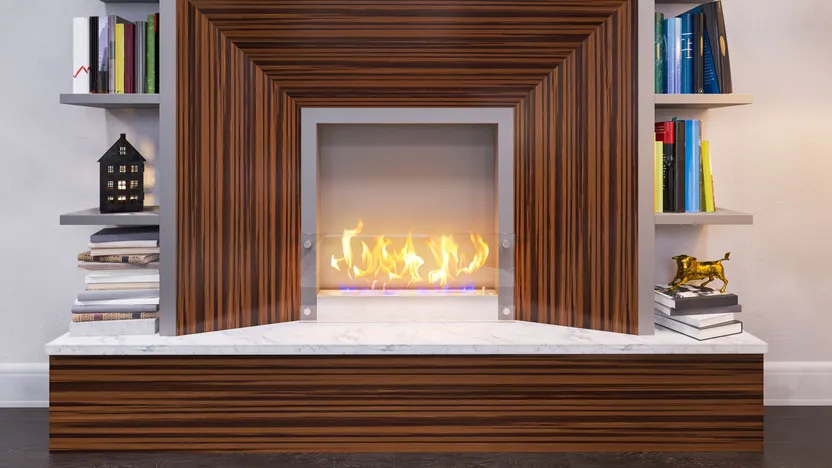
Bioethanol fireplace buying guide
'/%3E%3C/svg%3E)
Guide written on 6 February 2024 by:
Anne, Painter
Important features
- Materials
- Shape and style
- Built-in, wall-mounted, free-standing
Best sellers in this category
What is a bioethanol fireplace?
7 things to know before buying a bioethanol fireplace
Bioethanol fireplaces are used as an additional heat output to add a touch of charm to homes.
They function using bioethanol and are therefore 100% fuel efficient; all the fuel is converted into energy.
In terms of consumption, bioethanol fireplaces consume about 0.4 litres per hour, meaning up to 50 hours of operation for a 20-litre fuel bottle. However, it is not usually recommended to leave your fireplace burning for over 3 hours at a time (please make sure to read manufacturer's instructions carefully).
It's not recommended to install bioethanol fireplaces in rooms measuring less than 10 m². It is essential to air out your home regularly when using a bioethanol fireplace.
A bioethanol fireplace will be easy to install. It's up to you to decide between free-standing, wall-mounted or built-in models.
Bioethanol is clean burning and only releases water vapour and a small amount of carbon dioxide (CO²), so you don't need to connect the fireplace to a chimney flue.
Unlike electric fireplaces, bioethanol fireplaces produce real flames. They offer all the charm of a cosy wood fire without any of its drawbacks: you can say goodbye to the hassle of cleaning a wood fire! You should, however, be aware that the presence of flames does increase the risk of accidents.
Installation and risk prevention
It is necessary to ventilate the room where the bio-ethanol fireplace is used as they do emit small amounts of CO2.
It is highly recommended to install a carbon monoxide detector for risk prevention.
Free-standing bioethanol fireplaces are not an option for families with young children.
Carbon monoxide detectors
What is bioethanol?
Bioethanol is a vegetable-based fuel known as biofuel. It is produced mainly from cereals (corn, wheat etc.), beet or sugar cane. Bioethanol is one of the most widely used biofuels around the world. The fuel is obtained by an industrial-scale fermentation process which transforms the sugar or starch in the plants into raw alcohol. This is then distilled and dehydrated to create bioethanol.
Best sellers in this category
Bioethanol fireplace: safety and decorative burners
Bioethanol fireplaces generally fall into one of two categories:
Safety burner
These burners feature a safety tray containing a porous material to suck up excess fuel caused by accidental overfilling. Safety burners offer a high level of operating safety as there is no risk of fuel spillage.
Decorative burners
Featuring a relatively small fuel capacity, these burners are less economical and are generally considered low-end models.
Shop our bioethanol fireplaces
Different types of bioethanol fireplaces
Tabletop bioethanol fireplace
Bioethanol fireplaces are often used as a decorative element rather than a heating appliance. Tabletop models are often compact and easy to install on tables, cabinets etc. Bioethanol fuel fireplaces are also available in different colours and designs to fit in with your interior decor! These models are ideal for small and medium-sized surfaces.
Bioethanol wall-mounted fireplace
When mounted on a wall, your bioethanol fireplace can become a real decorative element! Designed to match your interior, these fireplaces are placed up high to keep them out of reach of children. Wall-mounted bioethanol fireplaces are, however, limited to use in one room which must stay properly ventilated. These models are ideal for smaller areas as they do not take up any floor space.
Free-standing bioethanol fireplaces
A practical option, a sturdy base provides stability and makes your appliance easy to move between rooms. Be careful, however, as this type of fireplace is likely to be within reach of children. These models are ideal for small to medium-sized surfaces.
Built-in bioethanol fireplaces
Some bioethanol fuel installations are designed to be kept in the open hearth of your existing fireplace! Some manufacturers even offer models in metal or stone. These fireplaces are generally more powerful and come close to competing with wood-burning fireplaces. They are therefore ideal for large rooms.
Shop our bioethanol fireplaces
Choosing a design for your bioethanol fireplace
Increasing in popularity in recent years, bioethanol fireplaces have adapted to the increasing demand. And that's where the main advantage of these appliances comes in: with their striking designs, these appliances are right at the top of the list of decorative fireplaces! There are several criteria to consider when picking the design of your bioethanol fireplace.
Material
Purists will prefer a "wood" finish for its rustic appeal while design lovers will choose contemporary materials, such as wrought iron, concrete or stainless steel. If you're looking for an up-market finish, go for a marble or stone model.
Shapes
Bioethanol fireplaces come in a multitude of different shapes: from the more common (round, oval or rectangular) for a classic vibe, to the seriously quirky (square, wave-form, "sculpture" effect, etc.).
Colour
Go for a design that will fit perfectly with your existing decor. Choose black to keep it classic and simple, or opt for an on-trend shade (aluminium, stainless steel, white) for a clean and modern design. Or why not push the boat out with a bright colour (blue, raspberry, yellow etc.) for a more personalised style? You can even get bioethanol fireplaces with interchangeable covers that allow you to change up your style whenever you want!
Shop our bioethanol fireplaces
Advantages and disadvantages of bioethanol fireplaces
Advantages of bioethanol fireplaces
Style: bioethanol fireplaces generally boast sophisticated designs, making them an item of decor in their own right.
Choice: building on its early success, you can now choose from many models in varied colours, designs, shapes and sizes.
Ease of use: pour fuel into the tank and carefully light the burner with care and that’s it! To be safe, use a long lighter.
Odourless: Curiously enough, beet alcohol is completely odourless by nature! So you can fully enjoy the flames without any unpleasant odours.
Safe: most bioethanol fireplaces have an automatic shut-off after 3 hours.
Easy installation: this is the main advantage! Bioethanol fireplaces do not require any installation work as they don't need to be connected to a flue. Portable models can also be transported easily between rooms.
Clean to use: this makes them ideal for use in flats.
Disadvantages of bioethanol fireplaces
Limited heating power: this type of fireplace is considered to be a supplementary heating appliance.
Price: style comes with a price tag! The more sophisticated the aesthetic, the higher the price. The initial purchase price of these appliances remains higher than that of electric fireplaces and can vary enormously from one model to another!
Consumption: while they don't consume electricity or gas, bioethanol fireplaces are greedy! Bioethanol is generally sold in 1-litre bottles and these burners can easily use up that much in a single cycle.
Flammability: Ensure that your bioethanol appliance complies with the relevant BS standards to protect you against the risk of burns or fire.
Ventilation: bioethanol fireplaces emit a small amount of CO2, so it is essential to air out your room every 2 hours or so. You should also avoid using them in bedrooms or rooms where people may be resting.
Storage: Ethanol bottles are highly flammable and hazardous. As such, they must be stored in a safe place, out of the reach of children and away from a heat output.
Shop our bioethanol fireplaces
Choosing the right power rating for your bioethanol fireplace
The amount of power you require will depend on where you want to install your bioethanol fireplace.
If your electric fireplace is free-standing and you plan on using it in a number of rooms, you'll have to find a good compromise to make sure it has enough power for each space. Remember that 10 m² requires 1 kW of power, so if the average area of your rooms is 15 m², choose an electric fireplace rated at 1500 W. Of course, if it's a built-in or wall-mounted model, there's only one room size to consider.
Be careful not to overestimate the heating capacity of these appliances – electric fireplaces are more decorative than anything else. As already mentioned, electric fireplaces are designed to be used as supplementary heating devices.
Shop our bioethanol fireplaces
Final tips for choosing your bioethanol fireplace
If you're a fireplace fanatic, a bioethanol fuel fireplace is a great alternative to electric versions with false LED flames. For your safety, make sure you follow all the manufacturer's instructions carefully. The use of these appliances requires care and vigilance as the dangers are real. Make sure to read all instructions and don't try to save money on a cheaper model at the risk of buying a faulty or substandard bioethanol fireplace. Although eco-friendly, if you're looking to make savings, it's important to remember that, like any alcohol, bioethanol is best consumed in moderation!
Shop our bioethanol fireplaces
You may be also interested in these guides
Guide written by:
Anne, Painter
After 8 years of trade, I turned professional: I trained myself to be a painter and carpet fitter, either on my own or with 16 year old comrades. 9 months later, following vocational training, I created my company. I’m a self-taught DIYer and decoration enthusiast, I love to find and restore furniture and to create unique decoration pieces. I completed the renovation of my sister’s house with my niece: electrics, tiling, plasterboard...we did it all. And today, if I can share my experience I'm happy to do it. Good Luck.
'/%3E%3C/svg%3E)