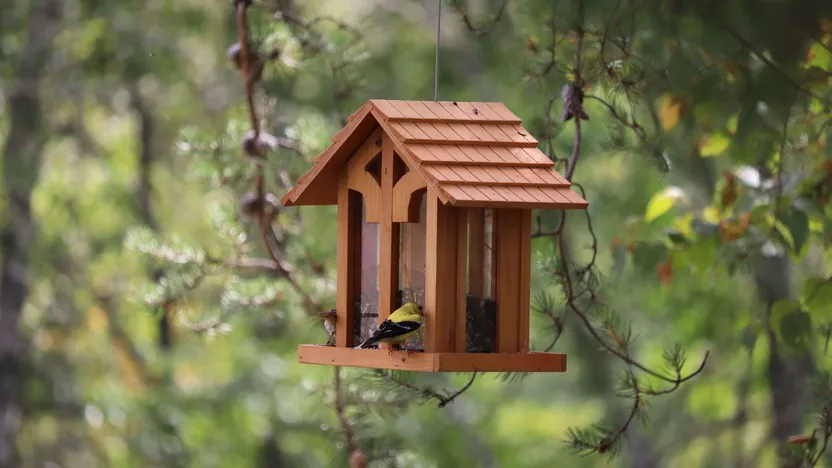
Bird house and feeder buying guide
'/%3E%3C/svg%3E)
Guide written on 6 February 2024 by:
John, Passionate gardener, Cambridge
Important features
- Materials
- Dimensions
- Bird species
- Installation
- Type of bird house
- Type of bird feeder
Best sellers in this category
How to choose a bird house
Features of a bird house
When picking out a bird house, it's important to check for the following qualities:
good weather resistance;
good thermal insulation;
appropriate dimensions for the birds in your area;
easy cleaning;
no perches!
Choosing a bird house material
Bird houses must be made of a weather-resistant material that offers good thermal insulation and prevents condensation. The best materials are woodcrete (i.e. wood and concrete) or plain wood. The most popular types of wood used for this purpose are red cedar and larch as both are very durable and won't bend upon contact with moisture.
Choosing the right size for your bird house
Your bird house must be the right size for the types of birds that frequent your garden. The opening, in particular, must be suitable. The same goes for the distance between the height of the entrance hole and the base of the bird house. This dimension is essential to get right in order to keep eggs and chicks safe from predators and also allow young birds to leave the bird house easily.
Cleaning a bird house
If you want your bird house to welcome visitors for many years, the inside of the structure must be easy to clean once your nestlings have flown the nest. You will therefore have to be able to remove either a side of the bird house or the roof.
Bird houses and perches: a bad combination
Bird houses should not feature a perch at the entrance as this makes it trickier for the birds to access the house.Most importantly, however, it can be used by predators.
Entrance hole size | Species |
25 to 28 mm | Blue tit, black tit, marsh tit, long tailed tit |
28 to 32 mm | Great tit, tree sparrow |
34 to 38 mm | House sparrow |
45 to 50 mm | Nuthatch, starling |
Semi-open bird house | Robin, black redstart, white-capped redstart, grey flycatcher, wren, blackbird, grey wagtail |
Shop our bird houses and feeders
Types of bird house
Two main types of bird house
Closed bird houses with a small circular entrance hole for birds such as sparrows and tits.
Semi-open bird houses with a larger rectangular opening (6 to 10 cm) for birds like robins, wrens and grey wagtails.
Species-specific bird houses
It is possible to find bird houses or nests designed specifically for certain species such as swallows or swifts. It's up to you to find the best spot for your bird house to avoid nests turning up in awkward spots!
Finally, some high-tech bird houses come with a mini camera to monitor the development of your little brood!
Best sellers in this category
How to choose a bird feeder
Key factors for choosing a bird feeder
First of all, you'll have to think about price. This can vary from a few pounds up to £100 for high-end models equipped with technology!
The types of birds you want to welcome will dictate the type of food you offer. In turn, you'll have to pick a feeder that can accommodate it.
How often the bird feeder will need to be topped up: if you tend to go away for a few days at a time. it's a good idea to go for a bird feeder that can hold a small reserve of food.
Location: choose between hanging or free-standing bird feeders but beware of cats!
The material that forms the feeder. If you go for a wooden bird feeder, choose a rot-proof variety like cedar or teak.
Shop our bird houses and feeders
Types of bird feeder
Bird tables
Whether set up on the ground (on a deck or balcony), on a post or hung from a tree, a bird table is the easiest way to feed birds. Feeder tables can be used to hold all kinds of seeds and fruit.
What's more, they allow birds to feed together in groups. However, you will have to clean these bird feeders on a daily basis as they quickly get covered in droppings. Most models come with a roof to protect the bird feed from the rain. Bird tables go down particularly well with robins and chaffinches. They can be free-standing (mounted on a stand) or hanging. It's also possible to buy them in kits to assemble yourself.
Bird seed feeders
Designed to hold things like sunflower seeds or seed mixes, bird feeders come in a range of designs and are particularly useful for protecting the bird food from the elements or contamination.
They can be used to store large amounts of seeds with some able to hold a few kilos of bird feed! This will last the birds several days as the seeds are dispensed gradually down to the feeder tray. Bird feeders are great for avoiding waste and will usually attract birds like tits, greenfinches and goldfinches.
Fat ball holders
You might also want to go for a hanging system designed to hold a fat ball. This type of feeder is very popular among tits, nuthatches and woodpeckers A range of designs is available with special holders designed to hold fat balls, fat blocks or even peanut butter!
Caged bird feeders
Peanuts, as long as they are not grilled or salted are an excellent winter food source for birds as they are high in fat, minerals and protein. They are enjoyed by many different species, particularly tits. Caged bird feeders are ideal for distributing peanuts.
Complete bird feeding stations
Made up of several feeders containing different types of snacks, these feeding stations are a bit like a bird buffet!
Bird feeders for balconies or window sills
Specially designed for urban spaces, small gardens or window sills, these compact feeders are used to feed birds that are comfortable getting fairly close to your home.
Windows
You may be also interested in these guides
Guide written by:
John, Passionate gardener, Cambridge
When I was young, I was already working in the family garden. Perhaps that is where my interest in plants and gardening came from. So, it was logical for me to study plant biology. At the request of various publishers I have, over twenty-five years, written many books on the subject of plants and mushrooms (a subject that is close to my heart). They were mostly identification guides at first, but shortly after they were about gardening, thus renewing the first passion of my childhood. I have also regularly collaborated with several magazines specialising in the field of gardening or more generally in nature. There is no gardener without a garden, I have cultivated mine in a small corner of Cambridge for the last thirty years and this is where I put into practice the methods of cultivation that will I advise you in as well.
'/%3E%3C/svg%3E)