Cat tree buying guide
'/%3E%3C/svg%3E)
Guide written on 6 February 2024 by:
Pauline, Self-taught DIYer, Leeds
Important features
- Cat tree type
- Basic or multi-level
- Stability
- Size
Best sellers in this category
Cat trees: for feline well-being
A good cat tree will give your furry friend a place to sleep, scratch and just watch the world go by. What's more, if you only have one or two cats, your cat tree doesn't have to be enormous. The main thing is to pick a model that is stable (i.e. with a wide base) and has several scratching posts. Most importantly, it should be sturdy enough to ensure your pet's safety.
Cat trees tend to be made of a mixture of wood, cardboard, fabric and rope, and are designed to provide an area where your cat can play and relax. Your cat will be able to climb and jump around the different levels at their leisure or just kick back and keep an eye on the rest of the house from their watch tower! Cats particularly enjoy having their own safe space at a height if you have kids or other pets.
It's important for your cat's well-being to be able to escape to their own space where they won't be bothered. Cat trees also provide a scratching post to help your cat relieve its need to scratch. Remember: if your cat doesn't have a dedicated scratching post, they will choose any spot they see fit (and that includes the sofa, curtains or rug...!).
Shop our cat trees
Different types of cat trees
Basic cat trees
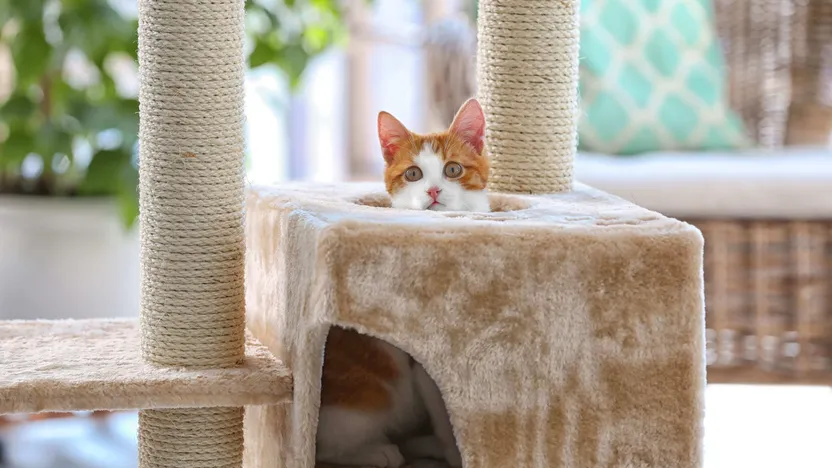
A basic cat tree will generally feature a box base and a rope-covered scratching post. The post may be topped with a little perch for your cat to sit on. The box entrance may be round, square-shaped or feature a fun design like a cat head.
Multi-level cat trees
These cat trees are made up of several levels and platforms. The most complex models will come with hideaways, flat platforms for relaxing, hammocks, ropes and other built-in games.
A multi-level cat tree will require careful assembly to ensure it is sturdy enough to stay steady under the weight of your cat as they leap around.
If you want to take your cat tree to the next level, you can even line the wall behind the structure with cushions to create your own cat parkour!
Best sellers in this category
5 tips for choosing the perfect cat tree
Firstly, think about how many cats need to use the cat tree as you'll need to provide one hideaway per cat. Ideally, if you have more than one cat, you should get a cat tree that has at least one platform and one hideaway per cat. Pay attention to the instruction manual which should provide the maximum load per cat tree; this is especially useful if you have several pets.
Think about how much your pet weighs as some of the cheaper cat trees are not terribly stable. A good indicator of strength is a wide base which will help to balance the structure.
Where do you plan to keep the cat tree? One of the best things about cat trees is that they can allow your cat to see outdoors. Your cat will be even happier if you can place the tree against a window or in a bay window. However, be sure to check that your window or balcony is absolutely secure to prevent any accidents.
How tall are your ceilings? Some cat trees can easily measure over 170 cm. Before purchasing, be sure to measuring up your interior to ensure that the cat tree will fit in your home without blocking any doors or passageways.
Looking for an attractive cat tree? Some manufacturers offer very stylish cat trees or hideaways. But looks shouldn't come first: the most important thing is to take care of your pet's well-being and provide a place for climbing, scratching and relaxing.
The perfect cat tree needs to be perfectly stable to help your cat feel at ease. Finally, once you've picked out a cat tree you choose any additional accessories you might need; from ropes to chew to multi-platforms to clamber up, it's up to you to decide!
You may be also interested in these guides
Guide written by:
Pauline, Self-taught DIYer, Leeds
With a handyman-father, I grew up with the soft sound of the sander and hammer on weekends. I am both manual and cerebral, I learned the basics of DIY and the customisation of furniture because I was passionate. The salvage mentality is a true way of life that allowed me to know how to use all the tools and products needed to give something a second life, from a sander to varnish. I have two favourite activities: the transformation of old furniture and decoration tips. I am always ready to lend a helping hand to revamp a table or to restore a mirror that was intended for the tip that will become a friend’s centrepiece. I’m convinced that it’s possible to reinvent an interior by small, regular modifications and I constantly research low-cost ideas.
'/%3E%3C/svg%3E)