Cement mixer buying guide
'/%3E%3C/svg%3E)
Guide written on 6 February 2024 by:
Denis, Self-taught DIYer
Important features
- Electric
- Petrol-powered
- Drum volume
Best sellers in this category
Selecting the right cement mixer
Occasional use
If you are not a professional and you only have a single masonry project, go for an electric cement mixer with a capacity of 120 litres.While you can purchase a cement mixer with a 60-litre drum a larger capacity will be the better choice given the minimal price difference. This will also give you the option of carrying out larger projects in the future.
Frequent use
If you work at several construction sites with access to an electrical supply a cement mixer with a 120-litre capacity will do the job and will still be light enough to transport.Depending on the scale of the work you'll be doing, you can opt for a cement mixer with a larger drum capacity of 160 or 190 litres.
Regular or intensive use
If you are a professional and you mix cement or mortar 5 days out of 7, consider a cement mixer with a larger drum (250 litre minimum). A petrol-powered mixer means you won't have to rely on electricity. However, given the weight and size of these machines, it's best to select one with a draw bar.
Components of a cement mixer
As a quick reminder, cement mixers are used to blend aggregates with cement and water to make concrete or mortar. They consist of the following parts:
an electric or petrol-powered motor;
a tilting and rotating drum;
a crank wheel equipped with notches which allow you to rotate and tilt the drum into different positions, and to dump the contents into a wheelbarrow;
a sturdy frame mounted on wheels.
Your choice of cement mixer will depend on the volume of concrete you plan to pour and the most convenient power source at your job site, alongside a number of less important criteria (metal or plastic parts, solid or pneumatic wheels, round or square crank, etc.).
Mortar
Mixing volume
First of all, it's important to pay attention to the terminology. The terms you'll most often hear are drum volume and mixing volume. There is a difference between the two.
The mixing capacity of a cement mixer is approximately 80% of the total volume of the drum.For example, a 150-litre drum produces about 120 litres of cement, or two wheelbarrows per load.
Also bear in mind that overfilling the drum will reduce the homogeneity of the mixture, while under-filling may cause the mixture to stick to the walls. Too small a drum volume will increase the number of loads you need to mix which will end up wasting you time.
Best sellers in this category
Number of cement bags per batch
As a point of reference, cement powder is generally available in 35 kg bags. From a practical standpoint, think about the number of 35 kg bags you'll need for each batch.
Cement mixers with a mixing volume of 110 litres will take half a bag of cement per mix; those with a mixing volume of 140–180 litres will take one bag, and so on.
Of course these numbers will vary depending on the kind of mix you're working with; the figures provided here correspond to screed concrete containing 350 kg of cement per m3 of concrete.
Shop our cement
Benefits of electric cement mixers
Electric cement mixers have a certain number of advantages over petrol-powered mixers. First of all, they are cheaper, and require little to no maintenance. There's no need for oil or petrol; all you need is an electrical outlet. They start up immediately – regardless of the outdoor temperature – and are lighter, making them easier to handle.
Most electric cement mixers run on 220 V single-phase electricity (500 to 1500 W). More powerful models (1500 W and higher) run on three-phase (380 V).
You can also get mini electric cement mixers which are easy to transport (for instance between the floors of a building or into a basement). Their drums are small, too, with volumes as small as 65 litres. These mixers are best suited to smaller, indoor jobs.
Shop our cement mixers
Benefits of a petrol-powered cement mixer
In certain cases, the advantages of petrol- (or diesel-) powered cement mixers are incontestable.They can be used anywhere as they do not require proximity to a power source.More powerful (1 to 7 HP) and robust, petrol cement mixers can produce much larger batches. They're used on large building sites and often outdoors, such as in residential construction. They generally have pneumatic wheels, meaning they can be towed on the road without the use of a trailer.Their performance makes up for their weight, size and the level of pollution (atmospheric andnoise) that they emit.
Cement mixer features
Gear or belt drive
Generally, the engine transmits movement to the drum via a removable ring gear that is fixed to the drum and driven by a pinion.A cast iron ring gearoffers strength and a long service life to the mixer, especially if protected from splashing.
Some cement mixers use a belt drive, which is a lot quieter and requires less maintenance (no greasing). Nonetheless, a belt can wear out and will eventually need replacing.
Mixing blades
The more mixing blades or paddles the drum contains, the more uniform the mix. Double or triple paddles are more efficient than single paddles at high filling rates.
Frame
A sturdy frame minimises the risk of the cement mixer tipping over on unstable or wet ground.
Crank wheels
You can choose between round and square crank wheels; this choice doesn't change an awful lot but we prefer round ones!
Drum
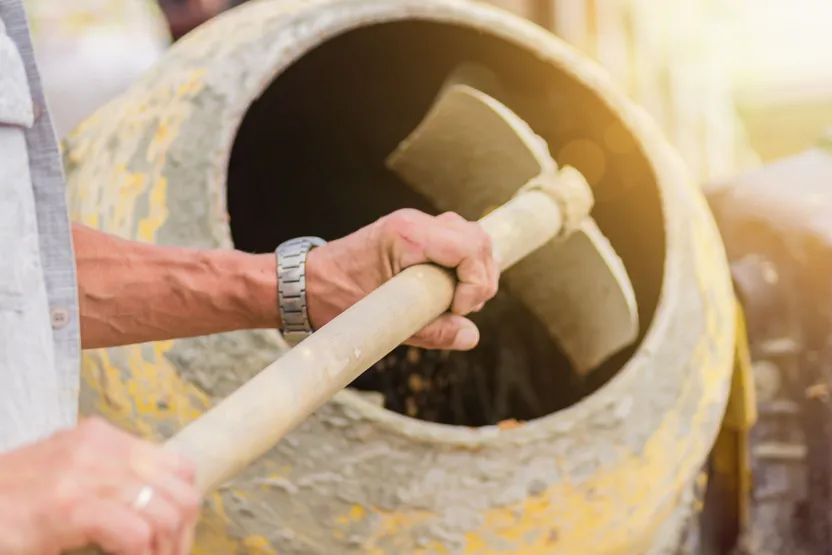
Over time, even if you regularly rinse out your mixer with water, hardened cement residue accumulates on the walls of the drum and the mixing blades. Once the cement has hardened, it will take several blows with a hammer to dislodge it. The metal drum (steel) will need to be able to withstand this.
Shop our cement mixers
Choosing the right wheelbarrow for the job
A cement mixer and wheelbarrow go hand in hand.
Wheelbarrows generally have a volume of 90 to 100 litres.
Unless you have outstanding balance, you can only really wheel up to 60 to 70 litres at a time, which means two wheelbarrows per batch for a 150-litre cement mixer.
Ideally, you should have at least two wheelbarrows on the go.
In any case, make sure you can fit your barrow under the drum of your cement mixer when it is in tipping position. It's better to be safe than sorry!
Wheelbarrows
Tips for choosing the right cement mixer
For domestic use, such as pouring small concrete slabs or masonry work, an electric cement mixer with a drum volume of less than 150 litres will be ideal.
If you're tackling bigger tasks, a petrol-powered cement mixer is the way to go.
And don't forget to have some cold beer ready in the fridge after all that hard work!
You may be also interested in these guides
Guide written by:
Denis, Self-taught DIYer
I started doing DIY 10 years or so ago, when I bought a house that needed to be renovated. After having installed loft isolation, and having refurbished the bathroom, the toilets, the kitchen, the bedrooms… I built an extension, installed a new fence with a gate and kitted out the house with a solar panel to make hot water. I have poured tonnes of concrete into slabs or into the foundations and renovated the roof… I can say that building materials and tools are no stranger to me! If I had a pound for every hour spent looking up information in forums and DIY magazines to find solutions to my problems, I'd be a millionaire! So passing on my knowledge on tools and home equipment is natural, as it is just giving back what I borrowed.
'/%3E%3C/svg%3E)