Chainsaw chain buying guide
'/%3E%3C/svg%3E)
Guide written on 6 February 2024 by:
Albert, Manager of a gardening service
Important features
- Cutter type
- Number of drive links
- Chain pitch
- Chain gauge
- Chain type
Best sellers in this category
Chainsaw chains: the basics
Is your chainsaw no longer cutting properly? Do you need to apply force to make your cuts? Getting sawdust instead of wood chips and already sharpened the chain to no avail? If so, it's time to replace your chainsaw chain!
Chainsaw chains are wear parts and will need to be replaced after repeated use and sharpening. To do so, you'll need to get to grips with all the chain components so you can make your choice with peace of mind and full knowledge of the facts.
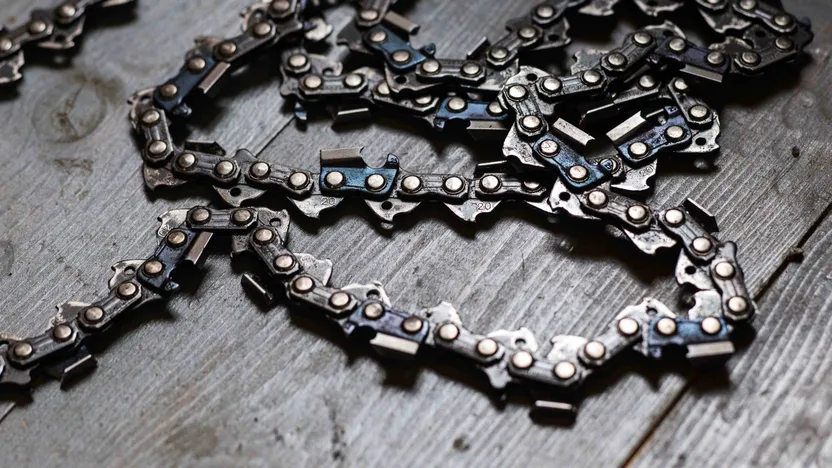
Chainsaw chains are made up of:
drive links;
tie straps;
rivets;
depth gauges;
top plates with cutters or cutting teeth.
What are the components of a chainsaw?
The drive links are slotted into a groove that goes around the guide bar and driven by the sprockets of the chainsaw and guide bar. This system allows the chain to rotate.
The tie straps form a gap to allow for removal of the material produced during cutting. The rivets keep the tie straps in place and allow for some motion at the ends of the straps.
Depth gauges are used to control the action of the cutters. The top plates of the chain dig into the wood while the cutting tooth penetrates through the material. Cutter teeth come in a range of different types or shapes.
Shop our chainsaw guide bars and chains
Cutter types
There are several different types of cutter teeth. Chainsaw chains are categorised according to the shape or type of their cutters. Luckily for woodcutting enthusiasts and beginners alike, this information will be noted on the packaging of the chainsaw chain! Cutters are all designed for different applications. Some types of cutter are multipurpose while others are designed specifically for hard or softwoods. The most common cutter shapes are as follows.
Square
Square-cornered cutters form full chisel chains. Designed for chainsaws with an engine size of at least 45 cc and for cutting into hardwoods like acacia or oak, full chisel chains can be used to fell and trim trees, and cut firewood. However, they do dull quickly and aren't easy to sharpen.
Round
Designed for less powerful chainsaws, semi chisel chains feature round-cornered cutters which are ideal for softwoods like birch and fir. These cutters are easier to sharpen. The downside of these chains is that it is more labour intensive to cut through hardwoods and you do need to sharpen them more regularly. Semi chisel chains are versatile and generally safer than full chisel chains.
Low profile chains
These chains offer a good middle ground between full and semi chisel chains. A low profile chain is suitable for all types of chainsaw. The rounded cutters on low profile chains work just as well on hardwoods as they do on softwoods. Sharpening is required less regularly and is easy to do. These chains are best for beginners as they are the safest to use.
Chainsaws
Best sellers in this category
Finding the right chain for your chainsaw
Chainsaw chain characteristics
To determine the type of chain that goes with your chainsaw, there are four criteria to take into account. This information should be noted on the packaging or in the product specifications of a new chain:
the length of the guide bar;
drive link count;
chain pitch;
chain gauge.
Please note that the length of the guide bar, the pitch and the gauge are given in inches as standard. However, this may occasionally be noted in millimetres or centimetres.
How to find the right chain for your chainsaw
A quick and easy way to find out the type of chain required by your chainsaw is to look at the tip of your guide bar.
Many models will note the following information:
the length of the guide bar;
drive link count;
chain pitch;
chain gauge;
a reference to the type of chain recommended by the manufacturer for your chainsaw (though this is optional).
You can, of course, purchase a chain from a different brand. However, you need to ensure that the new chain has the same chain pitch, chain gauge and number of drive links as the chain you want to replace.
This information may not necessarily be written on the guide bar in which case you will find it in the chainsaw instructions or on the packaging.
How to measure a chainsaw chain
If you have lost the instructions your chainsaw came with, the packaging has long been thrown in the bin or the information on your guide bar has worn away, you will need to take your own measurements. Start by simply using a tape measure to find out the length of your guide bar. You can then use callipers to measure the chain pitch and gauge.
The most important measurement to note is that the chain pitch is equal to half the distance between two drive links. In other words, you simply need to measure the distance between three rivets and divide the result by two.
The result should give you the chain pitch. Remember that you will need to convert the result in millimetres into inches as this is the most commonly used unit of measurement. As a quick reminder, one inch equals 2.54 cm. You should also note that there are four main standard chain pitches. Here is a quick guide converting chain pitch sizes from inches to millimetres.
Chain pitch in inches | Equivalent chain pitch in millimetres |
1/4" | 6.35 mm |
.325" | 8.25 mm |
3/8" | 9.52 mm |
.404" | 10.26 mm |
How to measure chain gauge
To find out your chainsaw chain gauge, use your callipers to measure the thickness of one drive link (the lower links on the chain shaped like an upside-down triangle).
Another method involves measuring the thickness of the grooves on the guide bar. Once you have this measurement in millimetres, you will need to convert it into inches. Here is a quick guide to converting chain gauge sizes.
Gauge in inches | Thickness in millimetres |
.043" | 1.09 mm |
.050" | 1.27 mm |
.058" | 1.47 mm |
.063" | 1.60 mm |
.080" | 2.03 mm |
.122" | 3.09 mm |
How to count drive links
To finish off, you'll need to count the number of drive links on the chain. This task will be easier if you proceed as follows:
position the chain so each drive link is opposite another on the other side;
count the drive links in pairs starting on one side and working your way to the other;
when you're done, add on the two drive links at each end of the chain.
It's worth noting that it is possible to buy chainsaw chains in rolls of several metres that can be cut to size according to the number of drive links required. This task can only be carried out by professionals or experienced DIYers with a rivet gun suitable for chainsaw chains.
Air rivet guns
Picking the right chainsaw chain for your job
There is a vast array of chainsaw chains on the market. Be sure to check that the model you are looking at corresponds to the characteristics of your chainsaw even if it is not from the same brand. Chainsaws all have different features making them suited to different applications. Some chains are multipurpose while others are designed for specific tasks. If you only use your chainsaw occasionally, go for a standard or multipurpose chain.
If you want to carry out heavy-duty tasks, go for a chain with low vibrations and low kickback. Kickback occurs when the nose of the chainsaw hits an object and causes the chainsaw to bounce back towards you which can be very dangerous. Low kickback chains are designed to absorb shocks and prevent this from happening.
10 main types of chainsaw chains
Micro-Lite: narrow kerf chain designed for more precision with less power.
Full chisel: square-cornered teeth with low kickback and low vibrations; designed for professional and tree felling and trimming, and cutting firewood.
Micro chisel for intensive pruning work; with low vibrations and reduced kickback, these chains cut quickly and are easy to sharpen.
Semi chisel: round-cornered teeth with reduced kickback and low vibrations; easy to sharpen, these chains are ideal for use in dusty or dirty environments.
Super chisel: lightweight chains with reduced kickback and a long service life; ideal for power pruners;
Multicut: chain with chrome coating for professional use.
Low profile: safer chains used for smaller chainsaws.
Chipper or Micro-bit: round-cornered teeth with rounded working corners for easy cuts through very hardwoods; designed for very powerful chainsaws;
Super Guard: low kickback chains for tree felling with very powerful chainsaws.
Xtraguard: multipurpose chains for general use; ideal for occasional DIYers and only suitable for use with chainsaws under 35 cc.
You may be also interested in these guides
Guide written by:
Albert, Manager of a gardening service
For several years I have been running a garden service with a clientele of both individuals and companies. I manage a team of gardeners and ensure the creation and maintenance of green spaces. At the same time, I bring my expertise to my clients in terms of the maintenance and improvement of their gardens. In fact, as a trainee and working in the hospitality industry at the beginning of my career, I focused on landscaping in a local community where I acquired solid technical skills through in-house training and the follow-up of major projects in a rapidly changing town. On a personal level, I am equally oriented towards the art of gardening. With my wife, I created our garden from start to finish and I maintain it carefully, the same goes for the vegetable garden. As for DIYing, it’s not to be outdone. Yes, gardening is also tinkering: pergolas, huts, pavements, fences, and so on...There is always something to do in a garden. After working well together, my wife and I are proud of the result and delighted to be able to take full advantage of a friendly and warm environment. So, let us give you advice and help you in your choice of tools, maintenance, or the improvement of your garden, nothing could be simpler.
'/%3E%3C/svg%3E)