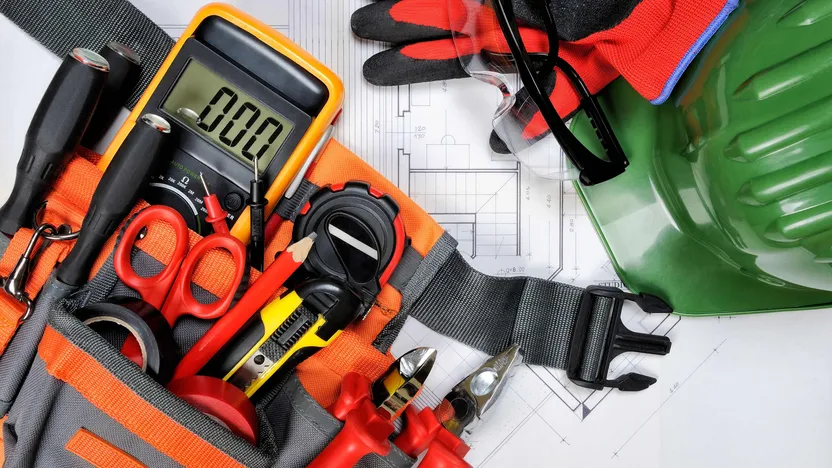
Essential guide to PPE for electricians
'/%3E%3C/svg%3E)
Guide written on 25 September 2026 by:
Pauline, Self-taught DIYer, Leeds
Important features
- Head protection
- Eye protection
- Hearing protection
- Respiratory protection
- Anti-fall protection
- Protective clothing
- Protective gloves
- Safety shoes
Best sellers in this category
Head protection: electrically insulated helmets
Preventing impacts and electrical injury
On construction sites, electricians must wear a properly fitted hard hat conforming to standard BS EN 397 A1. Hard hats have a limited lifespan (usually about 3 to 5 years) which is always marked on the product packaging. It is important to never leave a hard hat in the sun when not in use as this will weaken the outer shell.
Electricians must ask for a new hard hat when arriving on a job site in order to have full PPE. Some models have removable sweatbands or liners which can be washed or replaced to provide maximum comfort, especially during hot weather.
Depending on the type of work being carried out, electricians may also be required to wear a hard hat made of non conductive materials, bearing in mind that employers are legally obligated to provide adequate safety equipment. A class E hard hat will provide dielectric protection up to 20,000 volts.
Hard hats
Eye protection: insulated safety glasses
Preventing eye injury and irritation
Anyone working with electrical hazards may need to complete their PPE with safety glasses or a face shield. This type of equipment must be designed with electrical safety in mind. Safety glasses or over-the-glasses safety glasses must feature side protection (conforming to BS EN 166) and must meet standards for arc flash protection. Electricians should always wear appropriate face protection when carrying out lockout/tagout procedures.
Quick tip: some hard hats can be fitted with visors but it is important to consult the manufacturer's recommendations before adding any additional accessories to electrician's PPE.
Best sellers in this category
Hearing protecting for electricians
Preventing hearing loss after exposure to loud noises
If the electrician has to work on a job site at the same time as noisy work is being carried out, they must wear hearing protection in one of the following forms:
single use or reusable ear plugs (BS EN 352-2) ;
basic ear defenders (BS EN 352-1) ;
active ear defenders (BS EN 352-4).
Respiratory protection for electricians
Electrician's PPE also includes respiratory protection in order to limit the inhalation of dust and/or toxic and non-toxic fumes. If working alongside a painter or tiler, the electrician will likely be exposed to solvents or significant amounts of dust. In this case a P3 disposable half mask (EN 149 :2001 +A1 : 2009) or reusable (EN 405 or 140) mask is recommended. If the work takes place without any particular exposure to potentially irritating substances, a dust mask is not necessarily required.
Protective mask
Fall protection for electricians
Securing sites and preventing falls
This type of equipment should be distributed on site when teams are working at height, such as on scaffolding, where the platform alone will not provide adequate protection. So, what kind of equipment should be included in an electrician's fall protection kit?
a complete harness (BS EN 361);
a lanyard with shock absorber (BS EN 355) or a retractable type fall arrester (BS EN 360);
anchor points (BS EN 795);
carabiners (BS EN 362).
Before using fall protection equipment, the electrician should complete training on the ground and all fall protection devices must be checked before each use.
Carabiners and connectors
Electrician's workwear
Preventing work injury and pain
Electricians may be required to work on construction sites at fairly early stages and while they will usually be working in dry conditions, they may have to work in the cold. Standard BS EN 342 governs requirements for clothes used for protection against the cold. However, when working outdoors it is possible to come into contact with moisture. In this case, electricians should complete their PPE with workwear that provides protection against the rain (BS EN 323).
Electricians will benefit from trousers with reinforced knee pads to prevent knee pain when kneeling down for tasks like feeding cables or installing trunking. It's a good idea to use floor pads in addition to knee pads.
In terms of workwear, electricians should look for breathable materials that cover the body and limbs properly (ISO 13688).
Electrician's gloves
Limiting the risk of electric shock and injury
Electricians will often handle tools like wire strippers or cutters. But they may also have to use more dangerous tools such as saws (to cut trunking, for example). Connecting cables to power supplies and using measuring instruments such as voltmeters requires proper hand protection.
There are two types of electrician's gloves:
gloves that protect against mechanical risks (BS EN 388);
insulating gloves (EN/IEC 60903) to wear when connecting circuits and devices to power.
Safety shoes for electricians
Electricians may be working on construction sites with a lot of movement and various tradespeople. Wearing specially designed safety shoes is mandatory to prevent worker injuries.
Safety shoes designed for electrical protection combine several features:
P rated shoes feature a highly resistant puncture-proof sole;
S rated safety shoes feature toe caps;
electrical insulation (EN ISO 50321).
Shop our safety shoes
You may be also interested in these guides
Guide written by:
Pauline, Self-taught DIYer, Leeds
With a handyman-father, I grew up with the soft sound of the sander and hammer on weekends. I am both manual and cerebral, I learned the basics of DIY and the customisation of furniture because I was passionate. The salvage mentality is a true way of life that allowed me to know how to use all the tools and products needed to give something a second life, from a sander to varnish. I have two favourite activities: the transformation of old furniture and decoration tips. I am always ready to lend a helping hand to revamp a table or to restore a mirror that was intended for the tip that will become a friend’s centrepiece. I’m convinced that it’s possible to reinvent an interior by small, regular modifications and I constantly research low-cost ideas.
'/%3E%3C/svg%3E)