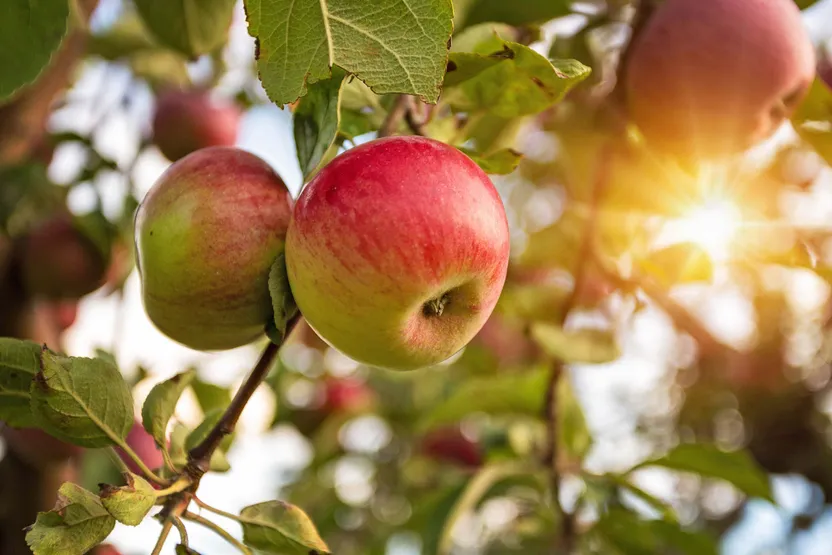
Fruit tree buying guide
'/%3E%3C/svg%3E)
Guide written on 6 February 2024 by:
John, Passionate gardener, Cambridge
Important features
- Fruit tree categories
- Where to grow
- Fruit tree varieties
Best sellers in this category
Types of fruit trees
Fruit trees fall into two main categories.
Pome fruit trees: such as apple, pear and quince trees.
Stone fruit trees: such as peach, nectarine, apricot, cherry and plum trees.
Less common fruit trees, such as fig trees, and nut trees like almond, hazelnut, walnut and chestnut trees can be grown alongside more common varieties. - Citrus trees like lemon, orange and mandarin trees will only really produce fruit in warmer climates.
The price of fruit trees varies widely. It all depends on the variety you choose and the size of the tree: the younger the tree, the less expensive it will be. If you have the choice, buy a bare root tree in autumn. These trees are less expensive and usually take to the ground better than trees sold in pots or with root balls. If possible, go for a local variety and ask a local producer for advice. They should be able to help you find a variety that matches your soil type.
Fruit trees
Fruit trees for small gardens
You don't need a huge outdoor space to plant a fruit tree. Dwarf and miniature varieties have been specially developed to grow in raised beds or planters on a balcony, patio or small garden. These trees are about four to five times smaller than standard fruit trees. The fruit is the same size as that of a standard tree and growth is quicker. However, dwarf trees won't produce for as long.
These days, you have a huge choice of dwarf fruit trees. Every standard fruit tree comes in a dwarf variety.
Apple trees : 'Garden Sun Red', 'Ballerina' (columnar trees).
Pear trees: 'Garden Pearl', 'Garden Gem', 'Williams' (dwarf variety).
Cherry trees: 'Noir de Meched', 'Garden Bing', 'Compact Stella'
Plum trees: 'Golddust'.
Apricot trees: 'Garden Aprigold'.
Peach trees: 'Amber', 'Diamond', 'Crimson Bonfire', 'Bonanza.
Nectarine trees: 'Snow baby', 'Nectarella'.
Mirabelle plum trees: 'Rubis'.
Almond trees: 'Garden Prince'.
Fig trees: 'Précoce de Dalmatie', 'Goutte d'or'.
You can also find columnar apple and pear trees which grow upwards in a very narrow shape.
Best sellers in this category
Common fruit trees and features
Category | Type of fruit tree | Variety examples | Soil type | Climate | Notes |
Pome fruit trees | Apple trees | Huge range of ancient and modern varieties 'King of the Pippins' 'Canadian Reinette' 'Jonagold', 'Chantecler' | All deep, rich and well-draining soil (even lime-rich) | Most parts of the country but does better in milder climates. Full sun. Blossom damage at -2°C. | Harvest from July to October, depending on variety. Plant several varieties for better pollination. |
Pear trees | Summer pears: 'Williams' 'Guyot' Autumn pears: 'Conference' 'Beurre Hardy' Winter pears: 'Passe-Crassane' 'Delbarexquise d'Hiver' | Well-draining and deep; not too chalky, not too wet. | Best in mild climates; ideally south-east or south-west facing. Protect from wind in colder regions. Blossom damage at -2° C | Can live for a very long time. Best to plant several varieties for better pollination. | |
Quince trees | 'Champion', 'Monstrueux de Vranja' 'Portugal' | Cool, well-draining, loamy. | All parts of country. Full sun or part shade. Enjoys sunny autumns for fruit ripening. | Only fruit that can't be eaten raw. Late blossoming usually protects blossom from frost. | |
Stone fruit trees | Cherry trees | 4 common groups: Royal Anne Guigne purple, true cherries, morello cherries. | Light, deep, slightly chalky and not too wet. | All parts of the country. Full sun, sheltered from prevailing winds. Matures in May/June. | Doesn't require maintenance or pruning. Choose late-blossoming varieties in the north to avoid late frost damage. |
Peach and nectarine tress | 'Reine des Vergers' 'Empress peach' 'Saturn' or 'Flat' peaches 'Galopin' nectarines | Light, deep and well-draining. Avoid wet and chalky soil. | Full sun. Cold-hardy but best trained on a south-facing wall. | Green pruning (in the summer) to prevent shoots growing too long. Yellow or white flesh and smooth skin. | |
Apricot trees | 'Bergeron' 'Rouge du Roussillon' 'Royal' | All well-draining soil, even rocky or chalky soils. No wet or compact soil. | Full sun (south or south-west facing), protected from cold winds and late frosts. | While these trees will cope well with frosty conditions, they do not enjoy late winter frosts. That's why these trees grow best in the south. | |
Plum trees | 'Reine Claude golden', Oullins Gage', 'Mirabelle de Nancy', 'Quetsche d'Alsace'. | Deep, rich soil. Mirabelles like fairly chalky soil; 'Reine Vlaude golden and 'Quetsche d'Alsace' prefer clay soil. | Very cold-hardy. Any area with full sun; copes with up to 10,000 metres of altitude. Mirabelle and Quetsches plums are best in the north-east. | One of the easiest fruits to grow. Fruits without pruning. | |
Others | Fig trees | 'Violette Dauphine' 'Blanche d'Argenteuil' "Sultane' 'White Marseilles' | Warm, well-draining and non-acidic soil. | Cold-hardy but needs warmth for fruit ripening. | Harvesting in August to October but some varieties will put out more fruit from June to August. |
Almond trees | 'Ai' / 'Myran' 'Ferraduel' 'Lauranne' 'Garden Prince' (dwarf potted variety) | Well-draining, rocky, chalky and dry soil. | Full sun. Very early blossom (end of February, start of March), frost-sensitive. | Grows best in Mediterranean climates. Should be grown against a south-facing wall in other regions to protect from frost. |
You may be also interested in these guides
Guide written by:
John, Passionate gardener, Cambridge
When I was young, I was already working in the family garden. Perhaps that is where my interest in plants and gardening came from. So, it was logical for me to study plant biology. At the request of various publishers I have, over twenty-five years, written many books on the subject of plants and mushrooms (a subject that is close to my heart). They were mostly identification guides at first, but shortly after they were about gardening, thus renewing the first passion of my childhood. I have also regularly collaborated with several magazines specialising in the field of gardening or more generally in nature. There is no gardener without a garden, I have cultivated mine in a small corner of Cambridge for the last thirty years and this is where I put into practice the methods of cultivation that will I advise you in as well.
'/%3E%3C/svg%3E)