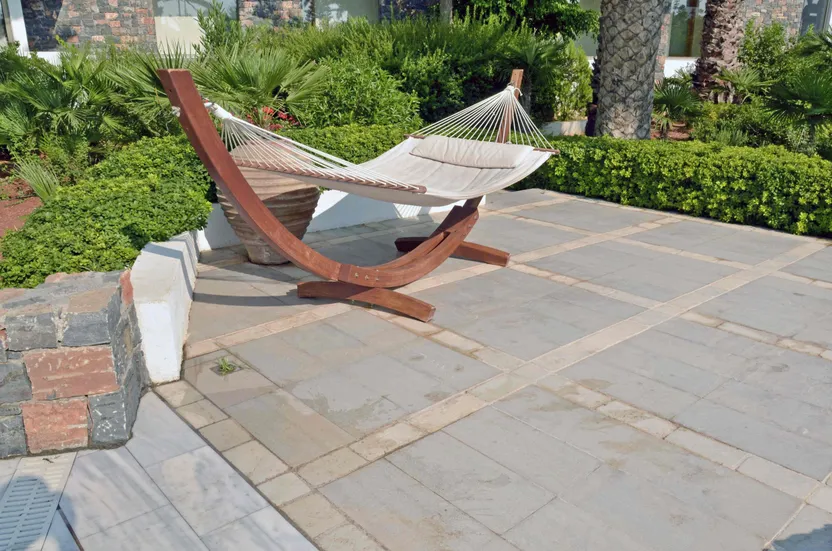
Hammock stand and fixing buying guide
'/%3E%3C/svg%3E)
Guide written on 6 February 2024 by:
Julie, Interior Designer, Manchester
Important features
- Fixing type
- Installation set-up
- Stand type
Best sellers in this category
Choosing a stand or fastening method based on hammock location
The most traditional way to hang your hammock is between two trees. If you haven't been supplied with any hardware, the ideal solution is to buy a fastening kit which generally consist of two highly resistant ropes (made of nylon, hemp. etc.) and two hooks. These kits may also contain two adjustable systems to change the length of the ropes and, in turn, the tension of the hammock.
If your hammock will be secured between two walls, either on the terrace or indoors, you will have to get a specially designed fastening kit with wall hooks. You will also need fixing plugs designed for your wall surface. If your walls are not strong enough, you can find hammock hooks used to spread the weight of the hammock over several points.
Chair hammocks can be secured to branches or beams. For these models, you just need a rope to be used with or without a hook. You can also add a spring to the fastener to absorb the weight of the hammock and a swivel hook to turn the hammock without having to unscrew it.
If you want the freedom to choose a spot to hang up your hammock, go for a stand. Be sure to check that the stand you choose is suitable for the type and size of your hammock. Please note that it is also possible to find stands for chair hammocks.
Hooks
Choosing a hammock stand
Hammock stands can be used if you don't have enough fixing points for your hammock and want to avoid having to drill into walls. They also allow you to move your hammock around as you like. Some models also allow you to easily change the height of your hammock. When choosing a stand, you will have to keep the following points in mind:
The type of hammock you have
Hammock stands differ depending on the hammock they are designed to accommodate. Chair hammocks, for example, only require one fixing point while classic hammocks require two. Your choice of stand will also depend on whether you have a fabric or net hammock, or one equipped with spreader bars.
Spreader bars prevent your hammock from bunching up and create a different reclined position for the user (you cannot lie diagonally on these hammocks). This means that the hammocks have to be fastened higher up to be sure that they won't touch the ground during use.
The size of the hammock
To check if stands are a suitable size for your hammock, you will need to add around 20 to 50 cm to the length of your model on each side to account for the length of the ropes.
The load capacity
Pay close attention to the load capacity of the stand, which must be suitable for the type of hammock you have. This will vary depending on the type of hammock – for example, those designed for one or two people up to family-sized hammocks.
Material type
Stainless steel stands
Stands made from stainless steel or powder-coated steel (with an epoxy resin layer) , are more modern in appearance and can be adjusted in length and height. Rust- and UV-resistant, this material does not require any particular type of care.
Wooden stands
Wooden stands have a natural and elegant feel and blend in well with outdoor décor. Beware that this material does require some maintenance and is usually more expensive than steel.
Best sellers in this category
How to correctly secure your hammock
No matter which type of fastening system you choose, be sure to check the strength of the cords, hooks and fixing points.
Fastening between two trees
Your trees should ideally be around three metres apart. Please note that the hanging distance must be increased for hammocks with spreader bars.
Tie a cord around each tree and knot them at the same height on each side. The greater the distance, the higher the ropes must be to prevent the hammock from sagging and touching the ground. The hammock should take the shape of a banana (with the exception of those with spreader bars). Too much tension and the hammock will be too enclosed; too curved and you will get a sore back!
All that's left to do is place a hook at each end of the rope to fasten and remove your hammock with ease.
Fastening between two walls
Drill two holes into your walls at around 1.8 m in height and use the right fixing plugs to insert wall hooks. The lowest point of the empty hammock should be around 80 cm from the ground or a little lower if designed for children's use.
Fastening to a branch or beam
When it comes to chair hammocks, all that needs to be done is to tie the rope securely around a branch or beam. You can add a spring or swivel hook to the fastener. The seat should be installed at around the same height as a normal seat, meaning approximately 50 cm from the ground.
Chair hammocks
You may be also interested in these guides
Guide written by:
Julie, Interior Designer, Manchester
After years of DIY, renovation and designing, I decided to turn my passion into a career. Starting in 2006, in the South-West, I helped people with renovation or construction projects. My expertise and curiosity led me to look further into innovative ideas for myself and my clients. Indeed, to live your passion is also to transform the space you live in and the objects you use daily. My family love my creations and ideas that I bring into their lives! My favourite thing to do: use colour to brighten up interior space. But also tips to hide away clutter. Your home is just never big enough, is it? It is therefore a great pleasure to share my tips with you, so that you also can take as much pleasure as I do when starting up your next project!
'/%3E%3C/svg%3E)