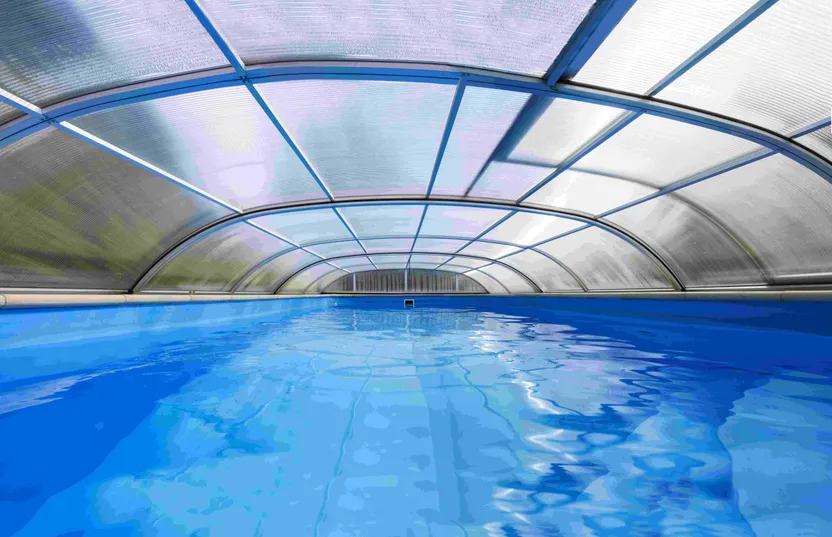
How to cover your pool
'/%3E%3C/svg%3E)
Guide written on 25 September 2026 by:
Sebastian, Self-taught DIY-er, Exeter
Important features
- Manual or automatic cover
- Opaque or net cover
- Solar cover
- Fixed or canopy enclosure
- Telescopic or retractable pool enclosure
- Sliding pool enclosure
Best sellers in this category
Advantages of covering your pool
Using a pool cover or enclosure has several advantages:
protects pool water from external pollution;
reheats pool water without a heater;
secures the pool without installing a gate (some conditions);
easy to maintain.
Protecting your pool from external pollution
A pool enclosure or pool cover limits using pool nets and preserves the pool filter system. Less dead leaves, flies and midges on the surface mean better quality water. That doesn't mean a pool robot or pool vacuum shouldn't be used, although it reduces their use.
Heating your pool without a heater
A pool enclosure or pool cover keeps the pool water at a consistent temperature and can heat it noticeably. A pool cover shelters the water from bad weather and stops the water from cooling down and evaporating - the addition of cold water can also lower the temperature of pool water. With a pool cover or enclosure, you are extending the bathing season.
Securing your pool
Pool enclosures and covers offer the best protection. Covering your pool reduces accidents as the pool can't be swum in and it also reduces the risk of a child falling in. Pool covers, pool cover rollers and pool enclosures are standard. Alarms and safety gates also protect your pool. Be aware of the current rules and standards.
Making pool maintenance easier
By keeping your pool water clean, you reduce cleaning it with pool nets and emptying skimmers. Pool covers and enclosures are strongly advised for winter upkeep. At a minimum, a winter pool cover is necessary. Of course, an analysis of the water and the addition of products such as chlorine, bromine and algaecides are necessary to keep your water healthy.
Swimming pool algaecides
Pool enclosure or cover
Pool enclosures and covers protect, heat, secure and make pool maintenance easier.
Pool enclosure
A pool enclosure extends the bathing season out of the summer season, depending on your region and if your pool has a heater. A pool enclosure protects the swimming pool and the greenhouse effect created, allows you to swim in bad weather or low temperatures. There are different types and heights of pool enclosures.
Swimming pool cover rollers
A swimming pool cover roller is chosen more as a protection as you can't swim with one. Less expensive to install and more understated, the pool cover, like the pool enclosure, is fixed to the pool coping. The swimming pool cover roller is resistant to UV rays and reduces photosynthesis. Like a pool enclosure, a pool cover roller comes in different types.
Swimming pool accessories
Best sellers in this category
Types of pool cover and enclosure
Covering your pool | ||
Swimming pool cover rollers | Pool enclosure | Pool cover |
Manual pool cover roller Automatic pool cover roller Immersed pool cover roller | Canopy Sliding pool enclosure Telescopic pool enclosure Retractable pool enclosure Fixed pool enclosure | Opaque Bubble cover Net pool cover |
How to cover your pool in winter
Pool maintenance and filtration is stopped in winter; for this reason the pool is said to be in winter storage. To protect the pool from bad weather and external pollution (dead leaves, insects etc.), a winter pool cover is necessary. There are two types:
net pool covers - let water and light in;
opaque pool covers - watertight.
The installation of a pool cover, or winter cover, does not take place without thorough cleaning. Pool skimmers, service room, pool liners, return inlets etc. must be cleaned or even blocked up and insulated. The winter pool cover is stretched and fixed above the pool water with an anchor at the level of the coping for in ground pools, or on the structure for wooden or steel above ground pools, or even on semi in ground pools.
A winter cover is not in itself a sufficient protection system (unless it complies with the NF P90-308 standard). Equip your pool with a protective barrier and/or an alarm and/or an enclosure or a cover that meets the standard.
Pool alarms
Covering your pool in summer
Other than a pool cover or enclosure, all pools can be covered with a protective cover. There are two different types:
the pool bubble cover, otherwise known as a solar cover, offers thermal and external pollution protection;
the net pool cover offers comprehensive protection against impurities.
The advantage of covering your pool with a cover is to limit maintenance and to even increase the water temperature if a solar cover is used.
More information
Pool robot buying guide
Pool enclosure buying guide
Pool alarm buying guide
How to clean your pool
How to heat your pool
You may be also interested in these guides
Guide written by:
Sebastian, Self-taught DIY-er, Exeter
Redo a roof with wooden beams? Check. Advise everybody in the DIY shop? Check. Redo bathroom plumbing? Check. If it doesn't work, try again! I'll do my best to advise you in your projects.
'/%3E%3C/svg%3E)