How to get rid of mealybugs
'/%3E%3C/svg%3E)
Guide written on 25 September 2026 by:
John, Passionate gardener, Cambridge
Important features
- How to identify them
- Vulnerable shrubs
- Current treatments
- Treatment period
Best sellers in this category
The damage caused by mealybugs
Once they have settled on a plant, these insects, measuring around 1-6 mm long depending on the species, produce a coating that protects them from their predators and from most insecticides.
Different types of mealybug
This coating can be waxy, powdery or cotton wool-like, depending on the species:
soft, powdery mealybugs protected by waxy filaments;
soft mealybugs but envelopped with a waxy shield, similar to the shell of a crustacean;
mealybugs with a hardened body from wax or lacquer, as if wrapped in a kind of shell.
In the case of mealybugs known as "waxy" or "shelled", this coating is usually brown or black; in the case of the "powdery" mealybugs it is white in colour.
Affected plants
Certain types of plant are particularly susceptible to mealybugs sucking sap:
plants grown in greenhouses: tomatoes, aubergines, melons, chards;
houseplants: ornamental fig tree, cycas, dipladenia, orchids;
plants grown in containers and returned indoors for the winter: oleanders, citrus plants;
fruit trees: fig, pear;
shrubs for hedge plants: bay leaf, silverberry, photinia;
ornamental shrubs: Japanese spindle, camellias, hydrangea, yew trees, olive trees;
cacti and succulent plants.
Areas of the plant affected and signs of infestation
Mealybugs are present all year around, but can be found outside usually between May and October. They thrive in hot and dry conditions, but can also flourish due to over fertilisation.
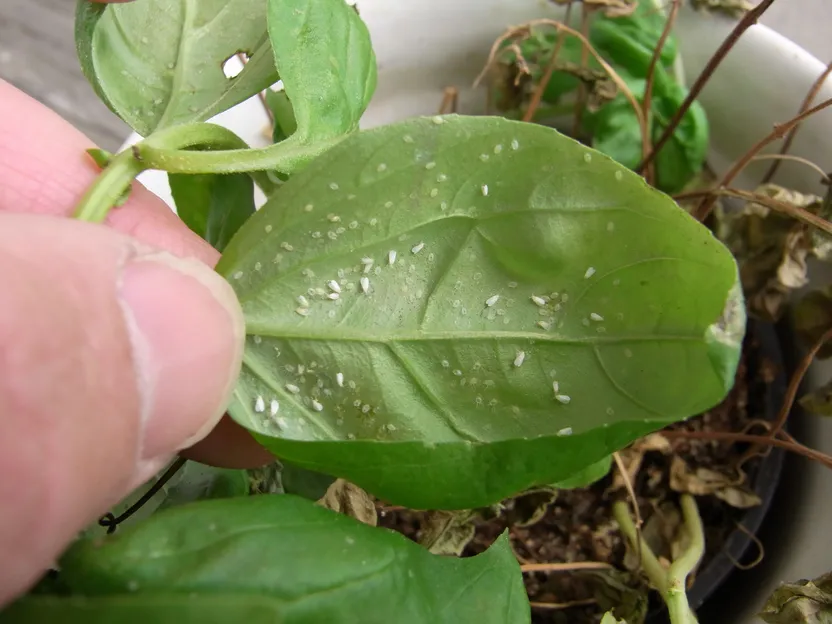
The insects attach themselves to the stems and along the veins on the underside of the leaves; while this makes it difficult to spot them, they can be identified by the floury, or powdery mounds they deposit, as well as from the presence of small shells found on the leaves.
It is possible to detect their presence without actually seeing them from a coating of black powder on the leaves: the sooty mould. This is in fact a fungi produced in honeydew that grows in the excrement of certain mealybugs, making the leaves sticky and suffocating them.
Often one of the first signs of an infestation is the yellowing of the leaves in infected areas. Although it is rare, a heavy infestation can cause the plant to die.
Just one careful observation of the plant can reveal the pale mounds or the small brown shells. These shielded mealybugs can sometimes be difficult to spot on the surface of certain shrubs; if the little patches come away easily by rubbing them with your nail, that means it can be harmful.
Best sellers in this category
How to combat mealybugs
Preventative treatment
Create plenty of opportunity for the ventilation of plants that are susceptible to mealybug infestations, by pruning for example.
Don't put too much fertiliser on plants, even if it is natural or organic.
Keep the soil moist by mulching.
Encourage the presence of beneficial creatures, such as hover-flies, ladybirds, insect-eating birds like blue-tits and grey tits...
Take indoor plants outside as much as possible, especially when it rains (mealybugs don't like the rain).
The only treatment that can be somewhat effective in preventing the bug is spraying a mineral oil on the plant after the leaves have fallen off, or at the end of winter.
Curative treatment
Organic treatment
Use the natural predators of mealybugs, such as certain ladybird species that are effective in greenhouses. For example, the Cryptolaemus montrouzieri feed on larvae and adult powdery mealybugs. This type of ladybird becomes inactive below 15°C.
The larvae or eggs can be deposited on the plants affected by the powdery mealybugs. Small wasps can also be used: they deposit their eggs inside the mealybugs during the nymph or adult stage.
Treatment products
Products available on the market are made from paraffin oil or rapeseed oil, the latter can be combined with pyrethrum to increase its effectiveness. They are known commercially as "anti-mealybug", "winter treatment", "insecticide oil", etc.
Slightly, if at all toxic for the environment, they are used in organic farming.
Rapeseed oil and washing-up liquid
For 500 ml of spray, pour 1 tablespoon of rapeseed oil and 1 tablespoon of washing-up liquid into a bowl.
Mix well until combined.
Gradually add 500 ml of water, stirring continuously. Pour into a garden sprayer by hand.
Spray the infested areas and repeat the treatment 30 minutes later.
The dead mealybugs will fall off the plant during the course of the following days, but it may be necessary to reapply a second time a few days after the first treatment.
Also note that this product can be sprayed on trees and shrubs for treatment in the winter.
Surgical spirit solution
If the infestation is light, has only just started, is on indoor or greenhouse plants, make the following solution:
Mix 2 tablespoons of washing-up liquid, 2 tablespoons of rapeseed oil and 2 tablespoons of surgical spirit.
Add 250 ml of water.
Stir well so that it is thoroughly mixed.
Apply to the affected branches with a brush or dab the insects using a cotton bud.
Whitewashing or limewashing
On trees that are heavily infested with mealybugs, the other solution is whitewashing the tree trunks in winter with hydrated lime, also known as limewashing. Apply to the entire surface of the trunk, starting from the ground and including the branches that grow around the trunk, but only try this method as a last resort.
Although the limewash will kill the destructive pests that are hibernating for the winter in the crevices of the bark, it will also kill the beneficial insects!
Precautions for use
Before carrying out a treatment, it is necessary to take certain precautions:
avoid doing the treatment during the flowering period of fruit trees as this interferes with reproduction and causes poor fruit crops;
avoid spraying mineral oil in direct sunlight or in hot temperatures as this will cause the leaves to burn;
avoid using oily products on succulent plants as this will destroy their protective coating;
avoid treatment of plants whose fruits are due to be harvested in the weeks to come.
There are also essential oil-based treatments, such as rose geranium and Jamaican chilli plant, amongst others.
The best time to take action
Mealybugs are at their most vulnerable during the larval stage, usually in June or July for outdoor plants. Washing-up liquid based treatments are only effective in destroying the eggs, before the insects have produced their protective layer. In other words, at the end of spring or beginning of summer. Outside of these periods it is better to use a mineral oil-based treatment.
You may be also interested in these guides
Guide written by:
John, Passionate gardener, Cambridge
When I was young, I was already working in the family garden. Perhaps that is where my interest in plants and gardening came from. So, it was logical for me to study plant biology. At the request of various publishers I have, over twenty-five years, written many books on the subject of plants and mushrooms (a subject that is close to my heart). They were mostly identification guides at first, but shortly after they were about gardening, thus renewing the first passion of my childhood. I have also regularly collaborated with several magazines specialising in the field of gardening or more generally in nature. There is no gardener without a garden, I have cultivated mine in a small corner of Cambridge for the last thirty years and this is where I put into practice the methods of cultivation that will I advise you in as well.
'/%3E%3C/svg%3E)