How to make liquid fertilisers at home
'/%3E%3C/svg%3E)
Guide written on 6 February 2024 by:
Pauline, Self-taught DIYer, Leeds
Important features
- Uses and plant extracts
- Making a liquid fertiliser
- Steps
- Fertiliser properties
- Plant properties
Best sellers in this category
How to use plant extracts in the garden
Homemade plant-based products can act as fertilisers, fungicides or insecticides. These products help your plants to combat things like disease, insects and mites while their smell works to repel pests. These homemade solutions are made using plants you can find around the garden or in nature, though it is also possible to find ready-made solutions in garden centres or other shops.
There are several ways to extract the active ingredients from these plants and make your own environmentally friendly fertiliser for the garden. The most common forms include:
macerations;
infusions;
decoctions;
slurries.
Liquid fertilisers are generally made by soaking plants in water for a few days to produce a fermented liquid.
6 steps to making a liquid fertiliser
Here is a basic step-by-step guide on how to make 10 litres of liquid fertiliser.
Collect about a kilo of fresh plants (stems and leaves).
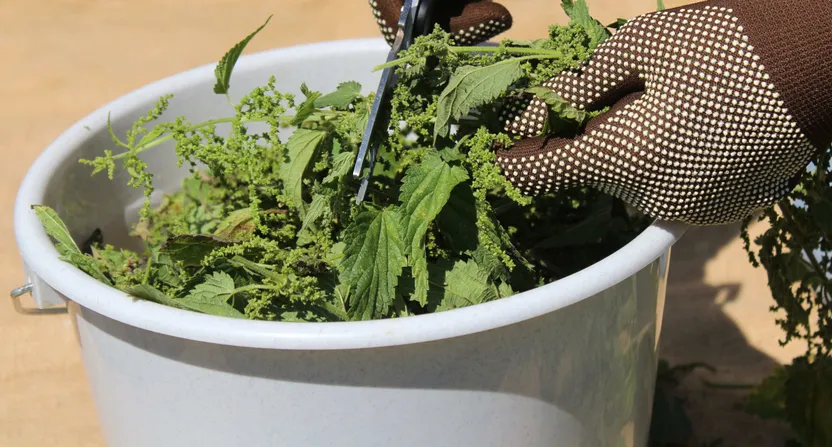
Roughly cut up the plant matter.
Add this to a large plastic container along with about 10 litres of rainwater. The plants must be completely submerged.
Cover the mixture up but not so it is airtight as the fermentation process requires oxygen to work. Place the container in a shaded spot.
Leave the solution to ferment making sure to stir the mixture every day. Once bubbles no longer form on the surface of the liquid when it is stirred, fermentation is complete. This might take anywhere from 8 to 15 days depending on the plant used and the temperature outdoors.
Filter the liquid and the fertiliser is ready to use.
If you can't use the fertiliser right away store it in airtight containers (such as bottles or jerry cans) and keep it in a cool, dark place. It will then last several months.
Do not use the solution neat. Dilute it to about 20% if you want to use to add it to your watering can to boost growth or 10% if you want to spray it onto the leaves.
Best sellers in this category
Tips for making the best liquid fertiliser
Use rainwater instead of tap water, especially if you're hoping for the mixture to ferment as rainwater is naturally soft. Failing that, try to use water from a well or another natural source.
If you have to use tap water, leave it to air out for two days taking care to stir it regularly; this will help the chlorine to evaporate.
Do not prepare your mixture in a metal container (with the exception of stainless steel) to prevent oxidisation. Similarly, don't use a wooden container as this can alter the end results. Instead, use glass, plastic or terracotta.
When filtering, work in two or three steps. Start with a rough filter to take out the largest debris (a sieve, for example) and work your way down to one or two passes through an old insect net or pair of tights.
Liquid fertiliser can be kept for a long time (up to a year) if stored in opaque, airtight containers kept in a cool spot. To ensure your fertiliser lasts, be sure to fill your containers up to the neck to prevent oxygen from getting in.
Do not mix plant varieties when making a plant-based liquid fertiliser. This can prevent the mixture from fermenting properly. However, you can make several different mixtures as long as you prepare them separately.
Nettles, comfrey and horsetail: the winning trio
Stinging nettle fertiliser
Stinging nettle fertiliser is by far the most common homemade fertiliser. Nettles are rich in nitrogen and mineral salt. They can help to boost plant growth, make plants better equipped to deal with things like disease, pests and drought, and improve fruit quality. Whether added to a watering can or sprayed onto foliage, nettle fertiliser can give plants a real boost after transplanting or damage from frost or hail.
Nettles also work to activatecompost by encouraging organic matter to transform into humus. Don't hesitate to add some to your compost pile.
Comfrey fertiliser
Comfrey liquid fertiliser is one of the most used products in organic gardens. It's a fantastic natural fertiliser thanks to its high potassium, phosphorus and boron content which all help to encourage growth and blossoming. It is particularly useful for promoting formation and growth of fruits and vegetables like tomatoes and squashes.
It can also be used as as insecticide. It's often used just before plant growth around two weeks before growth season really kicks off.
Horsetail fertiliser
Horsetail liquid fertiliser is a growth booster that helps to make plants more resistant to fungi or parasites. It allows plants to retain minerals like silica, potassium, calcium and various salt minerals.
When diluted to 10%, it will help to prevent disease caused by fungi, particularly powdery mildew.
Plant properties and uses for liquid fertiliser
Plant | Properties and use |
Wormwood (leaves and flowers) | Insecticide against aphids and caterpillars; spray on 20% diluted solution |
Comfrey (leaves and flowers) | Fertiliser and growth stimulant; dilute to 20% and add to watering can |
Bracken fern (leaves) | Insecticide against aphids; spray on 5% diluted solution Fertiliser; dilute to 10% and add to watering can |
Lavender (flowering stems) | Insect-repellent; spray on 10% diluted solution |
Nettles (leaves and stems) | Fertiliser and growth stimulant; spray on 10% solution or water with 20% solution |
Horsetail (leaves and stems) | Growth stimulant for young plants; spray on 5% solution Fungi-repellent; spray on 10% solution |
Tansy (flowers and leaves) | Insect-repellent; spray on 10% solution |
You may be also interested in these guides
Guide written by:
Pauline, Self-taught DIYer, Leeds
With a handyman-father, I grew up with the soft sound of the sander and hammer on weekends. I am both manual and cerebral, I learned the basics of DIY and the customisation of furniture because I was passionate. The salvage mentality is a true way of life that allowed me to know how to use all the tools and products needed to give something a second life, from a sander to varnish. I have two favourite activities: the transformation of old furniture and decoration tips. I am always ready to lend a helping hand to revamp a table or to restore a mirror that was intended for the tip that will become a friend’s centrepiece. I’m convinced that it’s possible to reinvent an interior by small, regular modifications and I constantly research low-cost ideas.
'/%3E%3C/svg%3E)