How to organise a garden shed
'/%3E%3C/svg%3E)
Guide written on 25 September 2026 by:
Tess, Painting & decorating consultant, Brighton
Important features
- Flooring and walls
- Large machinery
- Small equipment
- Hardware
- Regulations
Best sellers in this category
The benefits of organising a shed
A well-organised shed makes life easier no matter what you use it for. While most sheds are used for storing DIY or gardening supplies and equipment, some have been transformed to create offices or even extra rooms.
Whatever you do with your shed, it should be furnished and organised to match your needs. If you only want a place to store tools, a great storage system will make your space more functional and you'll save yourself a lot of time if you know exactly where every tool is kept.
In addition to organisation, it's essential to ensure your insulation and leak-proofing is solid. A well-insulated and watertight shed will keep your equipment in the best condition possible. These factors are especially important if you're hoping to set up a usable indoor space.
And if you are hoping to create an office or bedroom, you will also need to install lights and perhaps even run water to the shed.
Shop our garden sheds
How to fit a shed interior
Keeping your shed neat and tidy will make any DIY task a breeze. But you'll need to start by making sure your shed interior is up to scratch. Here are a few tips to keep your shed in top shape.
Flooring
The best foundation for a garden shed is a concrete slab. Concrete provides a really stable and strong surface for your shed to sit on. It's then up to you whether you want to leave the shed floor bare or lay an OSB or wooden floor. A PVC-based floor such as lino or interlocking tiles, is another possibility.
Wall covering
When it comes to the interior walls of your shed, your best option will usually be to line the walls with OSB or plywood to ensure you can easily hang accessories on the walls. You might also want to add insulation (such as glass wool) between the exterior and interior walls.
Ceiling
If your garden shed is tall enough, it can be a great option to create a little mezzanine to store things like pool toys or parasols.
Shop our garden sheds
Best sellers in this category
How to store your tools and equipment
Garden tool storage
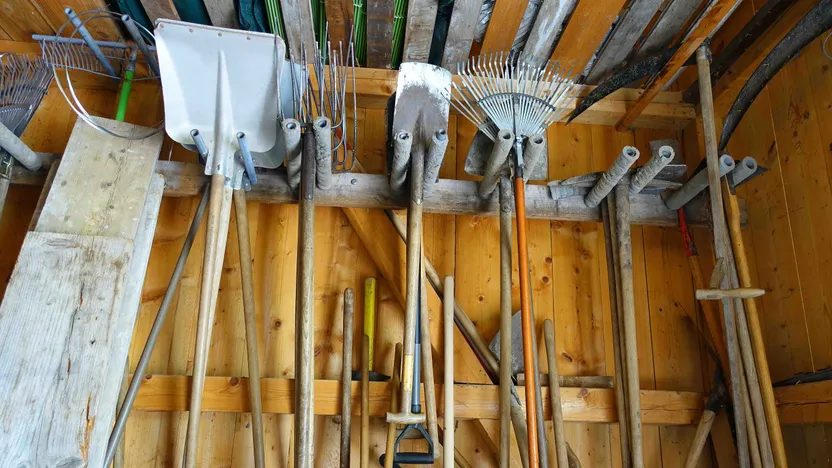
Tools like strimmers, shovels and rakes all take up space in the shed. In order to make the most of your space, fit the walls with hooks which you can use to hang your tools. This can help you to save a lot of room. You can even secure large mesh panels to the walls and use these to hang your tools on. The fewer things you have on the ground, the more space you'll have.
When it comes to larger machinery such as lawnmowers or scarifiers, it's best to leave them on the ground in a clean corner. Be sure to place your heaviest items closer to the ground and your lighter tools up high.
Tool trolleys
Any garden shed can benefit from a tool trolley which can be used to hold hand tools. Screwdrivers, spanners, files and rasps can all be stored according to size to ensure you can quickly get your hands on the tool you need.
Chemical storage
Products designed to protect plants, such as pesticides, can be dangerous and must always be stored securely. It's best to store these types of chemicals in a cabinet (ideally a plastic one) that can be locked by key or padlock to keep them out of reach.
Hardware storage
A really handy option can be to get wall-mounted metal or plastic drawer units to store your screws, bolts, washers and so on. Once again, organise everything by size and material and your DIY projects will go much smoother!
Shelving
Metal, composite or wooden shelves are perfect for storing drills, angle grinders and any other power tools. You can also use them to store paint and other supplies. Another option is to make your own shelves by fixing brackets to the wall and using them to mount wooden or melamine boards.
Installing a workbench
Setting up a workbench is a great way to create your own little workshop in the shed. The end of the workbench can be used to accommodate a vice. If you can't really justify investing in a full workbench, you can always set up a temporary bench using trestles and a wooden or composite board. Finally, it is always handy to install a paper towel dispenser to ensure you can wipe your hands whenever you need to.
Turning your shed into a bedroom or office
Insulation and comfort
Before you even think about using your shed for more than storage, be sure to ensure it has adequate insulation and a few creature comforts. To do so, you'll need to consider the following:
Pouring a concrete slab will ensure your garden shed has a solid foundation. It also makes it easier to lay the flooring you want.
Fitting joists allows you to lift the shed off the ground and protect it from ground moisture. You can then fit wooden boards over the joists. It's also possible to add another type of flooring over the top such as interlocking tiles.
Fix battens to the walls, install glass wool or another type of insulation and nail or screw wooden panels or boards to the battens.
Be sure to check the roof is absolutely watertight. You may have to add bitumen strips, for example.
If you want to run electricity to your shed, be sure to hire a qualified electrician to install your sockets.
Hire a plumber to create a system for the water to flow in and out of your shed so you can install a sink if required.
Once the work is done pick out functional and lightweight furnishings and opt for warm colours to create a cosy and inviting atmosphere.
Planning permission for sheds
Before you set about starting any work, make sure that you are allowed to do so. Generally speaking, you won't need planning permission for a single-storey shed. But if you want to build anything measuring over three metres in height, you will have to contact the local authorities. Even if you don't think you need permission, it's best to get in touch with the relevant authorities to avoid any unexpected surprises the line.
You may be also interested in these guides
Guide written by:
Tess, Painting & decorating consultant, Brighton
'/%3E%3C/svg%3E)