How to organise storage
'/%3E%3C/svg%3E)
Guide written on 6 February 2024 by:
Tess, Painting & decorating consultant, Brighton
Important features
- Assess your needs room by room
- Identify the space required
- Take measurements
- The active and passive zones
- Storage tips and tricks
Best sellers in this category
Organising storage: the basics
From a standard wardrobe to a walk-in wardrobe, via clothes racks or room dividers, storage comes in many shapes and sizes to suit all needs.
Assessing your needs and the amount of storage required
You need to start by assessing your storage needs, room by room, before you begin organising your storage space:
A clothes rail can hold coats and shoes in the hallway. If there isn't much space, a simple shoe rack can be tucked into a corner.
Don't be afraid to exploit the garage for storage purposes, or even install a wardrobe in it if you usually park the car there before heading into the house.
Use the often-wasted space under the stairs. Nowadays there are plenty of storage benches or units specifically designed for this purpose. Another option is a stair storage shelf that offers safety and storage in one.
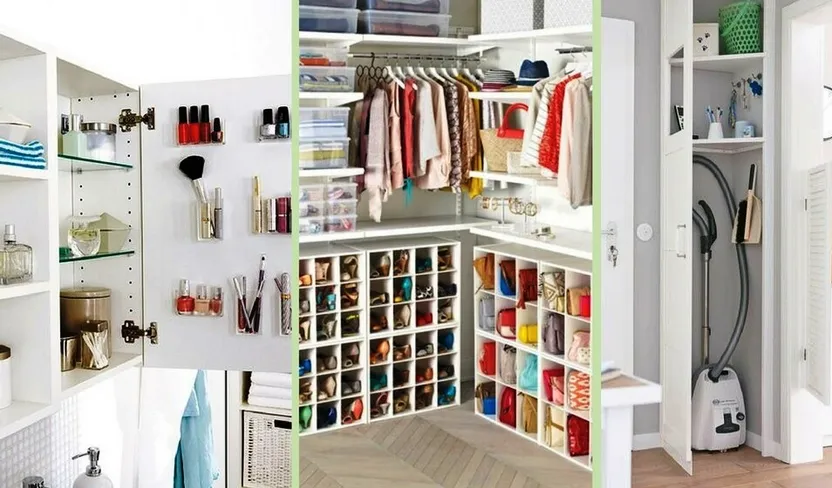
Whether it's in the bedroom or in a room of its own, a walk-in wardrobe provides practical, functional and customised storage.
In a large room, a room divider lets you create storage as well as partitioning the room to create more or less space, depending on whether the divider is open or closed.
In the kitchen or bathroom, use cupboards and shelves to make the most of high up spaces.
Once this step is complete, it's time to determine how much space is needed for the storage units by visualising their size. Then, take precise measurements and optimise your storage layout based on different zones and by streamlining the available space as much as possible.
Shop our wardrobes
Identify how much storage space you need
It's important to take stock of everything you need to store. This is because your wardrobes or clothes racks will be organised differently depending on whether you're going to hang up dresses and blouses, stack T-shirts, or even store books and other heavy items that will require sturdy shelves.
It's a good idea to group together all the items, kitchen utensils, or clothes you plan to store to get a better overview of how much space is required, as well as the maximum dimensions. Take into account, for example, how many piles of T-shirts or jumpers need be stored, how many shoes and/or bags, and their size, etc.
And don't forget to add on 20 to 25% extra space for your future purchases!
Best sellers in this category
Accurately measuring the storage space
If you're looking to build or organise a standard or walk-in wardrobe, it's vital to take accurate measurements, whether you're using simple planks of wood or a storage system.
So, even if the space to be fitted out is square or rectangular, be sure to measure the length, width and height at two or three points. This is because buildings, especially old ones, aren't always straight. Then, stick to the minimum dimensions you've noted down.
And don't overlook anything that might get in the way: plug sockets, switches, air vents, etc.
Optimising your storage layout
The active and passive zones
When it comes to organising your furniture or storage space, remember that it is divided into 2 zones: the active zone and the passive zone.
The active zone
The active zone is at the centre of your item of furniture in terms of height, i.e. between 40 and 140 cm high. Everything here is within sight and reach.
Between 40 and 70 cm, it is recommended that you store the things you only use occasionally, such as bed linen or hand towels.
Between 70 and 140 cm, you should store the clothes you use on a daily basis or the items and utensils used most in the kitchen, for example.
The passive zone
The passive zone is located above and below the active zone.
The lower part can be used to keep shoes or drawers where you can store things you only occasionally use. It's also perfect for heavy items.
Between 140 and 180 cm is the ideal place for clothes rails to hang up your clothes.
The highest part, which is harder to both see and reach, can be used to store suitcases, out-of-season clothes or even hats.
Well-thought-out storage
Here are a few tips and tricks to optimise your storage layout:
When organising storage in the bedroom, kitchen or bathroom, it's important that the clearance of any doors on your storage units doesn't block transit. Not got much space? Opt for sliding doors.
Drawers and pull-out shelves let you make the most of the full storage depth.
In a wardrobe, two clothes rails can be installed one above the other to optimise the storage space for shorter garments.
Vary the depth of storage in line with what it will be storing to visually streamline the space. Additionally, make the most of high-up spaces. This is a tip that comes in handy in the kitchen or bathroom where the available space is often at a premium.
Also consider using drawer dividers so that you can easily find your socks, underwear, toiletries or even kitchen utensils.
Wardrobe storage systems
Wardrobe organisation
A wardrobe or walk-in wardrobe will accommodate three main categories of clothing, bedding and accessories: hanging items, folded items and freestanding items.
Hanging clothes
A depth of 50 cm is enough if the wardrobe or walk-in wardrobe doesn't have any doors, while 60 cm is better if there are doors, so that you can store bulky coats on hangers, for example.
Allow a height of 100 cm for shirts and blouses, 110 cm for jackets, 120 cm for trousers and 170 cm for dresses and long coats. Be aware that these measurements should be adapted to suit the size of those using the wardrobe.
In terms of width, 100 cm offers adequate storage for 5 to 6 coats or a dozen dresses or shirts.
Folded clothes
A width of 40 to 45 cm is enough to hold multiple piles of folded clothes.
A space of 30 to 40 cm allows one pile of clothes to be stored.
A height of 50 cm will hold a pile of about 15 shirts. Plan for a minimum space of around 35 cm between shelves.
Freestanding accessories
A length of 100 cm will hold 4 or 5 pairs of shoes or approximately 40 books.
Clothes racks
You may be also interested in these guides
Guide written by:
Tess, Painting & decorating consultant, Brighton
'/%3E%3C/svg%3E)