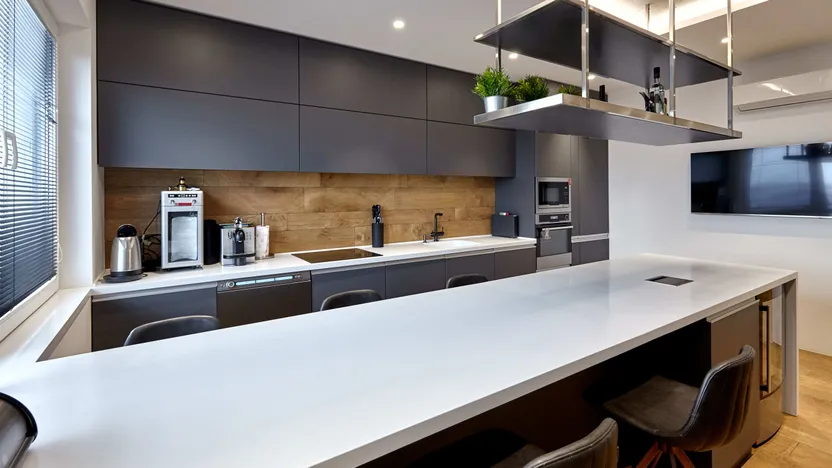
How to plan a kitchen layout
'/%3E%3C/svg%3E)
Guide written on 6 February 2024 by:
Julie
Important features
- Create a kitchen work triangle
- Pick a kitchen layout
- Account for clearance
- Plan unit height and depth
- Organise your storage
- Mix and match lighting
Best sellers in this category
Key steps to designing a kitchen
The kitchen is one of the most important rooms in the house. If you want to create a convivial space where all the family can gather, you need to think carefully about your kitchen design. Ergonomics and practicality are key when planning a kitchen. You need to be able to cook and wash up safely without hurting your back and without having to do too much to-ing and fro-ing!
To achieve this, you need to follow a few key rules:
Set out three different work zones (for washing up, cooking and storage) within relatively equal distance of each other in a triangular layout.
Choose a layout that matches your preferences as well as the shape and size of the kitchen. The most popular layouts are I, U and L-shaped kitchens. Remember that you can also install a kitchen island if you have the space – this option is particularly popular these days.
Make sure you leave enough clearance in front of all kitchen units and appliances.
Ensure the worktop and furniture height is suited to the main 'cook' of the house to create the most ergonomic design possible for them.
Organise practical storage space for all dishes and utensils to keep everything you need within reach.
Split your lighting into three categories: ambient lighting, task lighting and accent lighting. This should help to ensure that you leave no corner of the kitchen in the dark and that you don't overdo it and ending up with a cold and clinical atmosphere.
Kitchen units
1. Create a kitchen work triangle
The activity in a kitchen is concentrated around three zones:
Washing up: sink and dishwasher;
Cooking: hob, oven and other appliances;
Storage: fridge and pantry space.
You will spend most of your time going back and forth between these three zones in the kitchen so they should ideally be arranged in a triangle layout without too much space between them. If possible, the distance between each zone should be roughly equal.
It's also a good idea to leave about 30 cm to the side of each of these zones so you can pile up dishes next to the sink or set out plates and utensils next to the hob.
Best sellers in this category
2. Pick the right kitchen layout
The size and type of kitchen you have will of course affect your choice of layout. But you'll also have to think about your own preferences.
I-shaped kitchens
Linear, or I-shaped, kitchens are best for long kitchens.
In this layout, all units and work areas are spread along the length of one wall so you won't be able to create a kitchen work triangle.
Ideally, you should go for light colours and matching units to stop your kitchen feeling like a corridor!
Quick tip: choose sliding doors rather than hinged doors as doors that open out the way will take up more room than you have to spare.
L-shaped kitchens
L-shaped kitchens are set out over two walls meaning they work for just about every room size.
If you have the space, you can even add a dining table, island or bar table in the centre of the room.
U-shaped kitchens
U-shaped kitchens are arranged over three walls which is ideal for the kitchen work triangle as each wall can accommodate a different work zone.
This layout is perfect for spacious kitchens.
Kitchens with central islands
Kitchen islands can be installed right in the middle of large kitchens provided you have at least 14 m² to work with. In this case, the island can even form part of your work triangle.
Be careful to leave enough room around the island to move around easily and still be able to open your dishwasher or oven if you've decided to incorporate a washing up or cooking area into the kitchen island.
3. Leave enough clearance
Even in the smallest of kitchens, it's essential to leave at least 70 cm of free space in front of base units and wall units.
Furthermore, you'll need at least 90 cm in front of appliances like ovens and dishwashers. Units with hinged doors need to have 120 cm of free space in front of them if you want several people to be able to move around the kitchen at once.
Doors
4. Select the correct dimensions for units and appliances
The height of base units and worktops should generally be about 90 to 95 cm which should sit around waist level. However, some manufacturers offer units reaching up to 110 cm in height which is ideal if the person who does most of the cooking in the home is on the tall side. In short, the idea is to be able to prepare a meal or do the dishes without putting your back out!
In terms of depth, a worktop should measure around 65 to 70 cm. Any wider than this and you might have trouble reaching for appliances plugged into the wall.
Bar tables should level up to elbow height which is 110 cm on average, but they can be taller depending on how tall you are.
The highest shelf in your wall units shouldn't be any higher than 220 cm to allow you to easily reach any items stored on the top shelves.
Ovens should ideally be installed at eye level and cooker hoods should be fitted at least 60 cm above the hob to stop you from hitting your head while you're cooking.
5. Plan out your kitchen storage
Evaluating your needs
Start by weighing up what you need in terms of storage bearing in mind that utensils and appliances should be kept close at hand and not too stored too high up.
Exploiting all space
When fitting out your kitchen, be sure to make the most of all corners using corner units and shelves designed for this purpose.
If possible, go for practical and clever storage options such as item-specific drawers (for example, pan drawers), slide-out baskets, pull-out larder units, kitchen wall shelves, and so on.
6. Mix and match kitchen lighting
Even if your kitchen features a large window, natural light alone won't be enough. Ideally, several types of lighting should be used in tandem to create a warm atmosphere and a safe cooking environment. Kitchen lighting falls into three categories: task, ambient and accent lighting.
Ambient lighting
Ambient kitchen lighting is made up of ceiling-mounted lights. This includes:
ceiling lights;
downlights;
pendant lights.
Task lighting
Task lighting refers to more powerful, direct lights which are designed to be placed over strategic spots such as worktops, hobs, sinks or even storage units.
Choose between strip lights, LED bars or even adjustable spotlights.
Accent lighting
Accent lighting is all about playing with light and highlighting certain spaces. It can come in any number of forms from table lamps set up on shelves to in-built spotlights.
When it comes to decorative lighting, there's no end of options so just look for the light fittings that speak to you!
Hobs
You may be also interested in these guides
Guide written by:
Julie
After years of DIY, renovation and designing, I decided to turn my passion into a career. Starting in 2006, in the South-West, I helped people with renovation or construction projects. My expertise and curiosity led me to look further into innovative ideas for myself and my clients. Indeed, to live your passion is also to transform the space you live in and the objects you use daily. My family love my creations and ideas that I bring into their lives! My favourite thing to do: use colour to brighten up interior space. But also tips to hide away clutter. Your home is just never big enough, is it? It is therefore a great pleasure to share my tips with you, so that you also can take as much pleasure as I do when starting up your next project!
'/%3E%3C/svg%3E)