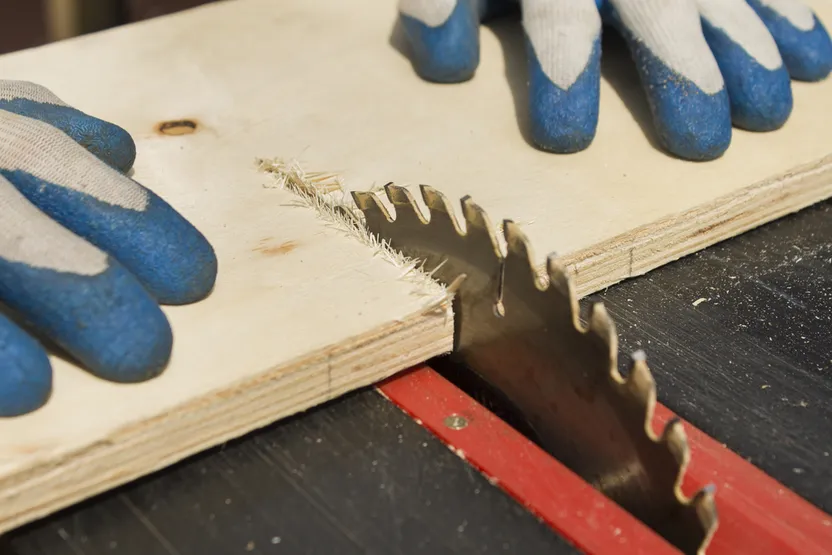
How to use a table saw to cut plywood
'/%3E%3C/svg%3E)
Guide written on 6 February 2024 by:
ManoMano Team,
Tip 1: Choose the Right Blade
While this may be surprising to some people, the saw blade that comes with your table saw will just not give you the quality of cuts you desire. Such blades are often designed for rough cuts common with construction-grade soft lumber. You will need to upgrade if you must use your table saw for sheet goods.
Experienced carpenters and woodworkers recommend you upgrade to something like 80 TPI plywood blade that is designed to work with rip cuts. A great blade can prove useless if you do not have the right technique to use it.
To do this, ensure you orient your plywood so that the blade exits the sheet on the excellent surface. Thus, you should have the excellent surface of the wood facing up.
Tip 2: Make Use Of Zero-Clearance Feature
To make precise cuts, you have no option but to go for a zero-clearance insert. The insert will close the gap around the saw blade in the shoe or throat plate. So for your table saw, you can purchase a sellout insert.
Alternatively, you can make an insert on your own if you have an idea what it should be like. There is quality information online to teach yourself how to make a zero-clearance insert on for your table saw. It is essential that you go for zero clearance for your saw to make high-quality cuts on plywood.
Tip 3: Seek or Improvise Some Support
The standard dimensions of plywood sheets are 4 inches by 8 inches. The size of these sheets makes them challenging to wield with any tool. Such large size makes it almost impossible to lay the sheet flat on the table and at the same time hold it tight against the fence.
This will force you to seek help from a friend or family if you must make clean, safe and straight cuts. If no one is available, you can hold the sheet flat using a roller stand or a sawhorse. This will allow you to focus more on what you are doing. You can conveniently push the wood or saw at a consistent feed rate. Only this way will you get cleaner and straighter cuts.
Tip 4: Prevent Kickbacks by Raising the Blade Height
One common and dangerous problem with power tools is a kickback. This term describes the sudden and unintended movement of the device or your workpiece. It can be hazardous to you and others in the vicinity of your work area. The cause of kickbacks is the pinching or binding of the workpiece.
To prevent kickbacks while using a table saw to cut plywood, set the blade to come off the wood at the gullets. Gullet is a term used to describe valleys between the teeth of the blade. Raising the blade serves to change the direction with which the blade’s teeth enter the sheet. This will cause the saw to shift to an almost vertical cut from the usual angled cut.
However, you will need to provide for that change by being much more careful with your cuts. A feather board and slowed feed rate can help you achieve this. This maneuver is dangerous. The recommendation is that you do not do it unless you are an experienced DIYer. Remember not to raise the blade more than an inch above the gullets and support the plywood on each side of the blade.
Tip 5: Use a Low-Adhesion Masking Tape for Better Results
Your aim when cutting plywood with a table saw is to set up yourself for a successful outcome. That is why you need to come up with ingenious ways to improve your results. Surprisingly, something as mundane as a painter’s tape can do you miracles.
Add some low adhesion blue or other colored masking tapes to each surface on the cut line. The aim is to hold the wood fibers together while cutting the sheet good. Make sure you secure the tape tightly and firmly and only lightly peel off to reduce the chances of splintering.
Tip 6: Always Use a Sharp Blade
Earlier, we talked about changing the blade that comes with your table saw if you must cut plywood correctly. You must ensure the new blade you have installed is sharp at all times to produce clear and precise cuts devoid of any splintering.
The good news is that most brands ensure the blades they sell come razor sharp as a marketing surgery. This does not mean the blade’s teeth will not grow dull. You may need to learn how to sharpen a table saw’s blade so that you can do it when the situation calls for such an action.
Tip 7: Put Your Safety First
Power tools have a reputation for causing deadly and debilitating accidents. It would be great if you were to put safety first. When using a table saw to cut plywood, ensure you wear safety glasses, face shield or goggles at all times. Wear a dust mask if you suspect the cutting operation will be dusty. Avoid wearing gloves while operating a table saw. You are also to avoid long sleeves, dangling jewelry, ties as well as other loose-fitting clothing while running the saw. You footwear must also be non-slip.
Final Verdict
I hope the information you have learned has answered your question on how to use a table saw to cut plywood. If you employ these tips, the chances are that you will end up with a clean, straight and beautiful cut. But the quality of the cut should not be your only concern. In fact, safety should be your number one concern. Doing this requires a lot of keenness and accuracy both of which come with experience.
Guide written by:
ManoMano Team,
ManoMano is the largest marketplace for products and services in the DIY, gardening and home improvement sector in Europe. Together, we are free to invent a sustainable future and committed to build it today. We are hands-on to improve our homes for tomorrow. Bold, from idea to action. Ingenious always & together. Responsible for people & our planet.
'/%3E%3C/svg%3E)