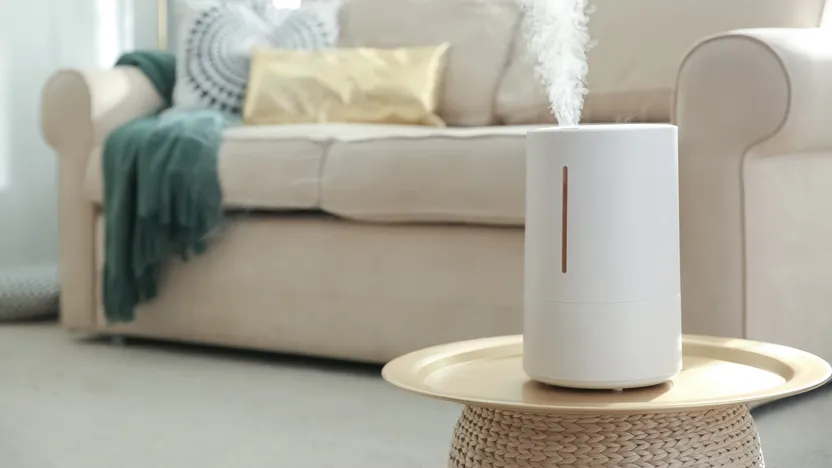
Humidifier buying guide
'/%3E%3C/svg%3E)
Guide written on 6 February 2024 by:
Anne, Painter
Important features
- Cool mist humidifier
- Warm mist humidifier
- Ultrasonic humidifier
- UV humidifier
- Essential oils
Best sellers in this category
Why use a humidifier?
Rebalancing the humidity levels in your home
Performing the opposite role of a dehumidifier, humidifiers are designed to generate moisture levels and help restore optimum humidity levels indoors.
The average indoor humidity rate generally ranges from 40% to 60%. However, when the heating is switched on over the winter, this rate can often fall to below 30%. A low humidity level can result in a variety of health issues including dry skin, chapped lips, sore throat, irritated eyes, sinusitis and respiratory problems. Air humidifiers help to alleviate these symptoms by combatting dry air which can improve everyday comfort and quality of life in general.
Choosing the right humidifier
When selecting a humidifier, pay special attention to the following:
moisture capacity, based on room size;
the sound level, measured in dB;
operating life, depending on the size of the reservoir;
operating mode, either manual or automatic (via a humidity sensor).
It's worth noting that the manufacturer's indications will note the maximum volume covered by the device. There are a few different types of humidifier, each with its own strengths and weaknesses:
evaporative cool mist, the most common type;
warm mist diffuser, allows you to diffuse essential oils, helps to reduce germs and bacteria;
ultrasonic, the quietest type, emits liquid water vapour into the air;
UV, less common and more expensive but emits healthier water vapour.
There is also a range of additional options for greater user comfort:
timer and programmer;
automatic empty reservoir turn-off;
essential oil diffusion for ultrasonic and warm mist humidifiers;
built-in light;
mister.
Shop our humidifiers
What are the different types of humidifier?
Cool mist humidifiers
Cool mist, or evaporative humidifiers work using the process of evaporation. The machine draws in ambient air before sending it in a continuous stream over a water-saturated filter, or wick, which works to vaporise the moisture. The main drawback of this system is that any impurities in the water are pulled in then diffused around the room. As such, it is recommended to go for a model equipped with washable filters or to choose a model with antimicrobial features. Using just 18W of energy on average, these devices are economical but are generally restricted to home use.
Warm mist humidifiers
Warm mist humidifiers operate using a heating system that brings water to a boil and sends it out as a gentle steam. The boiled water is free from bacteria meaning that these models do not require any filters. Furthermore, the warm air will evaporate quicker meaning you'll be able to feel the effects of the air humidifier faster.
However, be sure to consider the water type where you live. These devices work better with soft tap water; hard tap water will quickly clog them up. They may also increase the room temperature slightly. Warm mist humidifiers also have a diffuser to fill with essential oils, as long as you take care to use the right amounts; this option is not recommended around young children due to the risks of burns. While these models are much quieter than cool mist humidifiers – as they do not feature a fan – they can still emit a rather unpleasant noise during the boiling cycle. As such, it's best to avoid using them in the bedroom.
Ultrasonic humidifiers
Ultrasonic humidifiers are the quietest models available making them particularly handy for a nursery. High-frequency sound waves (which are almost inaudible) vibrate a metal diaphragm contained within the device. The water bursts and turns into microscopic droplets which are then propelled into the air by a fan. This system has one small disadvantage: the minerals contained in the water are also released into the air. It is therefore best to choose an ultrasonic humidifier with a descaling filter or to use distilled water to purify the air. Similarly, the humidifier should be cleaned regularly. These devices may also decrease the temperature of the room slightly.
UV humidifiers
UV humidifiers use UV rays to destroy any bacteria present in the water. They come in both warm and cool mist models and are especially recommended for children or adults suffering from immunodeficiency disorders. The downside of these humidifiers is that UV lamps have a fairly short service life meaning they will have to be changed after just a few months of use.
Shop our humidifiers
Best sellers in this category
Humidifier characteristics
Humidifier flow rate
The flow rate of your humidifier relates to the amount of water vapour it sends out. The higher the rate, the quicker the moisture is released into the air.
This rate will depend on the volume of the room you want to humidify; the greater the volume, the higher the humidifying capacity must be. This rate is usually provided in cubic metres.
Humidity settings
Humidity settings allow you to set your desired humidity level according to specific rooms. Some automatic models have a humidity sensor which automatically stops and starts the device when your room reaches your set humidity rate.
Operating time
The length of time your humidifier will run for is determined by the capacity of the water tank; the greater the capacity, the longer the running time. Most devices automatically go into standby mode when the tank is empty and feature a warning light that lights up when they need to be refilled.
Additional options for humidifiers
Depending on the model you go for, there may be a number of additional options available for enhanced comfort:
timer and programmers - used to programme different start times and mode cycles;
ionising mode - to neutralise odours;
anti-bacterial system - to slow down bacteria growth;
digital display of water level;
LED warning light to indicate automatic stop in case of empty tank;
fans - with two, three or four speed modes for different humidification rates;
control panel with digital display - to adjust set relative humidity rates and fan speed;
essential oils - for enhanced well-being.
How to use and care for a humidifier
Using your humidifier
Place the humidifier in the middle of the room for better distribution of water vapour. Set it down on a flat and stable surface.
In addition to using a humidifier, don't forget to air out your rooms for around 10 minutes each day to renew the air in your house.
Cleaning a humidifier
Disinfecting a humidifier
Preventing bacteria growth
More information
Follow the links below for advice on related accessories and more helpful guides:
You may be also interested in these guides
Guide written by:
Anne, Painter
After 8 years of trade, I turned professional: I trained myself to be a painter and carpet fitter, either on my own or with 16 year old comrades. 9 months later, following vocational training, I created my company. I’m a self-taught DIYer and decoration enthusiast, I love to find and restore furniture and to create unique decoration pieces. I completed the renovation of my sister’s house with my niece: electrics, tiling, plasterboard...we did it all. And today, if I can share my experience I'm happy to do it. Good Luck.
'/%3E%3C/svg%3E)