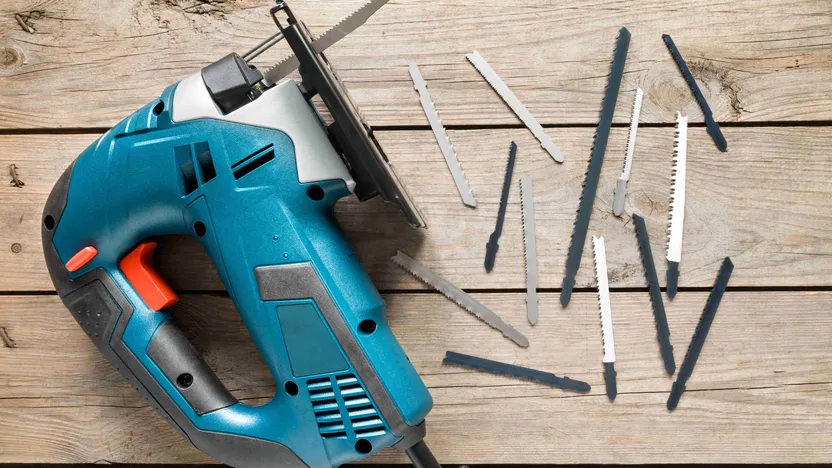
Jigsaw blades buying guide
'/%3E%3C/svg%3E)
Guide written on 6 February 2024 by:
Michael, Professional and passionate welder, Sheffield
Important features
- Fitting
- Material
- Number of teeth
- Length
Best sellers in this category
Jigsaw blades: what type of fitting?
Depending on the brand and type, your jigsaw will have a quick fixing system for receiving compatible blades. On modern electric machines, attaching these blades is often done without tools.
The two main types of fitting
There are two main types of jigsaw blades: U-shanks or T-shanks (also known as SDS).
For some jigsaws, especially from the brands Makita and Maktec (manufactured by Makita), specific fittings are required, known as Makita fittings. Other manufacturers are considering the same feature.
Be sure to check your jigsaw's manual before purchasing the blades. You can also take it apart to see what it is needed.
Jigsaws
Jigsaw blade characteristics
Number of teeth
The tooth pitch is always expressed in number of teeth to centimetres or inches (one inch = 2.54 cm). The teeth can be solid, medium or fine, set or straight. On the majority of blades, the teeth are sharpened in a triangle facing upwards.
Material
The blades can be made of different materials:
High Speed Steel (HSS), which is used in drill bits;
Bimetallic, HSS and HCS (High Carbon Steel) alloy;
Chrome vanadium;
Tungsten - toothless blade, one side covered with tungsten carbide.
Jigsaw blades
Best sellers in this category
Which blade for which material?
The most common blades have upward facing teeth, meaning that the blade cuts upwards. The sawdust chips are ejected from the top and can therefore be recovered by a dust extractor fixed to the back of the jigsaw. This also means that the cut will be thicker towards the top of the surface. If possible, you can trace the cut on the underside (less precision) or place adhesive on where the cut is made. Alternatively, there are down cut tooth blades and double tooth blades. Their use requires a little experience.
Wood and laminate blade
The most common and most flexible are wide-toothed, set or straight, milled or ground blades, with lengths of up to 150 mm. The larger the tooth pitch (number of teeth per cm or inch), the greater the output. The setting (two-sided tooth offset) is an important factor for the yield but produces a large amount of sawdust. Wide blades are used for straight cuts - particularly for carpentry and cutting worktops etc. If you need to cut curves and circles, then a scroll saw blade is necessary. You'll recognize it right away with its thin shape and forward facing teeth.
Plastic and PVC blade
With a medium-toothed blade, PVC blades are set or straight and of different lengths - the length of cut is set and in relation to the length of the blade.
Steel and non-ferrous metal blades
If you have fine-toothed blades in your collection, these should be reserved for the hardest metals. While aluminum, copper and brass will not be a problem, cutting steel is worth a bit of attention as it is possible to cut steel to a thickness of 1 to 8 mm. Use a low speed when using fine-toothed blades, as well as a lubricant, as the blade can be heated and burned. Stainless steel can also be sawed with the right lubricant.
Blades for ceramic and glass
In these instances, we use toothless blades. The tungsten carbide-coated front makes it easy to cut into tiles and ceramic. It is advisable to place a little water right next to the cut. For glass, the operation is more delicate but if you're left with no other option, special glass lubricant is available, although it is better to do a test run first.
Tips for use
You always learn from your mistakes: tests to determine the right choice of blade, the right settings (inclination and speed) are a guarantee of success. Today's tools and accessories are efficient, but if they are used incorrectly, they will not do their job.
When cutting ferrous metals, use a lower speed to avoid damaging the blade and use cutting oil. Also, do not over-size the blade, as this can lead to risks when cutting.
Remember to change the jigsaw blade when not in use; improper handling or malfunction will result in injury.
Cutting oil
You may be also interested in these guides
Guide written by:
Michael, Professional and passionate welder, Sheffield
I was trained as a pipe worker and a pipe-welder and after having travelled for 35 years working around the UK, I became the head of a metal shop, then a designer and in the end the head engineer. I have designed and built a workshop where I make metal sculptures: I managed to find a piece of paradise where I can let my imagination run wild. Auctions and garage sales are no secret to me. I find unusual objects and old tools there that I collect or transform into works of art. I also like decoration, painting on canvas, and gardening. I am developing new technologies concerning tools. To share my passion and advise you in your choice of materials is a real pleasure.
'/%3E%3C/svg%3E)