Leaf blower buying guide
'/%3E%3C/svg%3E)
Guide written on 6 February 2024 by:
Denis, Self-taught DIYer
Important features
- Electric
- Petrol-powered
- Weight
- Power
- Accessories
Best sellers in this category
Different types of leaf blower
Leaf blowers are designed to generate enough airflow to move around plant debris – usually leaves – into piles. However, blowers can also be used for many other tasks, such as cleaning gutters or drying off garden furniture. While all leaf blowers are designed to blow, some are also able to vacuum or shred plant matter for greater user comfort. These garden power tools can be combi garden vacuum blowers or 3-in-1 vacuum shredder blowers.
Leaf blowers
Low-end leaf blowers are only able to blow leaves and other debris. These lightweight models are used to blow plant matter into manageable piles for clearing up.
Combi vacuum blowers
Vacuum-blowers feature an additional vac function in order to save you the tedious task of raking up your leaf piles. The debris is sucked up and collected in a bag.
3-in-1 shredder vacuum blowers
These tools are designed to shred, vacuum and blow leaves. As leaves can be quite bulky, the idea is to break them down via a shredder, located at the top of the bag. This serves to drastically reduce their volume – by up to 16 times for the most effective models!
Leaf blowers
Electric vs. petrol-powered leaf blowers
Leaf blowers either operate using electricity (mains or battery) or 2- or 4-stroke petrol engines. Your choice will come down to the surface area you will be dealing with, the layout of your outside space and the type of work to be done.
Electric leaf blowers
Electric leaf blowers are suitable for the vast majority of domestic applications. It should be noted that corded models will restrict your movement to some extent, depending on the length of the power cord. On the other hand, a cordless blower will offer unlimited movement.
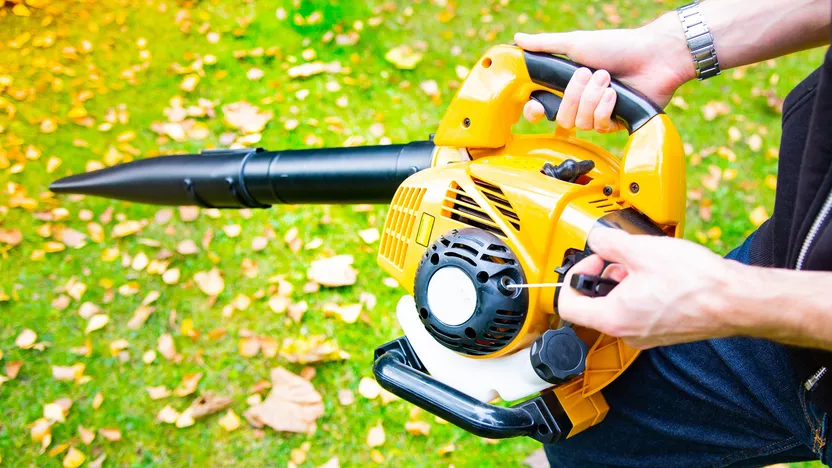
Petrol leaf blowers
In order to cover areas larger than 1000 m², you will need a petrol-powered leaf blower as these are better suited to longer periods of use.
Shop our leaf blowers
Best sellers in this category
Backpack vs. handheld leaf blowers
When it comes to choosing between a backpack and handheld model, your decision will depend on the weight of the leaf blower, the type of work and the strength of the user!
Blower weight
Electric blowers weigh between 3 and 6 kg, while petrol-powered models tend to be heavier, weighing in at around 4 to 18 kg.
.
Handheld leaf blowers
The lightest leaf blowers can be carried with a handle at arm’s length with part of the weight distributed with shoulder straps.
Backpack leaf blowers
Heavier leaf blowers are worn on the back like a backpack with a padded harness for increased comfort.
Leaf blowers on wheels
It is also possible to find leaf blowers with rollers attached to the end of the blower tube. More powerful self-propelled models can be mounted on wheels.
Electric leaf blowers: pros and cons
Electric motors are lighter, quieter and less polluting.
Mains-powered blowers
Mains-powered corded blowers require less maintenance. However, their main drawback is the power cord which can lead to a lot of coming and going on densely wooded land and ultimately makes for less convenient use. The power ratings of electric models are indicated in watts (W).
Cordless blowers
Cordless electric blowers, which operate on lithium-ion batteries, are ideal for small and/or very small outdoor areas. They're lightweight, easy to handle, quiet and give you the freedom to move about unconstrained. Nonetheless, their Li-ion battery often struggles to last beyond an hour at a time and they do have rather limited blowing power. The higher the current (in amps / hour or Ah) and voltage (in volts, V) of the battery, the more powerful the blower and the longer it will run.
Petrol leaf blowers: pros and cons
Compared to electric models, petrol-powered leaf blowers are heavier, noisier and more polluting. Their upkeep is also more complicated due to the requirement for oil and, of course, petrol. Getting them started for the first time in a while can be a pain. However, the advantages of these tools are undeniable: they're more powerful and do not have to rely on a mains connection or battery power. As such, you can enjoy complete freedom of movement.
Four-stroke engines are a bit quieter than 2-stroke engines; they also emit less pollution and vibrate less.
Selecting a power rating for your leaf blower
The power rating of motors in electric models ranges from 750–3000 W; however, most have ratings between 2500 and 3000 W.
The power of petrol-powered blowers can be indicated in engine capacity, which generally ranges from 25–50cm3 and as high as 70cm3 for some professional models. This power can generate an air flow of 150–500 km/h, equating to an airflow rate of 8–15 m3/minute. An added crusher function can reduce debris volume by up to 16 times. Go for metal impellers over plastic as you may end up sucking up more than just leaves!
Essential factors for choosing a leaf blower
There are various other specifications to consider when making your choice.
Variable-speed drive
This feature is used to control suction power depending on debris and surface type. For example, a lower speed will prevent you from sucking up pebbles or acorns, or from blowing gravel around your lawn. The most basic models are generally limited to two speeds.
Bag volume
The volume of leaf blower bags ranges from 30–50 litres. If you choose too big a bag, you might be held back by the extra weight; too small, and you'll spend all your time emptying it. As ever, it's all about finding the right compromise! In the case of self-propelled blowers, bag volumes can reach 250 litres or more.
Start-up assistance for petrol-powered leaf blowers
Traditional pull cords can be accompanied by easy-start engines, primers or even electric start-up to take the work out of firing up your petrol leaf blower.
Anti-vibration system
Sometimes vibration is no good thing! Luckily, leaf blowers can be equipped with an anti-vibration system.
Gutter attachment
A gutter attachment is simply a long tube with an elbow joint specifically designed for cleaning gutters.
Flat or round nozzles
Your choice of nozzle allows you to concentrate the air flow: the narrower the slot, the more powerful the suction.
Storage system
Tidy your attachments away with an efficient storage system.
Three top tips for selecting the right leaf blower
For areas under 1500 m² with sparse tree cover, a 3000 W electric leaf blower will do the trick.
Shredder models are a real convenience and provide added comfort.
Pay attention to the weight, especially if you have a large area to clean and need to use a petrol-powered blower! Also, protect your ears and wear protective glasses!
More information
To find out more about garden maintenance, follow our editors' advice and check out their other guides:
You may be also interested in these guides
Guide written by:
Denis, Self-taught DIYer
I started doing DIY 10 years or so ago, when I bought a house that needed to be renovated. After having installed loft isolation, and having refurbished the bathroom, the toilets, the kitchen, the bedrooms… I built an extension, installed a new fence with a gate and kitted out the house with a solar panel to make hot water. I have poured tonnes of concrete into slabs or into the foundations and renovated the roof… I can say that building materials and tools are no stranger to me! If I had a pound for every hour spent looking up information in forums and DIY magazines to find solutions to my problems, I'd be a millionaire! So passing on my knowledge on tools and home equipment is natural, as it is just giving back what I borrowed.
'/%3E%3C/svg%3E)