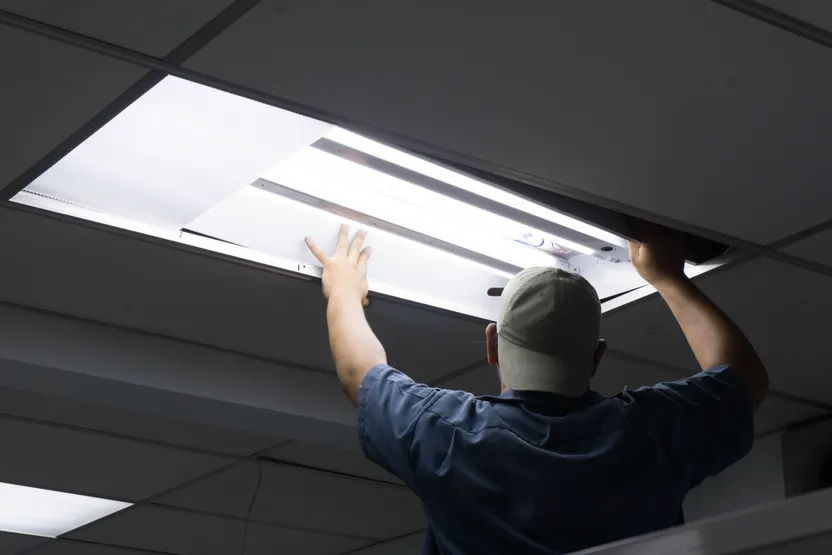
LED and fluorescent strip light buying guide
'/%3E%3C/svg%3E)
Guide written on 6 February 2024 by:
Julie, Interior Designer, Manchester
Important features
- Materials
- Size
- Light output
- Colour temperature
- Colour render index
- Ingress protection
- Additional options and features
- Fluorescent strip lights
- LED strip lights
Best sellers in this category
LED and fluorescent strip lights: the basics
Strip lights are discreet yet efficient lights. Whether you want to light under a kitchen cabinet, a bathroom mirror, a garage or a workshop, strip lights can work in a range of positions from ceilings to walls or even recessed into a wardrobe.
A strip light or light bar is a long light made up of an outer structure and a tube light that is often built-in. Of course it is also possible to buy an empty fixture and add your own tube light afterwards.
LED strip lights are energy efficient and have a long service life. Fluorescent strip lights are less expensive but use more energy and can flicker which some find annoying.
Both LED and fluorescent strip lights come in a range of dimensions and materials to match various applications. They also offer different types of light output and levels of protection against solid and liquid ingress. Finally, you can choose from a range of features such as an in-built plug socket, a motion sensor or a dimmer.
Shaver lights
Different types of lighting
There are two main types of strip lights: fluorescent and LED.
Fluorescent strip lights
Fluorescent strip light provide a diffused light and a faithful rendering of surrounding colours. They are cheaper than LED lights and have a power output of 5 to 120 W depending on the model. Fluorescent strips can be powered by an electronic or magnetic ballast. In the first case, expect about 10,000 hours of operating life and 16,000 hours of operation for the second.
While it is possible to find 'low impact' fluorescent strip lights for a 10% reduction in energy consumption, these lights will always consume more electricity than LED lights. Furthermore, they may flicker which some people find bothersome.
LED strip lights
Fitted with an LED (or light emitting diode) light bulb, these lights use significantly less energy. In fact, they can use around half of the electricity required by a fluorescent light.
What's more, they have a very long operating life of around 25,000 to 50,000 hours! However, they do cost more as a result.
Lighting ballasts
Best sellers in this category
Frame materials and strip light sizes
In terms of the frame material, you'll find the following options:
plastic for a lower price tag but less wear resistance;
anodised aluminium for rust resistance and style;
stainless steel for high moisture resistance.
These lights also come in different sizes to match the volume of the room, furniture or object you want to light. The most common dimensions are as follows:
20 cm;
60 cm;
90 cm;
120 cm;
150 cm.
Light output, colour temperature and colour rendering index
Light output
Light output is indicated in lumens and determines the intensity of the light. It should be chosen to match the size of the space you want to light.
Colour temperature
Colour temperature is indicated in kelvins (K) and provides information on the kind of light emitted by the strip light. The lower the colour temperature, the more yellow-toned the light tends to be. The higher the colour temperature, the more blue-toned the light tends to be. A light with blue tones is close to natural light.
2500 K to 3000 K: the strip emits a warm light.
3500 K to 4500 K: the strip emits a neutral light ideal for work spaces.
5000 K to 6500 K: the lighting is cool-toned and perfect for applications such as service rooms or medical use.
Colour rendering index (CRI)
A colour rendering index (CRI) describes a light's ability to render the colours of the object it is lighting faithfully. This index goes from 0 up to 100 for the most faithful rendering which is ideal for lighting decorative items or for use in a work environment where colour is important.
Ingress protection (IP) rating
Ingress protection (IP) ratings break down protection into two categories. The IP rating is made up of two digits: the first indicates the level of protection from solid matter and the second indicates protection from liquids. IP ratings range from 0 to 6 for solid matter and 0 to 8 for liquids. These ratings vary from no protection to maximum protection.
Ingress protection
IP rating | First digit Protection from solid matter | Second digit Protection from liquids |
0 | No protection | No protection |
1 | Protected against solid objects ≥ 50 mm | Protection against dripping water (vertically falling drops) |
2 | Protected against solid objects ≥ 12 mm | Protected against vertically falling drops of water when tilted to 15° |
3 | Protected against solid objects ≥ 2.5 mm in diameter | Protected against vertically falling drops of water when tilted to 60° |
4 | Protected against solid objects ≥ 1 mm | Protection against water splashed from all directions |
5 | Protected from dust ingress | Protected against low pressure water jets from all directions |
6 | Totally dust protected | Protected against powerful water jets from all directions |
7 | Protected against temporary immersion | |
8 | Protection against continuous immersion |
Additional options and features
Whether you go for LED or fluorescent lights, your strip light can be equipped with various additional options and features to match your needs:
Water-resistant lights are essential if you want to install the light in an environment with moisture such as in a bathroom, utility room or even a garage.
Low profile lights are very compact and streamlined, and ideal for use in an office or kitchen.
Recessed lights can be neatly tucked away in furniture.
A built-in plug socket can be really handy for use in a garage, for example.
An adjustable light allows you to tilt the light towards a specific spot.
A dimmer light allows you to adjust the intensity of the light to meet your needs.
A motion sensor can be used to turn on the light automatically when anyone walks past.
An RGB light is designed to change colours. The number of options will vary between models.
Remote control lights can be controlled from afar using a remote.
Smart lights can be controlled from a smartphone or tablet via a downloadable app.
You may be also interested in these guides
Guide written by:
Julie, Interior Designer, Manchester
After years of DIY, renovation and designing, I decided to turn my passion into a career. Starting in 2006, in the South-West, I helped people with renovation or construction projects. My expertise and curiosity led me to look further into innovative ideas for myself and my clients. Indeed, to live your passion is also to transform the space you live in and the objects you use daily. My family love my creations and ideas that I bring into their lives! My favourite thing to do: use colour to brighten up interior space. But also tips to hide away clutter. Your home is just never big enough, is it? It is therefore a great pleasure to share my tips with you, so that you also can take as much pleasure as I do when starting up your next project!
'/%3E%3C/svg%3E)