Motorised wheelbarrow buying guide
'/%3E%3C/svg%3E)
Guide written on 6 February 2024 by:
Alizée, Furniture Maker
Important features
- Wheels
- Tracks
- Volume of hopper
- Authorised loading weight
- Petrol or electric engine
- Power
- Slope
Best sellers in this category
Advantages of a power barrow
Whether we're talking about agriculture, construction or public work, transporting heavy loads over steep ground can prove impossible using a conventional wheelbarrow. Equipped with either an electric or petrol engine, power barrows guarantee effortless transportation of any loads from 100 to 500 kg, on slopes of up to 45%.
Barrows, whether wheeled or tracked, have a variety of accessories available depending on the task at hand. Their weight varies depending on their type but is around a minimum of 50 kg. The hopper comes in different sizes, and can normally be tilted.
Power barrows have several gears and some can tow a trailer or be fitted with a cutting blade.
Choosing the right power barrow for the job
With a handy motorised wheelbarrow, you can effortlessly transport loads of up to 100 kg over flat or sloping terrain. These come with either an electric or petrol engine:
electric- the battery can be recharged with a charger;
petrol- the 4-stroke engine needs maintenance (oil, spark plugs, filter).
There are various motorised wheelbarrows to choose from:
2-wheel 12 V;
3-wheel 24 V;
4-wheel 24 V;
4-wheel petrol engine.
Best sellers in this category
2-wheel motorised wheelbarrow
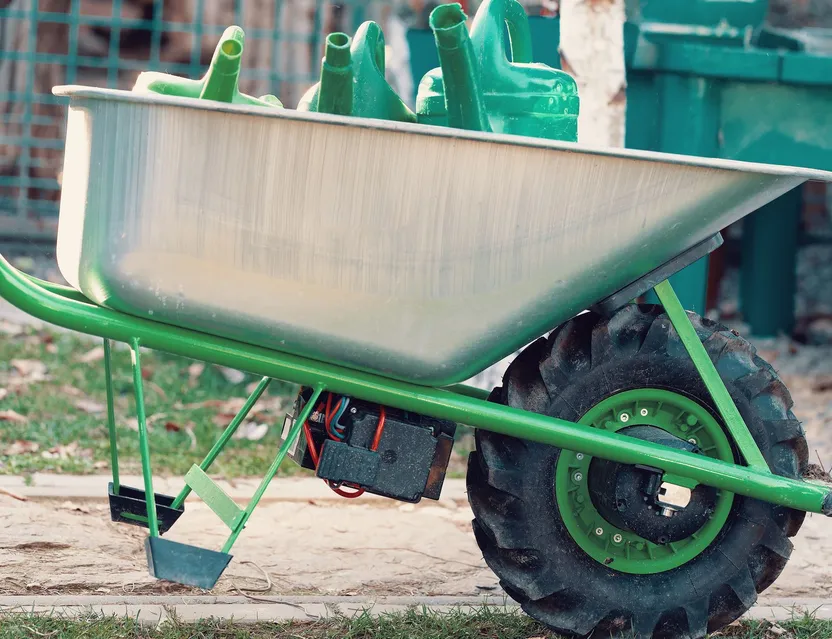
The smallest models look just like a classic wheelbarrow but feature an electric engine that allows you to transport around 100 kg of materials. The barrow weighs around 50 kilos and runs on a battery (12 V). The accelerator and brakes make the barrow easy to handle.
With an electric barrow you can transport cement, even if it's very liquid, over slightly uneven ground because you can maintain balance by manually raising and lowering the handles.
3-wheel motorised wheelbarrow
3-wheel motorised wheelbarrows, with 2 directional front wheels and a rear idler wheel or vice versa, is ideal for ground that's not too uneven.
This compact wheelbarrow can be used to transport a variety of materials thanks to its removable flatbed and hopper (manure, wood, cement, etc). The average run time of these engines is 3 to 5 hours. A charger is supplied to recharge the 24 V battery. The hopper has a capacity of around 100 l.
4-wheel motorised wheelbarrow
Barrows with 4 wheels offer the most stability. Like their 3-wheeled counterpart, these are available in handlebar or drawbar versions (with handlebars, the user is positioned behind the engine, and vice versa for the drawbar). With in-built speed control and electric tipping for the hopper, this barrow lets you transport any material over fairly steep slopes. A powerful brake ensures safety downhill. A mini 24 V battery is included.
4-wheel petrol engine barrow
Petrol engine power barrows have 4 wheels and offer at least the equivalent loading capacity in terms of weight and volume. These feature several gears (minimum two: one at the front and one at the back) and their tipping system is normally manual but might also be assisted. The main advantage is their run time and power - some models boast 4-wheel drive. Suitable for steep slopes, they can also tow a trailer thanks to their hitch ball.
Their 4-stroke engine requires maintenance, and the bigger the engine capacity, the better the barrow can deal with heavy loads and steep slopes.
Tracked barrows: the all-terrain power barrow
Tracked barrows are designed for sloping ground (slopes of up to 45°) and regular transportation of heavy loads (500 kg). These tracked power barrows are proportionally more powerful than their wheeled counterparts (electric, as we saw earlier), but are also noisier.
Equipped with a 6.5 - 9 horsepower 4-stroke petrol engine, these are true mini-dumpers. They can be started up either manually (via a starter drive) or electrically (by pressing a button), while steering and tipping are assisted by a hydraulic system.
For an average-sized barrow, calculate a weight of 250 kg when empty, and a hopper capacity of around 200 litres. As with the barrows described previously, these come with various detachable accessories:
hoppers;
flatbed;
cargo box;
snow plough;
self-loading/ lifting box, etc.
With these accessories your power barrow can be used for multiple purposes. Driving is effortless thanks to the gear lever, which offers good control as you move.
To give you an idea, the average size of a hopper is around 1 m long, 60 cm wide and 50 cm high.
The main features to look for when choosing a power barrow
The features you choose will depend on the intended use of your new power barrow. If you need to transport wood over a reasonably flat terrain, opt for a 3-wheel motorised wheelbarrow. For the same job on a sloping terrain, a 4-wheel motorised wheelbarrow is a better option as it offers more stability.
For public work or construction, opt directly for a tracked power barrow. Sturdier and more suited to steep terrain, tracked barrows come into their own over uneven ground. In summary, carefully consider:
engine power;
number of gears;
hopper size;
whether the hopper tilts or not;
maximum gradient when empty;
maximum gradient when full;
start-up - electric or manual;
working width of the barrow;
tow ball;
supplied accessories.
Maintaining a motorised wheelbarrow
Motorised wheelbarrow maintenance
Motorised wheelbarrows don't need any particular maintenance besides charging the battery and cleaning the barrow after every use.
Petrol-powered barrow maintenance
When it comes to petrol-powered barrows, you will have to perform maintenance on the petrol engine:
spark plugs - clean with a metal brush and replace periodically;
air filter - blow it out regularly;
engine - check the oil level and change it following the manufacturer's instructions.
The chassis on both types of barrow should be cleaned regularly, as well as the bucket, to prevent the onset of rust.
Screws can work themselves loose during use, so be sure to check that they're tight. Oil and lubricate the cables and the various rotating mechanical components (chains, etc).
Garden machinery maintenance
You may be also interested in these guides
Guide written by:
Alizée, Furniture Maker
I have been crafty since my childhood, I have always been fond of new tools and other small practical machines. Beyond my interest in tools and materials, I am interested in building of all types. My professional experience as an artisan craftswoman, allows me to work with a material that’s both noble and common at the same time: wood. Surrounded by carpenters and other builders, I am constantly interacting with professional and amateur wood workers, but also various kinds of manufacturing. I am also an amateur gardener, I like to cultivate my vegetable garden. You could say that summer ends under the sign of ratatouille. So, with two passions, I hope to answer your questions.
'/%3E%3C/svg%3E)