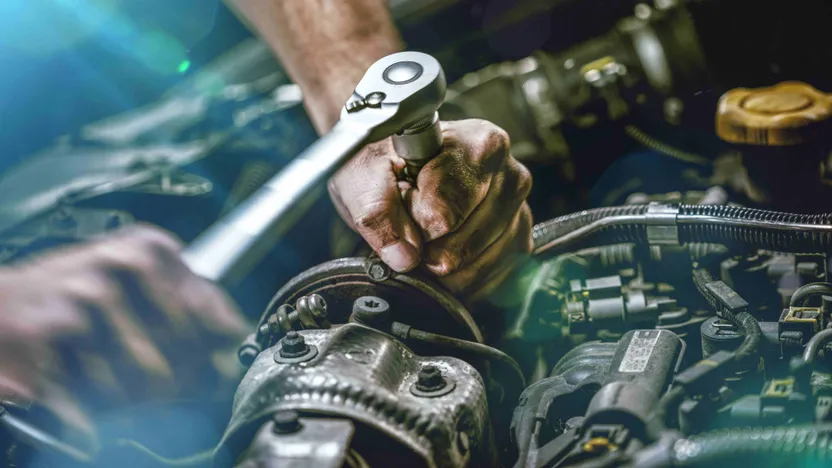
Ratchet handle buying guide
'/%3E%3C/svg%3E)
Guide written on 6 February 2024 by:
Michael, Professional and passionate welder, Sheffield
Important features
- Type
- Size
- Square drive size
- Uses
- Treatment
Best sellers in this category
Ratchet handles: an essential tool kit addition
A basic spanner kit will feature essentials like open-ended spanners, box spanners and ring spanners. But no tool kit is complete without a tool that can be used to tighten or loosen bolts quickly. Luckily, there's a special tool designed to do just this: the ratchet handle.
A ratchet wrench can be used to save precious time when working on repetitive or tedious jobs. Of course you can buy an individual ratchet, but there's nothing more practical than a ratchet set with a range of different sized sockets.
Socket sets
Types of ratchet spanners
Multi-purpose ratchets
Square drive ratchets
Ratchets are designed to work in one direction at a time. To reverse the direction, you simply need to press on the lever or dial switch on the back of the head . The simple design of this tool makes it very strong.
Ratchet hammers
This sturdy two-in-one tool is designed for specific tasks. However, the bulkiness of these tools means they can only be used in easily accessible areas.
Double ended ratchets
These tools feature two heads in different sizes and can be used in place of two ratchet wrenches.
Flex head ratchets
The handle of these tools can be tilted meaning they can be used to tighten screws or nuts in hard-to-reach spots.
Palm ratchets
A palm ratchet can be used for low torque tightening and features a knurled edge for easy grip.
Telescopic ratchets
A telescopic ratchet prevents you from having to use an extension bar which can make the tool less effective.
Composite ratchet handles
These tools are lighter but just as strong as other models.
Fine tooth ratchets
These tools feature upwards of 80 teeth and require just a 4.5° movement to advance the socket.
Detachable ratchet heads
These short reversible ratchet heads can be fitted to a standard ratchet handle or torque wrench.
Ratchet podger
This type of ratchet spanner is used to build scaffolding. These tools need to be matched to the size of the nut you are working with.
Specialist ratchets
It is also possible to find ratchets designed for more specialist applications, such as:
electrician's ratchets which allow you to work in environments exposed up to 1000 volts;
pass through ratchets for threading nuts onto threaded rods;
precision ratchet screwdrivers are used by electronics engineers or in precision mechanics to tackle small screws;
polypropylene-coated ratchets can be used by bodywork specialists to prevent scratches to paintwork;
24 or 32 tooth ratchets are used when you need a larger swinging action to turn the tool (for example, to change a wheel) and feature larger drives;
ratchet combination spanners with a ring spanner and open-ended spanner in one are becoming increasingly popular though these are still complementary tools.
It's worth mentioning that a ratchet may also be called a ratchet wrench or even a ratcheting socket wrench. These terms are all used to refer to a spanner with a ratcheting mechanism. While the term 'wrench' is more common in US English, 'spanner' is usually the preferred option in British English.
See our screws!
Best sellers in this category
Socket sets
Identifying the socket sizes that you use most often will help you to find the most useful socket set or sets for your requirements.
Manufacturers offer up a range of remarkably diverse and carefully sized sets to match every need. You may need a ratchet set to use for specific jobs. For example, you may need to invest in a set to match common screw, nut and bolt sizes used in auto mechanics.
A plumbing set will feature both ratchets and pass through sockets for threading nuts onto threaded rods.
A detection box features clear plastic holes in the top of the set so you can quickly make an inventory of the box's contents without opening it. A quick scan of the holes is enough to know if you're missing one or several parts.
Ratchet spanner materials and quality
Ratchet wrenches usually feature an ergonomically designed handle. The ratchet head comprises the ratcheting mechanism and is generally made up of a wheel with 24 to 80 teeth, a square drive and a lever or dial switch to change the tightening direction. These articulated tools are categorised according to the size of their square drive which is always indicated in inches.
Application | Square drive size (inches) | Square drive size (mm) |
Precision tasks | 1/4 | 6.35 |
Restricted access | 3/8 | 9.53 |
Standard | 1/2 | 12.7 |
Trucks | 3/4 | 19.05 |
Industrial machinery | 1 | 25.4 |
Ratchets are made from heat-treated chrome vanadium which is formed by compressing and sintering metal powders.
The mechanism rotates using a toothed wheel with 72 to 80 teeth and a working angle of 4.5 to 5° which is really practical for working in restricted areas. Since ratchet spanners are complementary tools and not to be used to tighten fasteners fully, the steel doesn't need to be the same quality as that of other spanners. Comparatively, solid spanners usually need to range from 42 to 50 HRC on the Rockwell scale.
It is not advisable to use excessive force or a hammer to loosen a nut held by a ratchet. Professional quality tools may stand up to the force but using a box spanner will always work better.
Ratchet wrench accessories
Sockets
Most standard sockets range from 8 mm (5/16") to 22 mm (7/8") in size. Square drives can vary depending on the socket.
Extension bar
An extension bar can be used to reach a bolt in a tricky spot or a recess.
Universal joints
Universal joints allow you to access fasteners at different angles where a handle would not have the clearance to move back and forth.
Drive adapters
Drive adapters are used to fix socket heads to different drive sizes. They are very handy for mixing different socket sets.
Hex shank adapters
Hex shank adapters are used to fix any screwdriver bit with a hex shank directly to a socket or ratchet spanner.
Nuts
How to use a ratchet wrench
Ratchet spanners are complementary tools designed to be used in combination with other spanners.
If you want your ratcheting tool to last, it is essential to follow a few basic rules:
tighten your nuts with a solid spanner or torque wrench after going as far as you can with the ratchet spanner;
loosen a nut with an open ended or box spanner first before using a ratchet spanner;
do not use an extension bar to increase torque;
follow the manufacturer's instructions to the letter.
Ratchet heads are often described as waterproof by manufacturers. However, it's important to be cautious as dust and other tiny particles can find their way inside the tool and scratch the mechanism. A good go with an air blow gun powered by a compressor followed by a wipe down should help to make these tools last.
Sockets and other accessories are traditionally held in place by small retractable ball bearings. However, it can be difficult to remove sockets from the drive which is why some models come with a quick release mechanism to detach the socket with ease.
While theoretically we should all be following user guidelines, ratchets are often incorrectly used to fully tighten nuts or screws. Luckily, most good manufacturers have made these tools stronger than standards demand (e.g. ISO 1174 and DIN 3120).
That said, don't go overboard with your tool and attempt to use it for the final stages of tightening. If you follow these rules, your ratchet should last for a number of years.
Nuts
You may be also interested in these guides
Guide written by:
Michael, Professional and passionate welder, Sheffield
I was trained as a pipe worker and a pipe-welder and after having travelled for 35 years working around the UK, I became the head of a metal shop, then a designer and in the end the head engineer. I have designed and built a workshop where I make metal sculptures: I managed to find a piece of paradise where I can let my imagination run wild. Auctions and garage sales are no secret to me. I find unusual objects and old tools there that I collect or transform into works of art. I also like decoration, painting on canvas, and gardening. I am developing new technologies concerning tools. To share my passion and advise you in your choice of materials is a real pleasure.
'/%3E%3C/svg%3E)