Rivet buying guide
'/%3E%3C/svg%3E)
Guide written on 6 February 2024 by:
Michael, Professional and passionate welder, Sheffield
Important features
- Types of rivets
- Uses
- Installation
- Accessories
Best sellers in this category
What is a rivet?
A rivet is a fastener designed to hold two pieces of material together via a single drilled hole. The tail of the rivet is deformed or 'upsetted' which holds it securely in place. Generally installed using a rivet gun, rivets are widely used in mechanics and auto body repairs, but that's not all – some types of rivets are even used in textiles.
A rivet is made up of three parts:
A head (which can be flat, domed, countersunk).
A body or shaft.
The tail which is 'upsetted' to fix the rivet in place.
Shop our rivets
Main types of rivets and uses
Name | Head/body shape | Material | Use | Installation tool | Features |
Solid | Domed Truss Countersink Flat Pyramid head | Steel Copper Brass Aluminium Stainless steel | Metal assemblies Knife making Armoury Decoration Model making | Rivet gun Rivet setter Gas welding torch | Largely replaced by other types of rivets |
Semi tubular rivet | Round Flat Truss Hollow at one end of rivet | Chrome-plated steel Aluminium Brass Stainless steel | Sheet metal assembly Knife making Moving joints | Punch Dolly | Possible to make pivot point |
Semi tubular rivets | Rolled Hollow body | Copper Brass Aluminium | Lightweight assemblies Electronics | Punch Dolly | DIN 7340 Possible to make pivot point |
Hammer drive rivet | Round Helical thread | Carbon steel Stainless steel | Can be installed in blind holes for manufacturer plates or signs | Hammer Press | Hammer in |
Split rivet | Round Split body | Galvanised steel Brass | Decoration Bikes Military | 2 wings to fold back | Can be set with a washer |
Standard blind rivet | Dome head Large head Countersink | Galvanised steel Brass aluminium | All sheet metal assemblies | Hand riveter Rivet gun | None |
Sealed blind rivet | Dome head Large head | Stainless steel | Water storage tank assembly Solder-free repairs | Hand riveter Rivet gun | Mandrel head contained within the sealed body |
Peeled blind rivets | Dome head Large head | Galvanised steel Stainless steel | Soft material assemblies | Hand riveter Rivet gun | Bodies splits into petals in T style rivets |
Multi-grip blind rivet | Dome head Large head | Aluminium | Large bearing surface | Hand riveter Rivet gun | Grip range depends on material thickness |
Plastic blind rivets | Dome head Large head | Acetate Polyamide | Fragile material assemblies | Hand riveter Rivet gun | Wide range of colours available |
Structural blind rivets | Dome head Large head Countersink | Galvanised steel Aluminium Stainless steel | Strong fastening of thin sheet materials (cladding, etc.) | Hand riveter Rivet gun | Built-in locking mechanism |
Groove blind rivets | Flat Grooved body | Galvanised steel Aluminium | For blind holes | Hand riveter Rivet gun | None |
Eyelets and grommets | Rolled Hollow body | Steel Copper Brass Aluminium | Feeding wires and cables | Hand eyeletter | Tailoring Tarpaulin Sail making |
Best sellers in this category
Solid rivets
Solid rivets were once mainly used to form hot riveted joints, but have largely been replaced by various other types of rivets which are quicker to install. However, hot riveting is still used today to restore old joints and for decorative purposes (in industrial design, for example). In this case, the tail of a steel rivet is heated with a gas welding torch before being upset with a rivet gun or setter.
Shop our rivets
Tubular rivets
Tubular rivets feature a shallow hole at the tip which makes them easier to install without heating. With careful installation, these rivets can be used as pivot points and can prove very handy for moving joints.
Shop our rivets
Semi tubular rivets
Semi tubular rivets are ideal for tasks like repairing belts and are made up of one or two parts. Usually made of brass, these rivets are easy to fit with minimum effort.
Depending on the type of rivet, you might need to use a punch for a neat finish. These rivets may also be known as hollow rivets.
All you need is a pair of revolving punch pliers to make a hole in the leather or fabric before using a specific hand riveter to match the diameter of the rivet to install the rivet and keep the elements in place.
Shop our rivets
Hammer drive rivets
Hammer drive rivets are solid rivets with a round or domed head, and a helical threaded body. They can also be called U drive screws. These fasteners are placed in blind holes using a hammer or press.
Hammer drive rivets are often used for installing wall signs, licence plates and car manufacturer plates. They can also be used to install signs on industrial machines or equipment such as pumps or valves.
Shop our rivets
Split or bifurcated rivets
Split rivets feature a domed or truss head made of brass or steel, and a tail split into two wings that are folded back to secure things like bike components (mud guards, plates, etc.). They can also be used for leather goods. It's important to install these rivets correctly on your first try as the wings will snap easily if they have to be bent more than once. You can add on a washer to these rivets to secure the fastening.
Shop our rivets
Blind rivets
These rivets have seriously revolutionised the industrial world. They are quick and easy to install and offer impeccable results. Blind rivets can be used to replace a whole range of screws in permanent assemblies. In fact, this type of rivet can be used to install miles of industrial ducting in no time.
They are made up of two parts:
a mandrel;
a pin.
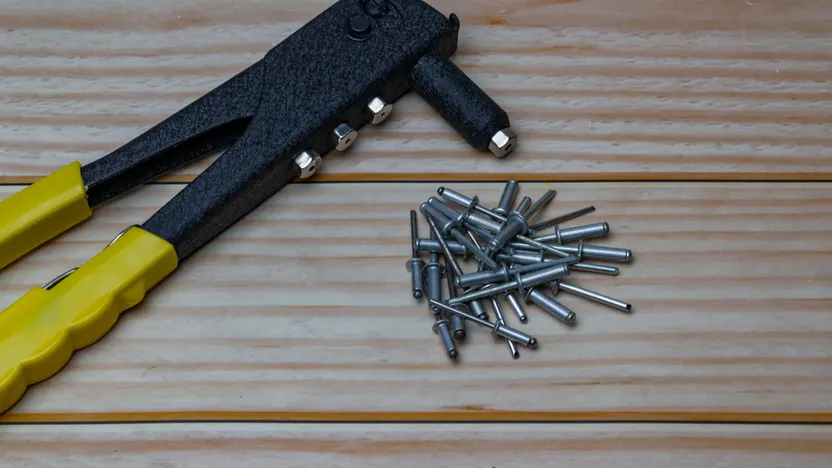
You only need a hand riveter or a rivet gun with the right kind of power to match the diameter of the rivet to install these rivets. Simply match the length and diameter of the rivet to the thickness of your materials.
Shop our rivets guns
Different types of blind rivets
How to calculate the length of a blind rivet
Here is a formula to help you find the right rivet to match the elements you want to assemble:
The total thickness of the materials you want to assemble x 1.1 = Total 1
Diameter of the rivet x 1.5 = Total 2
Total 1 + Total 2 = correct rivet length
For example: 1.5mm metal sheet = (1.5 + 1.5) x 1.1= 3.3 mm
Rivet Ø 2.4 mm x 1.5 = 3.6 mm
Rivet length = 3.3 + 3.6mm = 6.9 mm
Manufacturers will generally indicate a grip range for each type of rivet. Be sure to check this before purchase. Please note: choose a rivet that is too long for your assembly and the tail may protrude which can lead to injuries.
Different types of blind rivets
Standard blind rivets
Standard blind rivets are generally the most commonly used rivets. It's a good idea to have a range of these inexpensive rivets in your tool box with a hand riveter to cover a variety of DIY jobs. These rivets are often used to install car licence plates and come in all colours to match the plate itself.
Sealed blind rivets
The mandrel head of the rivet is contained within the rivet body which means these rivets provide a perfect seal even under pressure. It's important to follow the recommended hole sizes very closely with this type of rivet. It's also possible to add a neoprene washer under the rivet head. These rivets can be used to assemble metal and plastic.
Peeled blind rivets
As these rivets are set, the body divides into several parts for a larger bearing area which is ideal for fastening metal to soft materials. Included in this category are what some manufacturers call 'T-style' blind rivets which have a unique internal locking system which enhances shear strength.
Multi-grip rivets
Multi-grip rivets provide a large bearing surface and can fill holes effectively which is handy for dealing with uneven, oblong or misshapen holes. They can be used to replace several standard blind rivets in different sizes which can make storage easier. The pin remains locked and is impossible to extract. These rivets are ideal for thin metal sheet and components likely to deal with vibrations.
Plastic blind rivets
These rivets are installed just like standard rivets. They come in a range of colours and are used for non-conductive materials. The body and pin are made of plastic (either polyamide or nylon) and the head is flat. It goes without saying that these rivets can only be used for lightweight applications.
Structural blind rivets
These blind rivets come highly recommended thanks to their high tensile and shear strength. They feature a locking mechanism to keep the mandrel in place and a wide hat to prevent pull-out. The mandrel itself is grooved to allow hand riveters to get a better grip.
Grooved blind rivets
The grooved bodies of these rivets makes them easy to spot. This design makes them ideal for fastening in blind holes. It's important to choose the right rivet material depending on the materials you are assembling so as not to cause damage.
Rivets and eyelets for textiles
Used for a range of in day-to-day purposes, eyelets are often found alongside rivets. Fitted to things like clothes, shoes, tarpaulin sheets, sails and leatherwork, these rivets need to be installed using a special type of tool or a punch and die.
Comparable to tubular rivets, the idea is to create a rim for threading laces or cords through materials. Many different types of rivets and eyelets are used in clothes making, the most popular being:
rapid rivets;
rhinestone rivets;
oval or rectangular eyelets;
press studs;
pyramid studs.
These eyelets and rivets all require the use of special setting tools.
Hand riveters
Rivet accessories
If you are a perfectionist, you might find yourself unimpressed with the final look of a rivet. Some types of rivets (such as standard blind rivets) can be covered up by plastic or brass rivet caps. These caps are designed to improve the finish of fasteners.
But be careful – some rivet caps come with a component designed to be placed between the head and the fastening material. Don't forget to account for this part when calculating the length of the rivet.
It's possible to fit a neoprene washer under the head of a sealed blind rivet.
Hand riveters
Rivets: a brief history
Before the age of arc or gas welding, metal constructions were assembled by hot riveting. The Eiffel tower, for example, comprises 1,051,000 rivets. Bridges, steel water storage tanks and a great many boats were made strong, resistant and watertight using hot rivets.
A team of workers therefore had to rely on heat produced by furnaces to get the rivets red hot. On the other end, workers would use a hammer or handheld pneumatic riveting gun to shape the end of the rivet into a dome shape.
As the rivets cooled down, they would contract, permanently locking the assembled parts. Solid rivets can still be used for some small assemblies but more modern types of rivets do tend to make life easier.
World War Two was a time of technological innovation and blind rivets made their appearance during this time to keep up with the demand for rapid production on both sides.
Shop our rivets
You may be also interested in these guides
Guide written by:
Michael, Professional and passionate welder, Sheffield
I was trained as a pipe worker and a pipe-welder and after having travelled for 35 years working around the UK, I became the head of a metal shop, then a designer and in the end the head engineer. I have designed and built a workshop where I make metal sculptures: I managed to find a piece of paradise where I can let my imagination run wild. Auctions and garage sales are no secret to me. I find unusual objects and old tools there that I collect or transform into works of art. I also like decoration, painting on canvas, and gardening. I am developing new technologies concerning tools. To share my passion and advise you in your choice of materials is a real pleasure.
'/%3E%3C/svg%3E)