Travel adapter buying guide
'/%3E%3C/svg%3E)
Guide written on 6 February 2024 by:
Sebastian, Self-taught DIY-er, Exeter
Important features
- Plug format
- Voltage
- USB port
Best sellers in this category
Why do different countries use different plugs?
Everyone knows that wall sockets vary all around the world. While life would be much more straightforward if we all had the same sockets, the reason behind the difference dates back to when mains electricity was first wired into domestic properties. The ever first homes to have power were in the United States. Countries everywhere were keen to follow suit, but instead of sticking to the same technology used in the US, nations strived to find their own, more efficient means of doing so.
As electricity found its way into more homes across the globe, the World Wars made sure that there would be little chance for collaboration on a universal system. As a result, electrical plugs and sockets all differ from each another in terms of voltage and current rating, shape, size, and pin type.
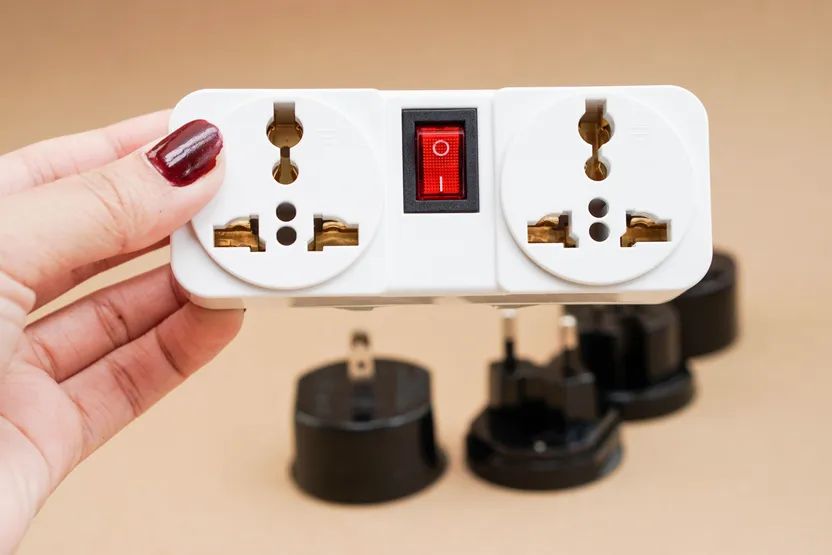
Luckily, these days we have a wide range of travel adapters, or travel plugs, to act as an intermediary between two different types of electrical socket. Designed to match your plug to a country-specific socket, travel adapters allow you to charge your devices abroad without fear of damaging them.
Shop our travel adapters
Different types of travel adapter
To make sure you go for the right type of adapter, there are a few things to keep in mind.
Pin format
The format of plug pins differs between countries in both shape (flat or round), layout and spacing. In fact, there are currently fifteen domestic electrical outlet plugs in common use worldwide. These formats have been categorised with letters A-O by the International Electrotechnical Commission (IEC).
As a general rule, a European plug will typically be a type C while a US plug type will typically be a type A. Bear in mind, however, that this isn't always the case; for example, Malta and Cyprus use type G plugs (i.e. the same as those used in Great Britain). Before you go abroad, remember to check which plug format is used in your destination country and pick up the right type of adapter.
Universal travel adapters
If you travel often, you might want to go for a universal or all-in-one adapter to give you more flexibility. These adapters tend to be bulkier and more expensive than single adapters, but will cover you for the 150 or so countries with the most common sockets; this means North America (A/B), UK (G), Europe (C/F), Switzerland (J), and Australasia (I). On the other hand, if you're hoping to visit countries with less common socket types (such as Brazil), you're best picking up a single country-specific adapter.
USB ports
These days, universal travel adapters may come with in-built USB ports in addition to multi-socket compatibility. Ideally you want to minimise the amount of plugging and unplugging you need to do between devices, and a USB port will help to make the process easier.
Voltage rating
It's important to note that standard mains voltage varies between countries: 110V in the USA, Central and South America and Canada; 100V in Japan and 240V in the UK. If your devices can't operate on the local voltage where you intend to travel, you'll also need a voltage converter or combined converter-adapter kit. So before you finish packing, be sure to check the power requirements of all your devices to be sure you've got the right kit to plug them in once you're abroad.
Sockets
Best sellers in this category
Final tips for choosing a travel adapter
Travel adapters usually indicate the countries they are designed to be used in rather than the plug type itself.
This makes things easier as you can simply choose between:
UK
Germany
Spain
Switzerland
China
Australia (etc.)
The adapter may feature the names of the country combinations it is designed for; for example, UK-France; UK-China, and so on.
With 'world' or 'universal' adapters, it's worth checking if the model you choose is definitely suitable for the country you're travelling to as these terms can be somewhat of an exaggeration.
Be sure to check that your travel adapter is safety-certified to keep you and your devices safe abroad. In the UK, all travel adapters – including those incorporating USB ports – must conform to the safety standard BS 8546.
Finally, bear in mind it's always best to buy your travel adapters in advance as they are usually much more expensive at the airport!
Shop our travel adapters
More information
For more advice on electrical products, check out the following guides.
Voltage converter buying guide
You may be also interested in these guides
Guide written by:
Sebastian, Self-taught DIY-er, Exeter
Redo a roof with wooden beams? Check. Advise everybody in the DIY shop? Check. Redo bathroom plumbing? Check. If it doesn't work, try again! I'll do my best to advise you in your projects.
'/%3E%3C/svg%3E)