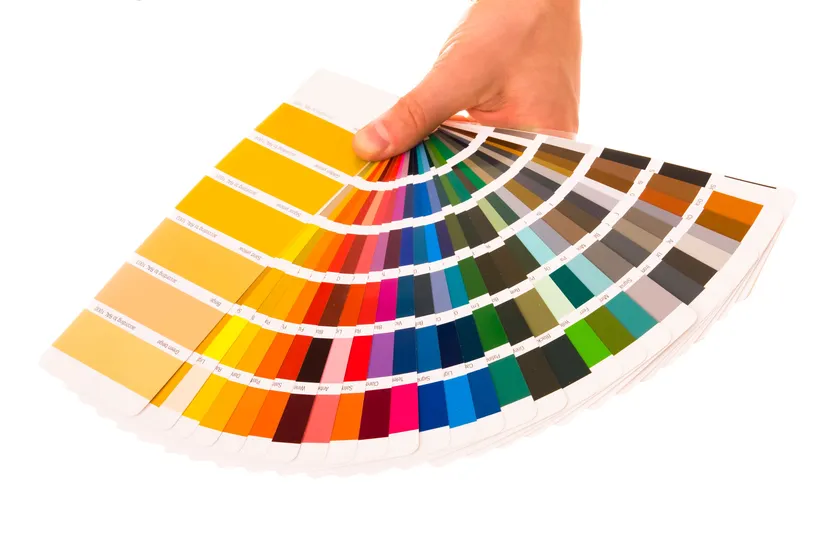
What is a RAL colour chart?
'/%3E%3C/svg%3E)
Guide written on 6 February 2024 by:
Anne, Painter, Cambridge
Important features
- Origins and use
- Standard colours
- Codes
- The various RAL colour charts
Best sellers in this category
RAL colour charts: description and use
RAL is an abbreviation of Reichs-Ausschuß für Lieferbedingungen und gütesicherung. OK, it's a bit difficult to remember, but luckily there's no need - just stick to the acronym. RAL is a European colour matching system developed in 1927 by the German Imperial Committee for Delivery and Quality Assurance.
The RAL colour chart is used to reproduce a colour in any type of paint, on any surface, and within the entire European Union, no less! The RAL colour chart features a total of 1687 shades broken down over several charts.
Main uses of a RAL colour chart
RAL colour charts are mainly used by professionals in industry and automotive, construction and even road safety sectors.
They are also commonly used by private individuals, with the help of a professional, to choose the right RAL colour for their gates, for example. What's the advantage? When someone wants to repaint all or part of said gates, they can be sure to find the right colour easily thanks to the RAL identification code. No more mismatched colours that force you to repaint everything from scratch!
Did you know...? The Pantone colour chart contains 992 colours and is used mostly in printing.
Colour charts
Best sellers in this category
What do the RAL numbers refer to?
Every shade in the RAL Classic chart is given a 4-digit code.
The first number represents the base colour.
The second one is always zero.
The last two arbitrary digits indicate the final shade.
RAL colour coding
RAL 10... | YELLOWS |
RAL 20... | ORANGES |
RAL 30... | REDS |
RAL 40... | PINKS AND PURPLES |
RAL 50... | BLUES |
RAL 60... | GREENS |
RAL 70... | GREYS |
RAL 80... | BROWNS |
RAL 90... | BLACKS AND WHITES |
To prevent any confusion between colours or coding that are too similar, each code has also been given a name.
Note: the exception is the RAL design chart where the codes have 7 digits.
The various RAL colour charts
RAL Classic
RAL Classic has featured 213 shades since 1961 although at first it only had 40. It is without doubt a fundamental tool for architects, designers or even DIY enthusiasts.
RAL Design Plus (formerly RAL Design)
The RAL Design chart is the updated version of the RAL Classic chart. Launched in September 2018, it contains 1825 colours classified by a 7-digit code called HLC (Hue, Lightness, Chroma). The 7 digits can be deciphered as follows:
TTT : 0 - 360 for the hue.
LL: 05 - 92 in ascending order from darkest to lightest, in terms of lightness.
SS: 05 - 80 in ascending order from very neutral to very intense, in terms of chroma.
This colour chart with its classification system comes in handy for decorators because it is so comprehensive.
RAL Effect
The RAL Effect chart has been specially developed for industry. It features 490 satin-finish colours and 70 gloss or metallic shades.
This colour chart was developed based on lead, cadmium and chromate-free water-based paints.
RAL Plastics
The RAL Plastics colour chart is the colour standard for plastics. There are actually 2 different RAL Plastics charts, featuring some shades from RAL Classic and Design.
RAL Plastics P1 features 100 popular shades from RAL Classic.
RAL Plastics P2 features 200 shades from RAL Design.
Tips for choosing the right RAL colour
It's best to choose your RAL colour on a physical colour chart. The digital colour charts available on the internet don't reflect the real colour and can only give you a rough idea of the actual shade. Physical colour charts come in the form of a fan or small booklet. Either get in contact with a professional who has the charts or order your own on the internet!
You may be also interested in these guides
Guide written by:
Anne, Painter, Cambridge
After 8 years of trade, I turned professional: I trained myself to be a painter and carpet fitter, either on my own or with 16 year old comrades. 9 months later, following vocational training, I created my company. I’m a self-taught DIYer and decoration enthusiast, I love to find and restore furniture and to create unique decoration pieces. I completed the renovation of my sister’s house with my niece: electrics, tiling, plasterboard...we did it all. And today, if I can share my experience I'm happy to do it. Good Luck.
'/%3E%3C/svg%3E)