Electrical conduits are used to protect embedded wires and cables within construction materials. They are suitable for dry, empty, or solid partitions, among other uses. These mechanical protections are mandatory for an installation that aims to comply with current standards.
There are two main families of electrical conduits:
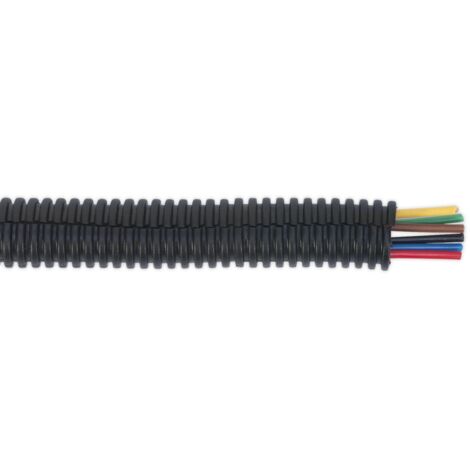
- the corrugated models, or ICTA (Transversally Bendable Corrugated Insulating), characterized by their gray color and the presence of small rings that facilitate bending;
- the smooth models or ICTL (Transversally Bendable Smooth Insulating).
To meet user needs, conduits are most frequently:
- offered in coils, available in a wide range of lengths;
- sold starting from 5 m for small projects up to 100 m for large construction sites;
- available in a vast panel of sizes to match the number of wires and the sections used in the installation (regulations do not impose any minimum diameter);
- designed to facilitate line pulling and allow for additions if necessary.
This protective element is appreciated for:
- its resistance, determined by the force needed to crush the covering, expressed in Newtons (N);
- its shock resistance, corresponding to the energy from which an impact can damage it, expressed in Joules (J);
- its compliance with European (CE) and French (NF) standards, guaranteeing the durability of the coating;
- its fire reaction. The LSZH (low smoke and zero halogen) designation for example indicates its environmentally friendly nature and the absence of harmful gas emissions in case of combustion of the material. Moreover, a self-extinguishing product limits the spread of fire in case of an incident. These models are mandatory in crawl spaces, especially if the installation is not embedded in a non-flammable material.
Installing protective coverings represents only half of the work. Most of the time, it is then necessary:
- to pull the wires using a draw-wire (integrated or not);
- to use specific lubricants to reduce friction and facilitate the operation;
- to exert more effort if the wires are long and numerous, or if the installation includes bends;
- to call another person to guide the wires throughout the pulling.
To choose the most suitable electrical conduits, it is essential to analyze the configuration of one's installation and consider the mechanical constraints exerted on the element. It is better to opt for a pre-wired model that is resistant to aging to avoid problems during or after installation.



'/%3E%3C/svg%3E)