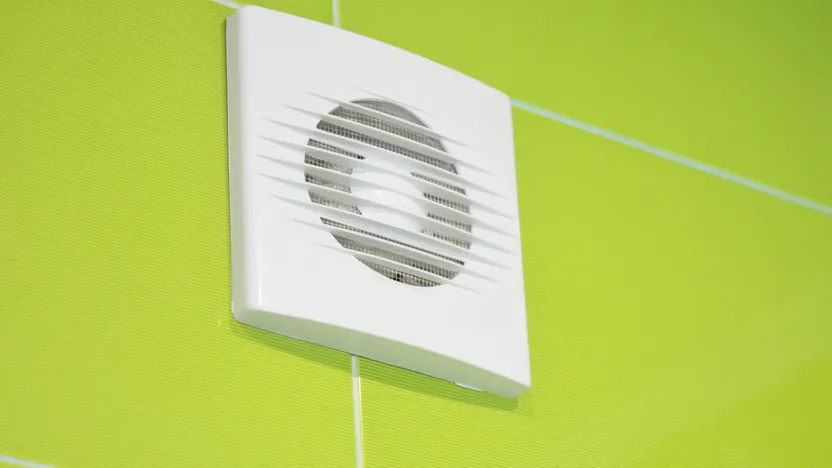
Bathroom extractor fan buying guide
'/%3E%3C/svg%3E)
Guide written on 6 February 2024 by:
Sebastian, Self-taught DIY-er, Exeter
Important features
- Room size
- Air change rate
- Flow rate
- Type of extractor fan
Best sellers in this category
Bathroom extractor fans: a must-have accessory to renew air
While natural ventilation - achieved by simply opening a door or window and letting the air flow through - is essential to replenish fresh air indoors, it isn't enough in areas where human activity is constant.
In a bathroom, neutralising the unavoidable condensation requires significant air renewal. No matter the season, air extraction and ventilation should be tailored to get rid of unpleasant odours and reduce the potential spread of microbes that can cause various allergies.
There are multiple solutions to choose from, depending on whether you live in a new build or old home. Let's take a look at how to choose a device capable of replacing stale air with fresh air.
What exactly is a bathroom extractor fan?
A bathroom extractor fan is a kind of reverse fan, designed to suck out stale air from a damp room and send it outside via a sealed duct.
Formula needed for choosing the right extractor fan
After calculating the volume of a room in cubic metres (L x W x H), you need to multiply the result by the number of Air Changes per Hour (ACPH) to obtain the required flow rate for air circulation i.e. room volume in m3 x ACPH.
How many ACPH does my bathroom need?
There are set scales according to location.
Location | ACPH/ min. | ACPH/ max. | Maximum extraction rate |
Bathroom | 10 | 15 | 150 m3 |
WC | 8 | 12 | 96 m3 |
Kitchen (excl. cooker hood) | 6 | 10 | 60 m3 |
Office | 6 | 10 | 60 m3 |
Garage | 5 | 8 | 40 m3 |
Best sellers in this category
Extractor fan installation accessories
The air inlet grille is designed to capture fresh air from outside. To optimise its efficiency, it should be installed at the bottom of a wall, as opposed to the bathroom extractor fan. The air inlet grille needs to be considered. You can opt for a louvred or baffled grille to prevent the direct intake of fresh air. This is designed to prevent rainwater entering, even in the event of strong winds. You'll need to drill a hole in the wall and install a duct.
The connector duct is made from a tube of HDPE (high-density polyethylene) or aluminium, or with a insulated or uninsulated flexible or semi-rigid duct.
Extractor fan control: in addition to an MEV system that's left to run continuously in the house, it's possible to install a bathroom extractor fan that can be switched on and off according to several factors: on-demand, manually (via a pullcord, timer or delay), according to the level of humidity (via a humidity sensor on the device) and via a motion sensor.
Flexible ducting
Types of extractor fan
Wall-mounted extractor fan
Centrifugal extractor fan
Duct extractor fan
Humidity-controlled MEV system
Noise level is a critical factor when choosing a unit. Unfortunately, there's a bit of everything on the market... but you do have to think about protecting your ears from loud noises. You might want to opt for an ultra-silent model, which is quiet enough for you to listen to music in the shower, for example.
Wall-mounted extractor fan
Models that are mounted on an exterior wall require the instalment of a short duct, usually a PVC or HDPE pipe, and an external grille featuring flaps that open when the air is expelled.
Installation requires drilling into a wall using a rotary hammer, a hole saw or a hammer drill with appropriate drill bits.
Window extractor fan
There are two types of window extractor fan: mechanical or motorised. You will have to cut a hole out of the window for either of these. If you feel up to the job of cutting glass, use a proper glazier's circular glass cutter.
Cylindrical mechanical extractor fans work with a pullcord to open the flaps. The temperature difference between outdoors and indoors creates air movement that triggers the system to rotate. This is a simple device that can be left on permanently. It has a low flow rate.
Motorised window extractor fans also require the window to be precision cut. It will need electrical wiring.
Centrifugal extractor fan
Centrifugal extractor fans, mounted on a wall or ceiling, connect via a duct to the outside when direct expulsion is not possible.
This device, which is often very quiet, lets you set variable flow rates and can compensate for the lack of an MEV system in the room concerned. You can leave it on for 24 hours a day because the thermal protection ensures the correct functioning of the motorised fan with ventilation holes.
Duct extractor fan
A wall vent connects to the outside via an insulated duct. A motorised fan is attached to this duct at a decent distance from the bathroom, to expel the stale air from the room to be treated.
This highly efficient set-up means that noise generated by the motorised fan is kept to a minimum. And if you use padded soundproof ducts, there is no more annoying loud noises. It can also be hung in the loft.
Mechanical extract ventilation system
MEV systems create permanent air renewal without wasting energy.
You might choose to install a single flow system that meet energy regulations for buildings.
A humidity-controlled extract-only ventilation system features inlets to detect humidity in the surrounding air which switches it on. This system consumes less energy than traditional ones.
MEV systems
Equipment certification: guarantee safety and peace of mind
Ensure that your planned investment meets both the technical and regulatory standards. Don't tinker with a set-up as this could cause accidents. Check that the equipment has the BSI Kitemark.
Installing a suitable extractor fan for the room's flow rate, following the installation guidelines and ensuring the unit is properly connected are all essential to achieve the ideal level of comfort in the bathroom.
You may be also interested in these guides
Guide written by:
Sebastian, Self-taught DIY-er, Exeter
Redo a roof with wooden beams? Check. Advise everybody in the DIY shop? Check. Redo bathroom plumbing? Check. If it doesn't work, try again! I'll do my best to advise you in your projects.
'/%3E%3C/svg%3E)