Brushcutter blade buying guide
'/%3E%3C/svg%3E)
Guide written on 6 February 2024 by:
John, Passionate gardener, Cambridge
Important features
- Vegetation type
- Material
- Engine power
Best sellers in this category
Brushcutter blades: picking the right blade for your tool
Choosing the right blade for the type of vegetation you want to cut makes for quicker and neater results with less effort. If the brushcutter seems to be struggling, don't hesitate to switch out your blade for another type. Brushcutter blades are usually made of metal and are fairly easy to change. They come in a wide range of designs and are often designed to fit on any type of brushcutter, regardless of brand. However, it is sometimes necessary to use an extra fitting such as a reduction ring, screw or nut.
Bore size refers to the diameter of the hole in the centre of the blade. The most common bore size is 25.4mm but can sometimes be 20mm. Here's a quick table comparing different brushcutter blades according to vegetation type along with their various pros and cons.
Vegetation type | Blade type | Advantages | Disadvantages |
Soft and tough grass Dense lawns | Metal 8 tooth blade | Lightweight Designed for low power engines | Needs to be sharpened regularly Small cutting surface Not designed for woody growth |
Dense and/or tough grass | 4 tooth blade | Lightweight - Designed for mid-power engines | Needs to be sharpened regularly Small cutting surface Not designed for woody growth |
Tall grass, undergrowth (up to 2cm branch diameter) | Universal blades | Versatile Effective on woody growth Reversible | Medium to powerful engine required Tricky to sharpen |
Grass and undergrowth | 2 tooth blade | Versatile Several diameters available | Non reversible Tricky to sharpen Powerful engine required |
Brambles and dense undergrowth | Shredder blades | Mulching vegetation | Noisy Powerful engine required |
Very thick or tough grass, ferns, nettles | Plastic 8 tooth blade | Even cutting | Lacks versatility |
Bushes, undergrowth | Sharp circular blade | Efficient cutting | Lacks versatility Tricky to handle |
Shrubs with branches up to 5cm, thick bushes | Chisel tooth circular blade | Efficient cutting | Lacks versatility Laborious to use |
Brushcutter blades: number of teeth and diameter
Before fitting a blade to your brushcutter, you need to check that the diameter and number of teeth are compatible with your machine:
The greater the diameter, the faster the cut but you need the engine power to match.
The fewer teeth the blade has, the more powerful the machine must be.
Using a large blade with few teeth can strain the engine of a brushcutter.
Shop our petrol brushcutters
Grass cutting blades: what can I use them for?
Grass cutting blades can feature between 2 and 8 teeth and are designed to cut soft, fresh grass in the spring as well as drier grass in the summer months. These blades work very well on dry grass, ferns, nettles, lawns with very dense grass. While grass cutting blades are sometimes used to cut small bushes, this isn't their main purpose. The blade must be very sharp if you want neat cuts.
Best sellers in this category
What blade do I need for very dense vegetation?
Blades designed for dense vegetation can handle large scale clearing of thick and tangled vegetation. They can also easily handle brambles, even thick branches, as well as dense bushes or thorny hedges like dog rose hedging.
In terms of results, you'll notice little difference between metal three- and 4-tooth blades. However, a four-tooth blade will generally be more comfortable to use.
Bramble cutting blades
These blades have two or three teeth and can be easily recognised by their design as each tooth is bent downwards towards the ground. By moving the brushcutter in an up and down motion, these blades can hack through bushes and brambles using a kind of shredding action. They can cut through dense vegetation without getting tangled or stuck which is often the case with straight blades.
Special bramble shredding blades can be used to create mulch to spread over flower beds or around trees or bushes.
Circular blades
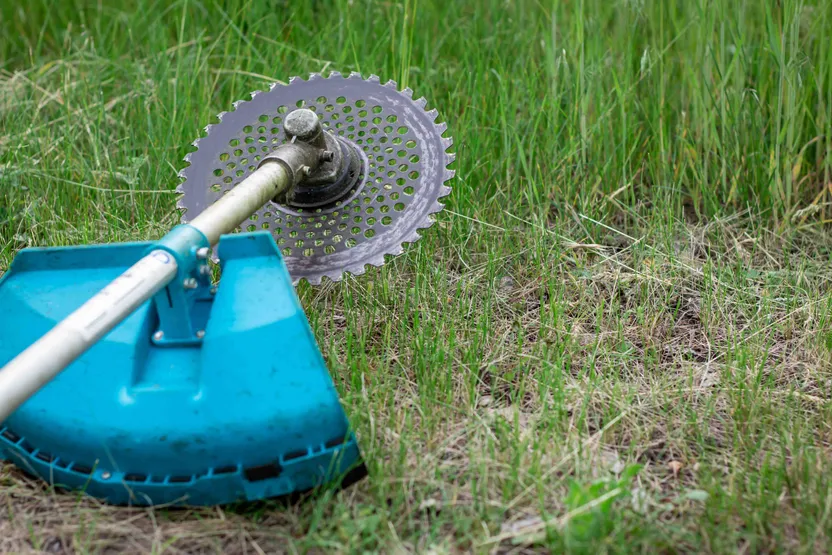
Circular blades have a large number of teeth all around the blade. They usually feature about 40 or 80 teeth but it is possible to find different designs (10 teeth, 54 teeth, etc.). These blades are more like circular saw blades than brushcutter blades. They are best suited to chopping thin branches and suckers or trimming small bushes.
Some of these blades feature carbide tipped teeth which have undergone a special heat treatment. Carbide tungsten tips are extremely resistant and often described as unalterable. However, these tips are shock sensitive and can crack. These blades are used to cut through dense thicket, clearing undergrowth and formative pruning.
Plastic blades
Very different from metal blades, these blades are limited to cutting grass in a lawn, or at the very most clearing light undergrowth. Nowhere near as hard as metal blades, these blades won't damage walls, borders or tree trunks as much as metal. It is best to use nylon line for these tasks. That said, a plastic blade can be used if you don't have a trimmer line head.
Shop our nylon line
How to use a brushcutter
Brushcutters are practical and efficient tools but they are also dangerous. While the blade alone poses risks, flying stones or debris can also fly several metres in the air.
That is why it is important to wear the right equipment and to follow safety recommendations.
Check that all brushcutter components are firmly secured, especially the brushcutter head and the blade guard.
Check the area for stones and other obstacles before starting, especially if you have thick growth.
Wear appropriate apparel including specially designed gardening clothes.
Use PPE including a visor helmet, safety goggles, safety shoes and protective gloves.
If you have a handheld brushcutter adjust the harness properly.
Always start the brushcutter with the machine flat on the ground.
Avoid working near people or animals in case of flying debris.
Be very careful of the blades when transporting the tool.
Sharpen the blades regularly to make your job easier.
Brushcutter accessories
More information
Guide written by:
John, Passionate gardener, Cambridge
When I was young, I was already working in the family garden. Perhaps that is where my interest in plants and gardening came from. So, it was logical for me to study plant biology. At the request of various publishers I have, over twenty-five years, written many books on the subject of plants and mushrooms (a subject that is close to my heart). They were mostly identification guides at first, but shortly after they were about gardening, thus renewing the first passion of my childhood. I have also regularly collaborated with several magazines specialising in the field of gardening or more generally in nature. There is no gardener without a garden, I have cultivated mine in a small corner of Cambridge for the last thirty years and this is where I put into practice the methods of cultivation that will I advise you in as well.
'/%3E%3C/svg%3E)