Brushcutter head buying guide
'/%3E%3C/svg%3E)
Guide written on 6 February 2024 by:
John, Passionate gardener, Cambridge
Important features
- Specific or universal
- Line or blades
- Uses
- Maintenance
- Engine power
Best sellers in this category
What type of brushcutter head do I need?
The cutting head of a brushcutter is held at a 45° angle by a gearbox which transforms the vertical rotation of the spindle into the horizontal rotation of the head.
Several different types of head can be fitted to a brushcutter.
nylon line trimmer heads;
plastic blade heads;
metal blade heads with 2, 3, 4 or 8 teeth;
circular saw heads with sharp or chisel teeth;
knot wire brushes for weeding.
Brushcutter
Different brushcutter heads for each type of vegetation
The type of vegetation you need to clear is the most important criterion to consider when choosing a brushcutter head. Below are some examples of the types of applications each brushcutter head cand handle.
Type of vegetation | Brushcutter head |
Grass - No obstacles | 2 or 4 line trimmer head / plastic blade head |
Grass with obstacles | 2 line trimmer head |
Grass in borders - Along walls - Around trees | 2 line trimmer head |
Thick, woody or dry vegetation - Nettles | Plastic blades - Metal grass blades Square or serrated line head (for powerful engines) |
Reeds and bushes with branches of up to 2 cm in diameter | Metal 8 tooth blades - Weed wacker blades - 2 or 3 tooth mulching blades - Circular blades with pointed teeth |
Undergrowth, thorny bushes, branches measuring over 4 cm | Chisel or sharp teeth circular saw head - Carbide circular saw head for cutting close to the ground |
Tangled bushes, thorny hedges | Metal brush knife and shredding knife |
Moss and grass in paved areas | Wire knot head |
Best sellers in this category
Nylon line: what kind do I need?
Nylon line is one of the most used accessories for trimmers and brushcutters. Nylon line heads offer several advantages over blades:
they are lighter;
they are inexpensive;
they won't damage walls;
there is no risk of sparks even after hitting a stone (which reduces the risk of fire during droughts);
the heads are versatile and come in several types to match different types of vegetation.
Nylon line heads come in a variety of different types. Brands usually feature their own designs (e.g. threaded, different screw diameters , retaining nuts, etc.) but there are also universal heads designed to fit on almost any type of brushcutter or trimmer.
Universal trimmer heads
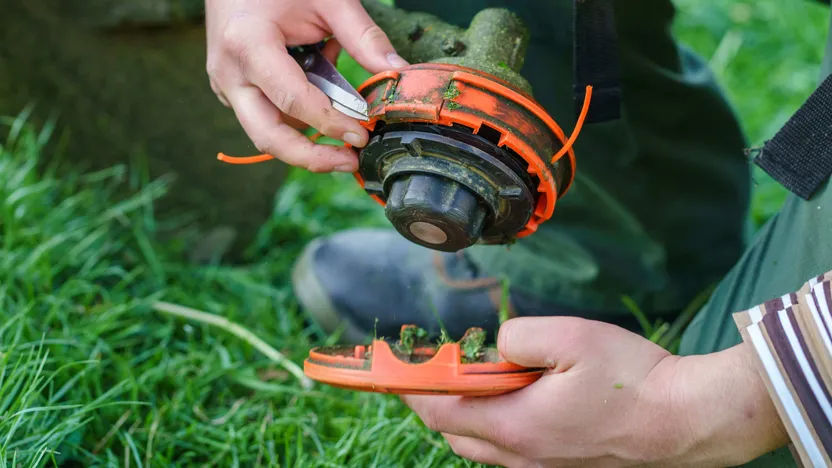
Universal trimmer heads are widely used these days. The trimmer line is much easier to fit compared to a classic spool and these heads can be used to fit thicker line.
The line is cut to the required length and fitted manually to the head. You don't need to remove the spool to change the line making it much quicker to replace trimmer line – especially for models with a ratchet spring system. If made from aluminium, these heads are strong and reliable, and can be used to fit nylon line in any shape or size.
This type of head can be used to fit 2, 4, 6, 8 or even 16 lines. The greater the number of lines, the more powerful the engine must be, and the stronger the gear box must be.
Manual feed trimmer head
In this case, the trimmer line must be adjusted in length manually from the spool and the line must be pulled out when it gets too short. While the system is generally considered outdated, these heads are still used today for their reliability, strength and low prices.
Bump feed heads
Bump feed heads are fitted with a system that releases a small length of line when the user bumps the head of the tool to the ground. These semi automatic heads might also be referred to as tap and go. If too much line is released, a built-in blade located in the guard of the brushcutter can be used to cut the excess length down to the right size.
Automatic feed heads
These heads adjust the line to the ideal length automatically without any intervention from the user. The line is released automatically through centrifugal force.
Shop our petrol brushcutters
Blade heads
Plastic blade heads
Designed for denser or taller grass, tri blade heads are equipped with 3 plastic blades. Each brand has its own head design. On some models, the blade folds back inside the head when it comes into contact with any obstacles which limits the risk of breakages. This is important as plastic is fairly brittle.
The blade can be removed and simply needs to be reversed once one cutting edge is blunt. If you have to change the blade altogether, it is recommended to change the whole set to ensure the tool provides a balanced cut.
Metal blade heads
Metal cutting blades are especially effective on tall, dense or tough grass or undergrowth that isn't too woody such as docks, goosefoot, nettles, brambles or reeds. These heads can be fitted with 2, 4 or even 8 blades depending on the type of grass being cut.
Once the cutting edge is worn, you can reverse the blade and when both sides are blunt it is possible to sharpen them using a flat file.
Shredding heads
Fitted with 2 or 3 blades, these heads are more specialised. They are designed to be used in a half circle motion or by moving the tool up and down to clear tangled vegetation or thorny hedges.
They are reversible and can be sharpened like regular metal blades.
Circular saw blades
Steel circular saw blades are only used to cut through woody undergrowth and bush branches measuring up to 5 cm. They are useful for woodland maintenance to cut broom, tree heather, vines and so on.
These blades are not reversible and must be sharpened using a round file.
There are two different types of circular saw blade:
Chisel tooth blades for soft wood.
Sharp tooth blades for hardwood.
Shop our brushcutters
More information
Guide written by:
John, Passionate gardener, Cambridge
When I was young, I was already working in the family garden. Perhaps that is where my interest in plants and gardening came from. So, it was logical for me to study plant biology. At the request of various publishers I have, over twenty-five years, written many books on the subject of plants and mushrooms (a subject that is close to my heart). They were mostly identification guides at first, but shortly after they were about gardening, thus renewing the first passion of my childhood. I have also regularly collaborated with several magazines specialising in the field of gardening or more generally in nature. There is no gardener without a garden, I have cultivated mine in a small corner of Cambridge for the last thirty years and this is where I put into practice the methods of cultivation that will I advise you in as well.
'/%3E%3C/svg%3E)