Circular log saw buying guide
'/%3E%3C/svg%3E)
Guide written on 6 February 2024 by:
Jérôme, Construction site supervisor, Cardiff
Important features
- Petrol-powered
- Electric
- Power rating
- Blade diameter
Best sellers in this category
Parts of a circular log saw
How does a log saw work?
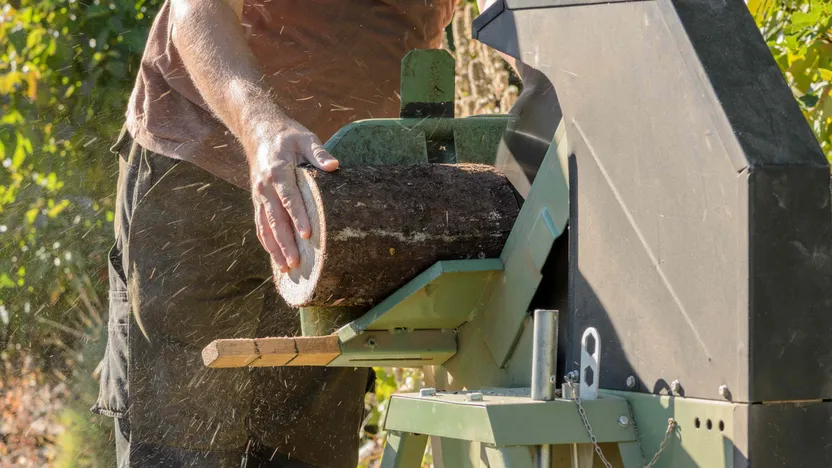
A circular log saw is a stationary saw that is used to cut logs down to size to make firewood. Relatively simple in terms of design, all log saws work in more or less the same way. An electric motor or a petrol engine drives a circular saw blade which can vary in size from around 40 cm (15.7") to 70 cm (27.5"). The motor and the circular saw blade combine to form the cutting mechanism. Whole multiple logs and sections of timber are placed on a cradle which is equipped with an adjustable stop to alter the length of the log as required.
These machines can be equipped with a swingarm which is controlled manually in order to cut down on the wood held in the cradle. However, due to the weight of the engine, more powerful petrol-powered models will generally be equipped with a swivel cradle which is used to feed the wood into a stationary cutting mechanism. The whole unit is attached to a frame for greater stability. This frame is usually fitted with wheels allowing you to move the saw around easily.
Shop our circular log saws
Types of log saws
All circular log saws are basically identical in appearance and operate in much the same way. However, there are two major categories of circular log saw, based on the machine's power source.
Electric log saws for ocassional use
Petrol-powered log saws for regular use
Electric log saws
Best sellers in this category
Electric log saws
Designed for small-scale or occasional garden work, electric log saws are primarily intended for personal use. Easy to operate, relatively lightweight and quiet, they are ideal for preparing wood for the winter, whether you are cutting logs to the right length or for breaking them down for removal. Commonly equipped with a 40 cm (15.7") to 50 cm (19.6") blade, the most powerful electric log saws can nonetheless accommodate a blade measuring up to 70 cm (27.5"). These saws are rated at around 2000 to 3000 W.
Petrol-powered log saws
Geared more towards heavy-duty or frequent work, petrol-powered log saws are generally reserved for professional use. Just as easy to use as electric models, they are nevertheless heavier and much noisier. On the other hand, petrol-powered log saws do not require an electrical outlet and can be used wherever you fell your trees or anywhere without a mains connection. The majority of petrol-powered models offer a blade diameter of 60 cm (23.6") to 70 cm (27.5"). In terms of power, a 45cc to 60cc engine (the equivalent of around 2.5 kW) is about the minimum requirement. Some saws can be equipped with a 125 cc motor (about 7 kW) for heavy-duty or continuous use.
Features of a circular log saw
Cutting capacity
Cutting capacity is the main characteristic to pay attention to when purchasing a log saw. This translates into the width of the wood you can cut. For example, you might think that a blade diameter of 50 cm (19.6") would be able to cut through a log of about 25 cm (9.8") no problem. Sadly, this isn't the case: the real log diameter is actually much less than that! Here is a short summary of cutting capacity vs. blade diameter to help you make the right choice:
Blade diameter of 40 cm (15.7") = maximum cutting capacity of 17 cm (6.6")
Blade diameter of 50 cm (19.6") = maximum cutting capacity of 19 cm (7.4")
Blade diameter of 60 cm (23.6") = maximum cutting capacity of 23 cm (9.0")
Blade Diameter of 70 cm (27.5") = maximum cutting capacity of 27 cm (10.6")
Power
Whether you go for an electric or petrol-powered model, the amount of power your machine provides will determine the maximum blade diameter of the saw. Whatever your cutting capacity needs, you will need at least 2000 W or about 50 cc for a petrol-powered engine. If you have particularly large timber or a large volume of wood, go for a high-powered motor rated at least 3000 W or a 75 cc engine.
Safety
As you can imagine, a large blade with sharp teeth working at high speeds is dangerous. Be sure to select a log saw with both a safety guard and an easily accessible emergency stop button to keep you safe.
Final tips for choosing a circular log saw
Log saws are handy but dangerous tools. When sawing, be sure to wear safety shoes, gloves, protective goggles, and noise-cancelling headphones.
If you have a log that is particularly hard to cut, it's a good idea to adjust its position on the cradle and make several attempts to cut through it.
In terms of maintenance, it's important to clean the cradle, stops and blade guard regularly. When cutting a large amount of wood, it’s a good idea to pause occasionally to remove sawdust and wood chips from your saw.
Remember to clear up your workspace as well: clean the floor regularly to avoid slipping or tripping.
More information
Check out the following guides for more advice on related products:
Guide written by:
Jérôme, Construction site supervisor, Cardiff
Electrician by trade, I first worked in industrial estates where I installed, wired and fixed a large number of electrical installations. After this, I managed a team of electricians for this type of work. 10 years or so ago, I turned to building and construction. From the modest family home, to gyms and theatres, I have been able to coordinate, audit and organise all sorts of construction sites. For 4 years now, I am restoring and building an extension to a bungalow in the heart of the Welsh countryside. My experience in manual work and my knowledge means I am proud to be of service. Terraces, interior design, roofing, plumbing, electrics, anything goes! My wife, daughter and I, built almost everything we have from scratch! So to answer all of your questions and advise you on choosing your tools? Easy!
'/%3E%3C/svg%3E)