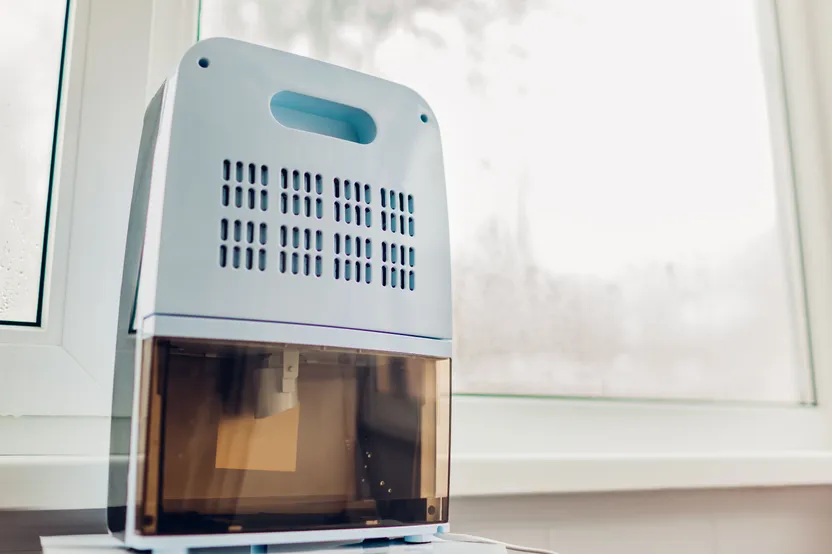
Dehumidifiers: the advantages and disadvantages
'/%3E%3C/svg%3E)
Guide written on 6 February 2024 by:
Pauline, Self-taught DIYer, Leeds
Important features
- Type
- Reducing humidity levels
- Sound level
- Maintenance
- Energy consumption
Best sellers in this category
The different types of air dehumidifier
Two types of air dehumidifier are available:
Dessicant (or absorption) air dehumidifiers are effective and relatively quiet, but not often used in the home;
Compressor (or refrigerant) air dehumidifiers are powerful and energy-efficient but have sound levels of up to 50 dB.
Useful tip: when used in a living area, a heating system must be used alongside this type of dehumidifier. This will help to reduce mould issues on the floor, walls or furniture.
Shop our dehumidifiers!
Air dehumidifiers: a simple and effective system
Designed to improve air quality, the idea behind these machines is simple:
the dehumidifier draws in ambient indoor air;
the air is separated from the water;
the water is collected into a tank;
the processed air is released back into the room.
Whether they are run by electricity or use chemicals, air dehumidifiers have the advantage of not requiring any refills or special maintenance – besides emptying the water-collection tank. Dehumidifiers start to reduce the amount of water in the air as soon as they're switched on.
Shop our dehumidifiers
Best sellers in this category
Disadvantages of dehumidifiers
Dehumidifiers do have some disadvantages that you should be aware of before purchasing.
Firstly, these humidity-reducing devices do not address the source of the problem: they simply take care of the symptom (i.e. too much water in the air). As such, they won't deal with any issues caused by poor insulation.
Furthermore, dehumidifiers won't have any effect on the deterioration of moisture-sensitive materials such as furniture, wallpaper, or other household items.
Using an air dehumidifier will also increase your electricity bill; if you leave it switched on constantly, you will pay for it!
Finally, these machines do emit some background noise that users may find bothersome. This can be as loud as 20 to 50 dB.
Shop our wallpapers
Using an air dehumidifier to tackle mould
If you want to live in a healthy environment, it is vital to properly ventilate your living space. This will also help to prevent mould growth. Considering the many forms of pollution affecting the air in our cities, it is especially important to monitor your indoor air quality!
It is a known fact that spores have a negative impact on the respiratory health of vulnerable groups of people such as children, the elderly and those with lung or bronchial issues (for example, asthmatics).
Additionally, did you know that indoor fungal pollution can also lead to poor concentration, headaches and even fatigue?
Experts recommend using a dehumidifying device when the moisture level in the air reaches 60% or more.
Dehumidifiers are effective machines used to process air containing excessive amounts of water which can lead to respiratory issues and the appearance of mould. However, these devices are by no means a solution to the underlying causes of humidity. These problems are generally treated through building work and the use of proper insulation. Dehumidifiers should also be used alongside an efficient heating system, proper ventilation (such as a mechanical ventilation system) and, where necessary, paint with humidity-resistant properties.
You may be also interested in these guides
Guide written by:
Pauline, Self-taught DIYer, Leeds
With a handyman-father, I grew up with the soft sound of the sander and hammer on weekends. I am both manual and cerebral, I learned the basics of DIY and the customisation of furniture because I was passionate. The salvage mentality is a true way of life that allowed me to know how to use all the tools and products needed to give something a second life, from a sander to varnish. I have two favourite activities: the transformation of old furniture and decoration tips. I am always ready to lend a helping hand to revamp a table or to restore a mirror that was intended for the tip that will become a friend’s centrepiece. I’m convinced that it’s possible to reinvent an interior by small, regular modifications and I constantly research low-cost ideas.
'/%3E%3C/svg%3E)