Dishwasher buying guide
'/%3E%3C/svg%3E)
Guide written on 6 February 2024 by:
Julie, Interior Designer, Manchester
Best sellers in this category
Dishwashers: the basics
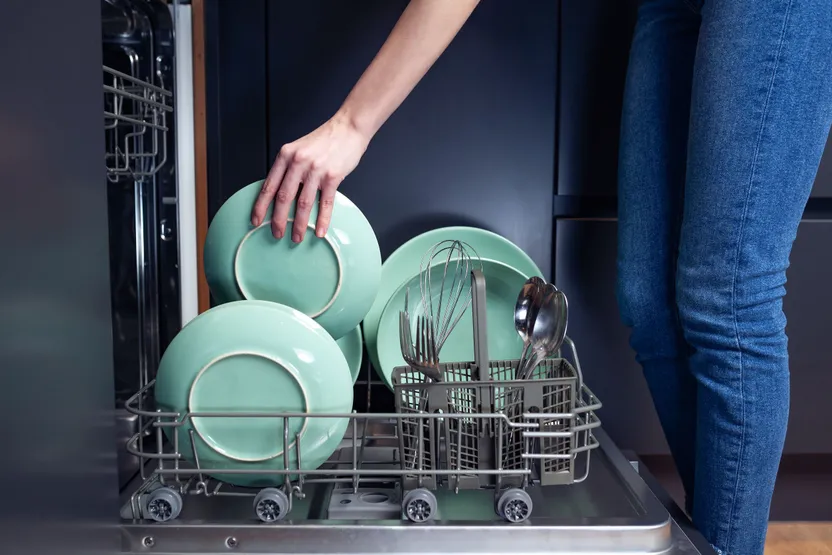
Dishwashers are particularly welcome household appliances. This is no surprise, as who likes washing up? In addition to saving you time, dishwashers provide other benefits as well.
They help keep your kitchen tidy, as dirty dishes, whether in the sink or on kitchen worktops, are not a pleasant sight. Dishes, glasses and cutlery disappear behind the dishwasher door in a flash.
Cleaning dishes in a dishwasher is also more hygienic, as germs and bacteria are removed effectively using washing programmes with temperatures over 70 °C. This is particularly important if you have a baby in your household.
Using a dishwasher in most cases also saves more energy and water than washing up by hand.
Kitchen sinks
An overview of dishwasher types
Integrated dishwashers
Integrated dishwashers do not have cladding. They are installed directly into your kitchen units in the same fashion as built-in ovens and fridges. With all kitchen cabinets having the same panel design, your kitchen will have a tidy look to it.
Under counter dishwashers
Under counter dishwashers fit perfectly into your kitchen in a similar fashion to integrated dishwashers. The difference is that under counter dishwashers have both front and side cladding. They are placed under the kitchen surface and can be adjusted to the right height, using adjustable worktop legs.
Freestanding dishwashers
Freestanding dishwashers can be placed anywhere in proximity to your water and electricity supply. When moving into a new house, freestanding appliances are more practical than integrated dishwashers as they don't have to be adjusted to fit your new kitchen units. The top surface can also be used for additional storage space. A freestanding dishwasher is also a good option when equipping a pre-designed kitchen.
Semi-integrated dishwashers
If the dishwasher has a visible control panel, it is a semi-integrated appliance. The benefit of having a semi-integrated dishwasher is that you can see the display, so you will be able to tell immediately when your dishes are clean.
If your appliance is entirely concealed behind a kitchen panel it is a fully integrated dishwasher. The control panel is located on the upper edge of the door. As there is no panel display informing you when your dishes are clean, modern appliances project the time remaining on the kitchen floor using an LED light.
See all kitchen units
Best sellers in this category
What dishwasher size should I choose?
Finding the right sized dishwasher depends on your needs and the amount of space available. The most common measurements are 45 cm wide for slimline dishwashers, to 60 cm for standard dishwashers. Ensure that your chosen model fits into your kitchen units or under your kitchen worktop.
In addition to exterior measurements, loading capacity is another important criterion. It is important to note that a dishwasher performs optimally when it is full. Do you live alone and eat out often, or are you an enthusiastic cook living in a four-person household?
Loading capacity is displayed in accordance with BS EN 60436. Place settings include:
A dish plate, soup bowl and dessert plate;
a cup and saucer;
a drinking glass;
a knife;
a fork;
a ladle, teaspoon and dessert spoon.
The following summary provides an overview of recommended loading capacities according to household size.
Household size | Number of place settings (loading capacity) |
Single household | 7 |
2-person household | 12 |
4-person household | 16 |
See all worktops
An overview of the most important dishwasher programmes
Modern dishwashers offer a range of washing programmes that vary in terms of duration and temperature. Most standard dishwashers have the following programmes:
Normal or standard programme: suitable for delicate dishes that are moderately dirty.
Baby or hygiene programme: suitable for baby bottles or cutting boards, upon which raw meat or fish is prepared.
Quick wash or short programme: practical if in a hurry, or dirty dishes are everywhere after a party.
Energy saving or Eco-programme: lets dishes soak for longer so that less energy and water are needed to clean them.
Delicate, gentle or protection programme: perfect for delicate glass or porcelain.
Automatic programme: automatically adjusts the programme length and temperature based on the dirtiness of the dish.
The names, duration and temperatures of the programmes will vary based on the manufacturer. The following table provides an overview of the most common wash programmes, as well as their average duration and temperature.
Programme | Duration | Temperature |
Standard or normal programme | 60-120 minutes | 60-70 °C |
Energy saving/eco-programme | 90-180 minutes | 45-50 °C |
Quick wash programme | 30-60 minutes | 40-45 °C |
Automatic programme | 90-140 minutes | 45-65 °C |
Delicate programme | 70-120 minutes | 40-55 °C |
Baby or hygiene programme | 130-150 minutes | 70-75 °C |
Cutting boards
Further criteria for purchasing your dishwasher
In choosing your new dishwasher, you should pay attention to additional features and equipment, which can improve safety and ease of use.
Features, equipment and accessories for dishwashers
Automatic door opening ensures that the door opens after the programme has finished so that your dishes dry quicker.
Smart dishwashers can be easily operated using your smartphone.
A level gauge for dishwasher salt and rinse aid lets you know when to refill.
Child protection: a button lock prevents your children from setting a programme by mistake when playing with the buttons.
The flood protection feature interrupts the water supply when there are defects, preventing your kitchen from flooding.
Adjustable upper racks allow more space for the lower shelf, if required.
Glass and bottle holders, or removable cup trays are found in many dishwashers but can also be bought separately.
What is better? A cutlery tray or basket?
The cutlery basket is placed in the lower shelf and is removable. This allows you to place the clean cutlery on your kitchen surface so you can easily tidy it away.
Many modern dishwasher models, however, are equipped with a cutlery drawer that is pulled out above the upper rack. This allows you to pre-assort your cutlery and easily remove it without having to bend over.
Dishwasher noise
Loud dishwashers are particularly annoying in open plan rooms and can affect your comfort in the home. Choose a model with a maximum of 45 decibels - this is the equivalent of a residential area without street traffic, or a quiet conversation.
You can discover the decibel levels of a dishwasher is by reviewing its product information or energy label.
Drawer dividers
How to save energy when washing dishes
Dishwasher energy labels
Choose a dishwasher that is as efficient as possible. Energy-efficient dishwashers work using minimal electricity and water. This allows you to save money whilst protecting the enviroment. Since March 2021, all new dishwashers must be marked with an energy label. The best energy efficiency grade is A. Dishwashers with energy ratings of F or G, on the other hand, consume a lot of energy.
In addition to the energy efficiency rating, the label also provides information on:
energy consumption per 100 operating cycles in kWh;
Water consumption per cycle;
the appliance's operation noise level in dB;
maximum loading capacity;
the length of an eco-programme wash cycle.
6 tips on washing dishes economically
Ensure that your dishwasher is completely full to save electricity and water.
Choose an appliance that is appropriate for your household and your habits.
Choose the energy-saving/eco-programme as often as possible when washing.
Care for your dishwasher regularly so that it cleans smoothly and lasts longer: clean the filter, remove limescale regularly using the appropriate cleaner, and use a programme running at a minimum of 60 °C.
Switch your dishwasher off as soon as your programme ends.
Use renewable energy to operate the dishwasher.
Ensure to dispose of your old dishwasher correctly by having it collected, or bringing it to a household recycling centre.
Multi purpose cleaners
Dishwasher care and maintenance
In order for your dishwasher to continue to operate without issues, make sure to clean it regularly. Taking care of your dishwasher correctly prevents unpleasant odours from developing inside.
Select the appropriate hardness level to prevent limescale. Water hardness varies according to different regions, so it is best to enquire at the relevant water company as to the exact details regarding your water supply.
Regularly clean the filter at the bottom of your dishwasher.
Check the water dispensers for limescale or food bits, which can block the nozzles.
Wipe the door seals occasionally using a wet cloth .
Run your dishwasher empty, once per month at 60 °C , using the appropriate cleaning product, such as appliance cleaner.
You will find all the specific recommendations for your appliance in your dishwasher's product guide.
Dusters, microfibre cloths and wipes
More information
Further information on household appliances and kitchen cleaning can be found in the following advice guides.
Cleaning
You may be also interested in these guides
Guide written by:
Julie, Interior Designer, Manchester
After years of DIY, renovation and designing, I decided to turn my passion into a career. Starting in 2006, in the South-West, I helped people with renovation or construction projects. My expertise and curiosity led me to look further into innovative ideas for myself and my clients. Indeed, to live your passion is also to transform the space you live in and the objects you use daily. My family love my creations and ideas that I bring into their lives! My favourite thing to do: use colour to brighten up interior space. But also tips to hide away clutter. Your home is just never big enough, is it? It is therefore a great pleasure to share my tips with you, so that you also can take as much pleasure as I do when starting up your next project!
'/%3E%3C/svg%3E)