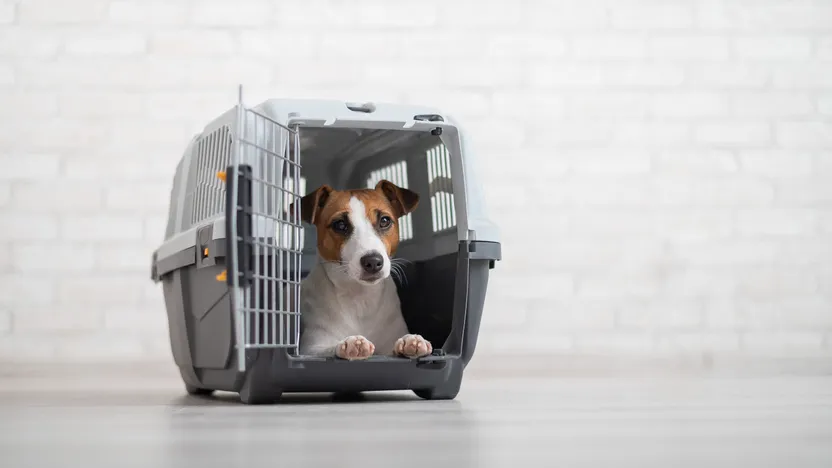
Dog travel crate and carrier buying guide
'/%3E%3C/svg%3E)
Guide written on 6 February 2024 by:
Jennifer, Self-taught DIY enthusiast, Manchester
Important features
- Mode of transport
- Dog size and weight
- Cage material
Best sellers in this category
How to choose a dog travel carrier
Choosing the right cage, crate or carrier comes down to the following factors:
the mode of transport you plan to take and the type of travel cage allowed;
the size and weight of the dog;
the type of fastening system;
material.
Size guidelines by breed type
Cage type | Size (Depth x Width x Height) | Breed |
Toy | 64 x 43 x 43 cm | Yorkshire terrier, toy poodle |
Small | 69 x 54 x 51 cm | Cocker spaniel, small beagle |
Medium | 81 x 57 x 59 cm | Bulldog, Staffordshire terrier |
Large | 91 x 62 x 66 cm | German shepherd, boxer |
Large - Extra-large | 101 x 68 x 75 cm | Rottweiler, German shepherd |
Extra-large | 122 x 81 x 89 cm | Saint Bernard, Great Dane |
Dog size and mode of transport
Travelling with a large dog
When travelling in the car, your dog needs to be secured at all times. In fact, this is a legal requirement in the UK. The most common option is to fit your dog with a harness which can be clipped into to a special dog seat belt. Alternatively, your dog can travel in a crate set up in the boot of the car or in a special compartment on the back seat separated from the front by a grid.
Travelling with a small dog
Small dogs can travel in a pet carrier or travel cage positioned on a seat as long as the cage is secured to the seatbelt buckle. Remember that even small dogs must be fastened securely and it's usually best to use a seatbelt and harness. If you do not secure your dog, it will not be protected in the event of an accident. Furthermore, your dog could distract the driver and put all passengers in danger.
Best sellers in this category
Hard cages and crates
When choosing between a cage or crate, you'll need to think about the weight of your pet. In the car, travel cages or carriers are best for small dogs (up to around 11 kg) while travel crates are best suited to medium to large breeds. However, bear in mind that only large IATA-approved travel cages will be accepted by airlines.
Travel cages are similar to those used for cats. They feature an open grid front and may also be open at the back. They are made up of three parts:
a bottom half;
a top half;
a grid door.
The travel cage must be big enough for your dog to stand up in and turn around comfortably. It must also have adequate ventilation, which is why the front is open and the sides of the cage will usually feature ventilation grids. These cages generally come flat-packed; you will have to make sure to screw in the fasteners in the right place and to position the safety clips correctly. This is essential to ensure that the top and bottom parts are held together securely.
Don't forget to lay a cover in the cage for your dog's comfort and pop in a favourite toy or treat to make your dog feel more comfortable. Add a puppy pad even if your dog is toilet trained as the stress of travelling can cause accidents!
Go for a material that is hard-wearing and can be easily cleaned. The following options are common:
a plastic cage with metal grids;
a metal crate with a plastic base;
a pet carrier made from flexible, synthetic materials.
The fastening system that comes with your cage or crate should be secure enough, but don't hesitate to double up on hardware if you have a little escape artist on your hands!
Shop our dog carriers
Flexible dog carriers
Suitable for toy or small breeds weighing up to 11 kg, this option requires a little more thought. You'll find carriers designed for cats and dogs, but the only really difference between models is the type of weight they are designed to support.
Pet carriers come in a range of different designs. Some are entirely closed with mesh sides; others are basically dog beds with handles. While it is possible to find dog backpacks, the most traditional carriers are designed to be carried by hand or slung over your shoulder. Some pet carriers come with clips for attaching a lead but it is best to let your pet loose in the carrier to prevent injuries.
If you are looking to invest in a pet carrier, be sure to look out for the following:
Several mesh panels for ventilation.
A secure handle for carrying.
Top opening for easy access.
Be sure to check that the zips are in good condition before you start every journey!
Cat carry bags
Travelling with a dog on public transport
Train travel
Dogs are allowed on all British trains free of charge up to a maximum of two dogs per passenger. They must be kept on a lead at all times unless held in a travel cage or carrier.
Bus travel
Most buses around the UK will allow dogs as long as they are well-behaved and kept on a lead at all times. However, be sure to check with the bus company before travel as there may be further restrictions.
IATA-approved pet carriers
Some airlines allow dogs to travel in the cabin with you, as long as they weigh less than 7 kg (carrier included). The carrier must be enclosed and secure, and your dog will not be allowed out of the carrier at any time. Pet carriers with open parts are not allowed on planes. You will need to buy a ticket for your dog at the same time as you purchase your own. The fee varies depending on the airline.
However, if your dog is travelling in the hold, it must be secured in a IATA-approved pet carrier. Some airlines require you to cable tie the door(s) in addition to the fastening system. It's always a good idea to double check this before travel! The following features must be included:
The pet carrier structure must be made of solid plastic or fibreglass.
If the pet carrier comes with wheels, you must remove them before travelling. If the wheels can be stowed, they should be made inoperable with the use of tape.
The door of the pet carrier must have a locking system with two secure fasteners located at the top and bottom of the door (1).
The carrier door hinges and locking pins must extend beyond the horizontal extrusions above and below the door opening by at least 1.6 cm (5/8 inches).
The two halves of the carrier should be held together by bolts. Any other type of side fastener is strictly forbidden. However, you can use an additional fastening system alongside the bolts (3).
Your pet must be able to stand up without having to lower their head and their head must not be able to touch the top of the carrier. They must also be able to lie down and turn comfortably in the carrier.
Pet carriers should be equipped with a double pet bowl system to separate food and water. The bowl should be firmly attached and accessible from the outside of the cage.
Shop our dog bowls
You may be also interested in these guides
Guide written by:
Jennifer, Self-taught DIY enthusiast, Manchester
I didn’t receive any special training, I learned everything on the job. And what a joy it is to be able to do little jobs around the house that we love so much. That is, until the moment we decided to move and had to do everything; from the floor to the ceiling, from the kitchen to the bathroom...In short, you become as good as a pro. So today, my friends don’t hesitate to call me when they need help. And when you dip your toe in, there’s no turning back. It’s a true passion that drives us to take on the challenges, to have an idea in mind and see it come alive with just a few tools. And a passion is even better when you can share it. So, whenever I can give you a little advice, it’s with great pleasure.
'/%3E%3C/svg%3E)