Dog whistle and clicker buying guide
'/%3E%3C/svg%3E)
Guide written on 6 February 2024 by:
Pauline, Self-taught DIYer, Leeds
Important features
- Dog whistle types
- Clickers
Clicker training: how does it work?
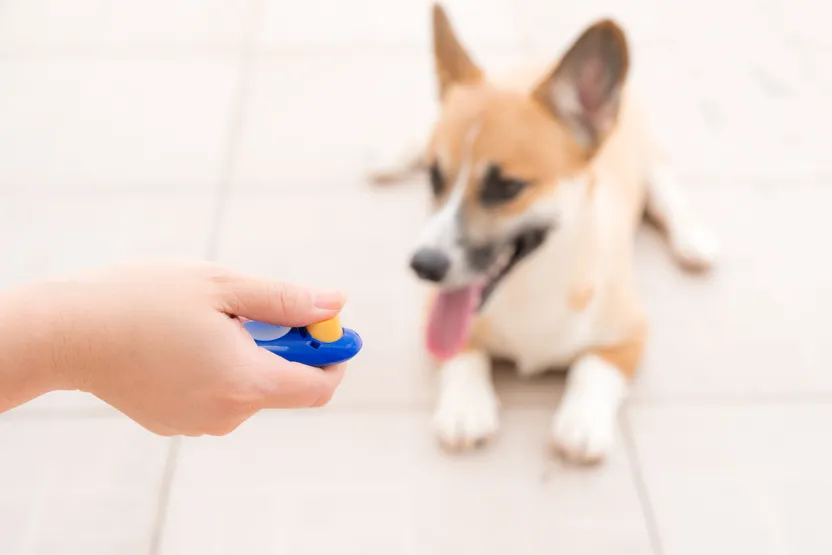
A clicker is a little plastic tool with a metal tongue inside. When you press the button, the metal part vibrates and makes a clicking sound. This sound can be used to train certain behaviours by immediately marking the appropriate response and following up with a reward such as a treat, praise or a pat.
There's not much more to it than that: clickers are simply made to click!
To start, you will use the clicker to mark the trick or behaviour you want as soon as your dog offers it and then offer a treat. After the dog has performed the trick or behaviour several times, you can start to add in the verbal command (or gesture) you want to teach, followed by a reward.
Once the command has been taught, you no longer need to use the clicker but be sure to keep on rewarding the behaviour you want.
Clickers may vary in colour and may or may not come with a plastic or nylon wrist strap. However, all clickers are basic, hand-activated tools. They are usually fairly cheap and made of brightly coloured plastic – although some do feature nice patterns!
Shop our dog whistles and clickers
Dog whistles: how to choose the right one
Just like clickers, whistles use your dog's sense of hearing to encourage certain behaviours. However, it's the whistle that causes the action here. If you want to use the whistle for recall, you will have to start by conditioning your dog with rewards every time they return to the sound of the whistle.
From that point, every time your dog is off lead you can recall them without having to shout. You might want to combine the whistle with a specific gesture to ensure your dog returns right to your side. Ultrasonic dog whistles are less bothersome for humans than traditional short whistles.
While we aren't able to hear them, these whistles are designed to tune into ultrasonic frequencies heard only by some animals. This means they can be heard by dogs even in noisy environments.
You can also match different types of whistling to different commands; for a herding dog, for example.
Three types of dog whistle
Ultrasonic whistles (long whistles)
Classic dog whistles (short, referee-type whistles)
Sheepdog whistles
Some dog whistles can be used to make different sounds while others only make one type of sound. Dog whistles can be made of metal or plastic and some are fitted with a 'pea' which can be used to change the type of sound produced; these models are great for anyone who wants a wider variety of signals. Your choice of dog whistle will therefore depend on what you want to use it for, be it for simple recall or to emit a range of sounds for different behaviours. If you want to do the latter, you will need an ultrasonic whistle that offers different tones.
Of course, your dog won't immediately respond to the whistle itself: this is just a signal. You will have to work with your dog to teach them what they need to do when they hear the whistle. You can also use your whistle to signal an unwanted behaviour; however, remember that positive reinforcement is always more effective.
A wrist or neck strap will prevent you from losing your whistle.
When used the right way, clickers and dog whistles can be great tools to train your dog kindly and coherently. Give it a try!
Shop our dog whistles and clickers
You may be also interested in these guides
Guide written by:
Pauline, Self-taught DIYer, Leeds
With a handyman-father, I grew up with the soft sound of the sander and hammer on weekends. I am both manual and cerebral, I learned the basics of DIY and the customisation of furniture because I was passionate. The salvage mentality is a true way of life that allowed me to know how to use all the tools and products needed to give something a second life, from a sander to varnish. I have two favourite activities: the transformation of old furniture and decoration tips. I am always ready to lend a helping hand to revamp a table or to restore a mirror that was intended for the tip that will become a friend’s centrepiece. I’m convinced that it’s possible to reinvent an interior by small, regular modifications and I constantly research low-cost ideas.
'/%3E%3C/svg%3E)