Drip irrigation system buying guide
'/%3E%3C/svg%3E)
Guide written on 6 February 2024 by:
Michael, Professional and passionate welder, Sheffield
Important features
- Controllers
- Straight, elbow and tee connectors
- Drip emitters
- Sprinklers
- Soaker hoses
Best sellers in this category
Choosing the right drip irrigation system
There are many different types of drip irrigation system available on the market depending on the length of time you will be away from the garden.
Short absences
Leaving home for a few days and need to keep a few house plants watered while you're away?
Go for a watering globe or a drip irrigation kit equipped with a water supply. Be sure to choose the right size of container for the number of plants you have – a large plastic bottle will usually suffice!
Systems for several plants with different watering needs
Off on holiday for a few weeks and have a lot of house plants with precise watering requirements? Go for a holiday watering kit with a variety of emitters to suit the individual needs of each plant. These systems can even be fitted with a timer or controller.
Easy-to-install systems
Need to water a hedge, flowerbed or packed vegetable garden and don't want to spend too much time installing a watering system?
Go for a soaker hose. Simply place the hose on the ground and connect it to your outdoor tap to keep your plants watered. You can even link several soaker hoses using tee connectors.
Systems with different water flow
Got a lot plants spread several metres apart and looking to save water? Want to install a custom watering system?
Install a drip irrigation network with an drip emitter to serve each plant. You'll be able to keep all your plants hydrated while minimising water loss. You may even be able to adjust the flow rate for each plant!
Controllers: an eco-friendly choice
Quick tip: with the exception of systems equipped with their own water supply, all drip irrigation systems can be linked to a controller with a moisture sensor that can be set for daily or weekly watering.
Shop our drip irrigation systems
Watering vs. irrigation
Above ground watering systems (such as sprinklers or even watering cans) are designed to emulate rainfall.
Irrigation takes place at the base of plants at soil level and is much more economical.
Best sellers in this category
Manual watering
Watering cans can be used to either pour water over the leaves using a watering rose or to direct water to the base of the plant. A watering can allows you a lot of control over how much water each plant receives and can be a great option for a small vegetable garden.
Your choice of watering system will depend on the plants you have and the size of the area you need to water. Hoses, watering lances, spray guns or watering cans will all work for medium-sized gardens.
Automatic watering systems
The most traditional above ground watering system consists of a hose-connected sprinkler system designed to tackle a specific area. Sprinklers are fairly cheap and easy to install.
A soaker hose is the easiest watering system to set up and the most economical in terms of water usage. You simply need to place the hose next to your plants. This system works best for plants with little space between them.
A drip irrigation system is an automated system set up at the base of your plants. This type of system is easy to install and can help you save a lot of water as you can customise the layout to fit your needs.
A pop-up sprinkler system is made up of a series of underground sprinklers designed to pop up through water pressure and hide away when not in use. This type of system is essential for watering large lawns or public gardens. While pop-up sprinklers are trickier and costlier to install than other systems, they won't get in the way of your lawnmower!
All automatic watering systems can be programmed.
Drip irrigation systems
Drip irrigation systems are economical and easy to install.
Soaker hoses
Soaker hoses offer the quickest and most hassle-free solution for watering a vegetable garden, flowerbed, border or hedge. The most basic systems consist of a single hose which takes the water from your supply point to the base of your plants. Water seeps out of the pores of the hose and spreads evenly over the area surrounding it. Soaker hoses can also be joined together by tee connectors and connected to a timer or controller to form an above-ground watering network. Often used by professional growers with long rows of crops to water, soaker hoses are really quick to set up – even the ones stretching 50 metres! Delivered in rolls, these hoses provide a constant flow of water which means you can't cater to the individual needs of each plant.
Drip irrigation
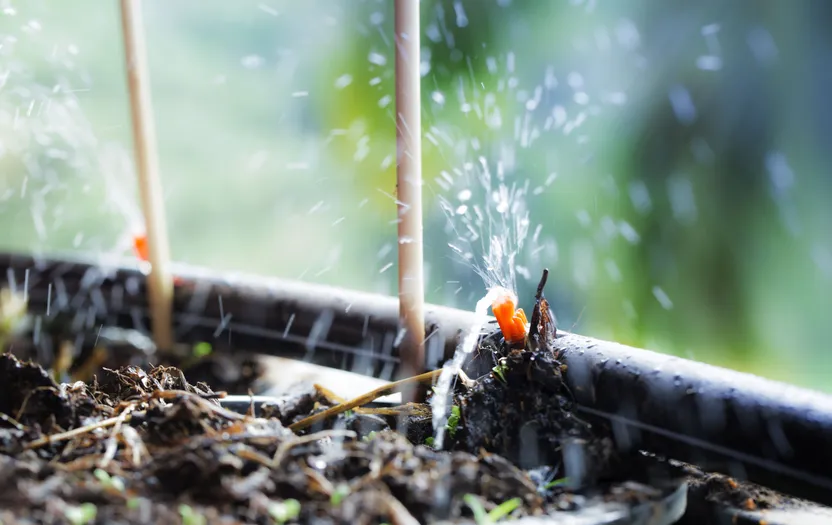
Drip irrigation is a much more accurate way to water and is a better option for plants that are spaced far apart or have specific watering needs as you can adjust the flow rate of each drip emitter. This type of installation comprises a valve box which connects your hose (or other water supply) to a network of pipes linked together by connectors. The water is released to plants via drip emitters.
You can set the number of times per week or day the system is activated as well as the length of each watering session. The range of control allowed varies between controllers or timers so it's up to you to compare models. Instead of a valve box, you can always set up a number of tee connectors or multi-way tap connectors to supply a number of pipes and water a range of plants at the same time.
The main advantage of drip irrigation is the amount of water it can save. Water loss and evaporation are considerably reduced with this type of system.
Indoor drip kits
When it comes to house plants or balcony plants, there are a few different drip systems to choose from. Your choice will depend on whether you have one or several plants to water.
If you've just got one plant, go for a basic system consisting of a basic drip line attached to a container of water – something like a big bottle of water works just fine!
For several plants, the ideal watering system will be made up of several drip emitters all connected and fed by the same tank or container with a capacity of several litres. This type of kit should be placed above the plants and is made up of flexible 4/5 mm pipes called drip lines, tee connectors and individual drip emitters, where the flow rate can individually adjusted.
You can also go for a fully automatic system with a battery-powered, programmable watering kit. An automatic watering kit requires no intervention from you and most don't even need to be plugged in – as long as there's water, it'll drip!
Parts of an irrigation system
Like any conscientious gardener, you will probably want to water each of your plants with the exact amount of water it requires and to do so as often as needed. Of course, you'll also want to think of the environment and avoid wasting any water. The answer? Automatic drip irrigation.
Controller
The irrigation controller is the brain of the installation. Originally just a basic analogue timer, most control systems are now full digital calendars. These systems can be linked to a weather station, soil moisture sensor or even a rain gauge. After all, if it's raining why bother watering?! The latest models are Bluetooth-connected or Wi-Fi-enabled and can be linked to a smartphone or tablet via a special app which allows you to program your watering system remotely in just a few clicks. This way, you can monitor things like watering duration, cut-off times and even battery life. In short, there's no easier way to water!
Valve box
The valve box is the part of the system used to create a custom watering network. You can lay out the system in any way you want using the solenoid valves and connectors. This part of the system also works to reduce pressure from your tap or pump and may be fitted with a filter.
Polyethylene tubing
Polyethylene tubing, or poly tubes, are used to transport the water used for watering. These tubes are resistant to UV rays, cold temperatures and algae growth. They differ from classic hoses in that they are designed for low pressure. With an inner diameter of around 13 to 16 mm, these supply pipes carry the water to the area you want to tackle. Connectors are then used to bring the 4/5mm drip lines to the plants you want to water. It is possible to find pipes with drip heads already built in (usually spaced around 30 cm apart). These pipes can stretch up to 50 metres in length which is ideal for watering a hedge!
Fittings and connectors
In order to compose the spider's web that is your drip irrigation system, you'll need a variety of accessories including things like shut-off valves, fertiliser dispensers, cross connectors, tee connectors, goof plugs, elbow connectors, filters and quick connectors. Drip lines are the thinner flexible pipes used to hold the drip emitters that water your plants. These drip heads also come in a range of different designs:
basic drip emitters for targeted watering – can provide 2 to 4 litres per hour (l/h) to the base of your plants;
micro sprinklers or micro spray heads for vegetable patches and flowerbeds – can provide 40 to 120 l/h; the water is dispersed from above like fine rain;
misting nozzles send out the water in a fine mist for plants that prefer humidity – can provide 16 l/h as a light mist.
Drip emitters are installed in groups and may be fitted in one of two ways:
in-line drip heads are designed for rows of crops or raised beds and planters;
end of line drip heads can be used for things like hedges.
Micro sprinklers
Installation tips
Fitting drip lines
In order to connect the drip lines to the main supply pipes, you'll need a tool called a tube punch which is designed to make holes to fit connectors or drip emitters. Tube punches are often included as part of an irrigation kit but can also be bought separately.
Modifying your system
If you want to make changes to the system, remove the drip emitter in question and install a goof plug (also known as a blanking plug) instead. Don't be tempted to plug up the hole with just any old fitting – you need some degree of precision to ensure the system remains watertight.
Installing a drain valve
Don't forget to plan ahead by installing a drain valve to empty the system before winter as frost will damage your poly tubes.
Saving water
Choosing a drip irrigation system can cut down your water usage by up to 70% which can't be sniffed at!
So what are you waiting for? Dive head first into drip irrigation and use your ingenuity and creativity to control your watering system – and save the planet in the process!
You may be also interested in these guides
Guide written by:
Michael, Professional and passionate welder, Sheffield
I was trained as a pipe worker and a pipe-welder and after having travelled for 35 years working around the UK, I became the head of a metal shop, then a designer and in the end the head engineer. I have designed and built a workshop where I make metal sculptures: I managed to find a piece of paradise where I can let my imagination run wild. Auctions and garage sales are no secret to me. I find unusual objects and old tools there that I collect or transform into works of art. I also like decoration, painting on canvas, and gardening. I am developing new technologies concerning tools. To share my passion and advise you in your choice of materials is a real pleasure.
'/%3E%3C/svg%3E)