How to control water pressure?
'/%3E%3C/svg%3E)
Guide written on 6 February 2024 by:
Jérôme, Construction site supervisor, Cardiff
Important features
- Pressure reducer
- Booster pump
- Pressure limiter
- Pressure gauge
- Meter regulators
Best sellers in this category
Water pressure: how to control your installation's water pressure?
Drinking water sent to your home by private companies or municipalities is distributed under pressure. The average delivery pressure is 3 bars.
This pressure is required for the network to properly function and allows water to be pushed to the upper floors of buildings.
Insufficient pressure will result in your faucets only providing a small trickle of water, your washing machine or dishwasher ceasing to function, or you won't even have water upstairs...
Too much pressure, and your entire sanitary installation will suffer. Your water heater, your electrical appliances and all your pipes can bedamaged, so water pressure is a crucial parameter that should not be overlooked. There are different methods for measuring, regulating, and effectively controlling water pressure:
Pressure reducers for when you need to lower the distributed water pressure - most pressure regulators are factory configured;
The booster pump and their accessories for when, on the other hand, water pressure you are receiving is insufficient;
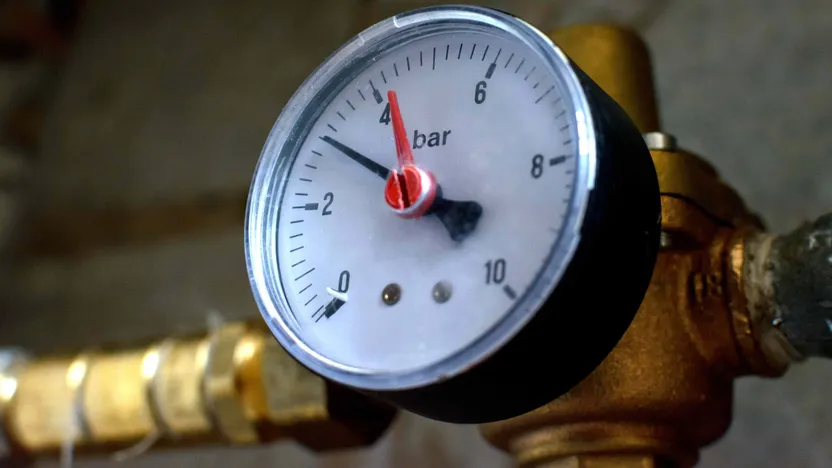
Pressure gauges are very useful for reading and monitoring water pressure in real time - often displaying bars or PSI, 3 bars being a standarddistribution pressure;
Pressure limiters are also called pressureswitches. Most often used in industry, limiters deviate overflow pressure to a third-party circuit or a tank - away from the pump etc.;
Meter regulators are used when the water pressure is too high, to reduce the pressure to a normal operating value (the regulators are adjustable). It differs from the pressure reducer in that the meter regulator, by design, is less sensitive to changes in inlet pressure and delivers a more constant operating pressure.
Pressure regulators
Water pressure: what is a pressure reducer?
Sometimes the distributed water pressure is just too high to be used. You cannot ingore the risk of the pressure is being too high! Leaks, breakages and damaged appliances can easily occur!
To prevent this, you can lower the water pressure, starting at the water meter's outlet. The simplest way is to set up a pressure reducer.
Characteristics of a pressure reducer
A pressure reducer is installed at the meter's outlet and ideally comes after a shut-off valve, if your installation is equipped as such. To connect it, depending on your installation, you can opt for a male-to-male, male-to-female or female-to-female pressure reducer. For a home network, the fitting size is 3/4", or 20x27 using the metric system. As a result, the pressure reducer can be mounted directly on both a meter or a valve.
The large majority of pressure reducers are factory preset with an output pressure set at3 bars. For better control (since some reducers are adjustable), you can set up a pressure gauge to read the generatedpressure in real time.
Be careful not to mix up the reducer and the regulator! A pressure reducer is less efficient in terms of regulation if the incoming pressure fluctuates greatly.
Pressure gauge
Best sellers in this category
Water pressure: booster pump and accessories
If your biggest problem is not to lower the water pressure but the opposite, to increase it, you need the perfect tool: a pressure booster. This appliance consists of a membrane and its seal, a pressure limiter and one or more pressure gauges.
Membrane: inflated in an expansion tank, the membrane pressurizes the water throughout the network.
Membrane seal: A metal part used to seal the membrane/tank connection.
Pressure limiter or pressure switch : detects set pressure points, protects pipes and the general installation against high pressures, as well as triggering or activating the pressure booster's operation.
Pressure gauge : reading the pressure level in real time.
Shop our pressure vessels
Water pressure: what is a pressure gauge?
A pressure gauge is crucial for getting real time data on your network's water pressure of a network. This measuring device is delimited in bars (metric system) or in PSI (Anglo-Saxon system).
A tapping connection is used to attach it on the water pipe. It can also be installed directly on any element (such as a reducer or pressure regulator) provided that it has a specific mounting system to accommodate it.
The most useful information to obtain in relation to water pressure is the pressure being received by the water meter, basically the same pressure that will be distributed in the house, building, workshop etc. Placing the pressure gauge right after the meter is the ideal configuration.
In order to check the pressure regulator or reducer's proper operation, the best configuration is to have a pressure gauge before and after the pressure reducer or pressure booster.
If you need to adjust your regulator or reducer, remember that it should always be set in dynamic pressure, as opposed to static pressure. You must therefore adjust your mainframe network (like a large open tap).
Important to know, and should help you in the initial configuration, always remember that 3 to 3.5 bars or pressure is ideal. If your pressure gauge is delimited in PSI, this corresponds to a pressure of 43.5 to 51 PSI (1 bar = 14.50 PSI).
Water meter
Water pressure: what is a pressure limiter?
Pressure limiters (or pressure switches) are mainly used in industrial installations.
The pressure limiter is used to protect appliances and pipelines as well as users from abnormal overpressurization.
It is often used at the pump outlet, at the network's start and wherever there may be an unexpected rise in pressure throughout the network.
Depending on its technology, the excess pressure can be redirected to a tank (if installed at the pump outlet), or eliminated by a valve (open air). In some cases, the excess pressure can also supply a third-party network.
The pressure limiter can be equipped with an adjustablepressuregauge: when the pressure in a grid drops below 3 bars, the pump activates, and as soon as the pressure rises to 4 bars, it will cease operation.
Pressure limiter
Water Pressure: What is a meter regulator?
The meter regulator is reality another type pressure reducer. However, due to its design (often with spring and membrame) it is much less sensitive to incoming pressure fluctuations, and therefore produces a more stable operating pressure.
Characteristics
The meter regulator is installed at the meter outlet - ideally after a shut-off valve if your installation is equipped with it.
To connect it, depending on your installation, you can opt for a male-to-male, male-to-female or female-to-female reducer. Domestic installation will generally use the fitting size of 3/4 inches, or 20x27 in metric. The regulator can therefore be installed directly after the meter or valve's outlet.
The pressure regulators are generally preset at the factory with an output pressure set at 3 bar. For better control, you can add a pressure gauge to provide the pressure data in real time.
To accurately set your regulator, remember that this type of appliance must be calibrated in dynamic pressure (ie when the water network is open downstream), so a large, open tap should do the trick.
Shut-off valve
More information
To further your understanding and discover everything there is to know about pumps, valves and water connections, follow the links below for accessories, advice from our editors and more helpful guides:
How to choose your water shut-off valve?
How to connect a PVC hose to your installation?
How to choose your thermodynamic water heater?
How to connect your electric water heater?
How to choose your solar water heater?
How to choose your gas water heater?
How to choose your thermodynamic water heater?
You may be also interested in these guides
Guide written by:
Jérôme, Construction site supervisor, Cardiff
Electrician by trade, I first worked in industrial estates where I installed, wired and fixed a large number of electrical installations. After this, I managed a team of electricians for this type of work. 10 years or so ago, I turned to building and construction. From the modest family home, to gyms and theatres, I have been able to coordinate, audit and organise all sorts of construction sites. For 4 years now, I am restoring and building an extension to a bungalow in the heart of the Welsh countryside. My experience in manual work and my knowledge means I am proud to be of service. Terraces, interior design, roofing, plumbing, electrics, anything goes! My wife, daughter and I, built almost everything we have from scratch! So to answer all of your questions and advise you on choosing your tools? Easy!
'/%3E%3C/svg%3E)