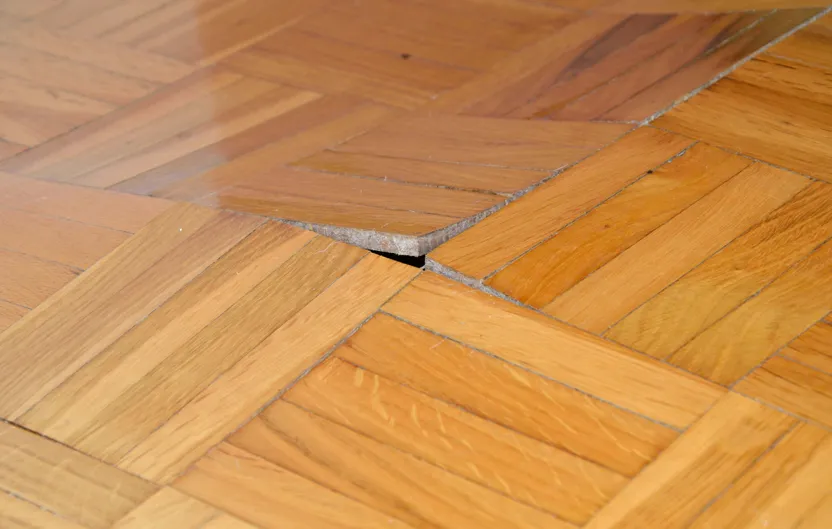
How to fix buckled wood flooring
'/%3E%3C/svg%3E)
Guide written on 25 September 2026 by:
Kate, Flooring Expert, Swansea
Important features
- Causes of wood floors buckling
- Repairing wood flooring
Best sellers in this category
Causes of wood floors buckling
Moisture is the enemy of wood flooring; it makes no difference whether it's a floating floor or a glue down floor! We often think of moisture as being on the floor, but the worst of it is underneath! 85% of buckled wood floor issues are caused by moisture in the subfloor. There are different sources and types of moisture. It's not always easy to find the cause in order to solve the problem!
Residual moisture
Residual moisture is a problem that can manifest shortly after laying a new wood floor (around 2 weeks), after screeding. In fact, screeding is often a necessary stage in properly preparing a sublfoor before laying the wood floor. You must always take into account the drying time, which can vary depending on the condition of the building: lack of air flow, not enough or no heating, etc.
It can also occur some time after laying the floor.
For example, in June, when the weather is good, you lay your floating wood floor on a subfloor that seems in decent condition. When you first turn the heating on in October, the heat will draw the residual moisture from the subfloor out of the wood floor, causing it to warp.
If the subfloor is tested in advance with the correct hygrometer, the problem can be detected before installing the floor. The subfloor must be tested by professional floor layers, who are equipped with these types of tools. The moisture content in the subfloor should not exceed 3%. If it does? The only solution is to wait before installing.
If you're in a hurry, your floor will buckle!
If residual moisture is the issue, there will be a lot of water, but it won't come back. Unfortunately your wood floor will still be somewhat buckled.
Moisture in the subfloor
Following the same principal as residual moisture, moisture in the subfloor is not restricted to new-builds. There can be dampness coming from a cellar, for example, and not affecting any other surface.
Remember: on a new traditional style subfloor made of concrete, you must allow at least 1 mm per day of drying time. So if you have a 10 cm deep subfloor, you would have to wait at least 100 days, unless you accelerated the drying process. However, you still must test the subfloor with a hygrometer; it is vital to check.
The floating wood floor will expand due to the moisture present in the subfloor and will end up distorting.
You don't need a miracle to avoid this! The subfloor must be checked before laying the floor. And the moisture content must be less than 3%. If it's not, the floor should not be installed.
Alternatively, you must treat the subfloor to stop this moisture from persisting. There are solutions, but they involve treating the base of the subfloor.
Warning: the necessary underlay used with floating wood floors usually has a vapour barrier. This is not enough to contain the moisture. Treatment for the moisture must be done in advance, BEFORE installing the wood floor.
Water damage
Moisture (again!), this time above your floating wood floor. In the case of water damage, often due to stagnant water that has been sitting for a while, the wood floor becomes saturated.
It won't appear distorted to the naked eye until it begins to dry.
The less water there is, the less obvious it is.
You should allow it to dry as much as possible and wait a little to observe the damage of the distortion.
Replacing some planks may be enough if the distortion has not affected the entire floor.
Moisture / dryness in the air
Unlike the two examples discussed previously, moisture or dryness in the air can both lead to the distorting of a wood floor.
This can happen with a floating wood floor, which is more stable than hardwood, but that would be due to extreme air conditions.
Air that has too high a moisture content, can lead to the buckling of a wood floor. It is mainly air that is too dry (less than 30% moisture), central heating and air conditioning that can upset the balance of your wood floor.
Once the problem has been identified, all you need to do is humidify or dehumidify the air so that the wood can return to its original shape. This is possible unless the wood has warped too much.
Note that the level of humidity in the air for the laying of wood flooring must be between 45 and 65%.
Inadequate expansion gap
This is the second major cause of the bucking of floating wood floors. The floor should not touch ANYTHING on the perimeter, it must be able to expand naturally within the allotted space. This space must be a minimum of 8 mm, as a rule.
This space should be left around the door frames, the whole way around the edge of the room, around all heating pipes, at the joins of floor surfaces; in other words, wherever there is an obstruction!
Not leaving this space, or leaving less than 8 mm, is a serious mistake in floor installation. The floor will therefore push against the obstructions, not have anywhere to go and will start to buckle. It only takes contact in one place for the entire floor to distort. It will feel as though you are walking on a trampoline!
Repairing wood flooring
Fixing a warped floating wood floor is completely possible but would entail undergoing new work. Once the problem has been identified and treated, you will be able to fix it and make it almost as good as new. It is not necessary to replace everything; engineered wood flooring is fixable, which is one its major advantages.
Light sanding
If the warping is not very serious, you can start by lightly sanding to eliminate the light buckling. After this, you will obviously need to refinish the floor, which will be difficult if your wood floor is varnished.
Sanding
When the warping is serious, a more vigorous sanding technique may be necessary.
If you've opted for a wood floor with chamfers, they will disappear with vigorous sanding. You will take off around 1, even 2 mm of wood, which is the depth of a chamfer.
Once the effects of buckling have been eliminated, you will now need to re-varnish or re-oil your floor in order protect it. You could also apply a wood stain, if you would prefer.
Distortion around the edges
Where the buckling has been caused by a lack of space in the expansion gap, you can just loosen the floor planks around the outside where the obstruction is and it will return to its original shape.
You now need to draw out the planks so that the necessary 8 mm space is there again.
The quicker you can do this, the less the potential damage to the wood floor.
Complete removal
If the buckling of the floor is too serious, it is likely that you will have to take up the entire floor. Unfortunately, a complete removal will be necessary.
Important advice
The buckling of wood floors is completely avoidable. If your wood floor is laid to the letter, you won't have a problem. Testing the subfloor is crucial. If you are getting your floor laid by a professional, think about asking them to show you proof that it has been thoroughly tested before starting.
Shop our safety and workwear
Best sellers in this category
You may be also interested in these guides
Guide written by:
Kate, Flooring Expert, Swansea
Flooring is my life. I love what I do, and I've been doing it for as long as I can remember. So, I'm not bragging when I tell you I know all there is to know about every flooring product. From laminate, parquet and linoleum to PVC, carpeting and tiling, my workdays are spent learning about manufacturing processes, composition, performance, laying techniques and maintenance methods. I've certainly seen my share of mistakes made on construction sites because of what was essentially a lack of information or understanding of the product. Flooring elements are constantly evolving and being improved upon - even us pros can find it hard to keep up! Some of us in the industry use language that is overly technical or loaded with jargon you'd have to be an expert to understand. What's more, flooring salespeople are often so focused on closing the sale that they don't take the time to explain the products in any detail. That's why I want to pass on my knowledge in a way that's clear and accessible, and maybe a bit fun too. Because flooring shouldn't be a chore!
'/%3E%3C/svg%3E)