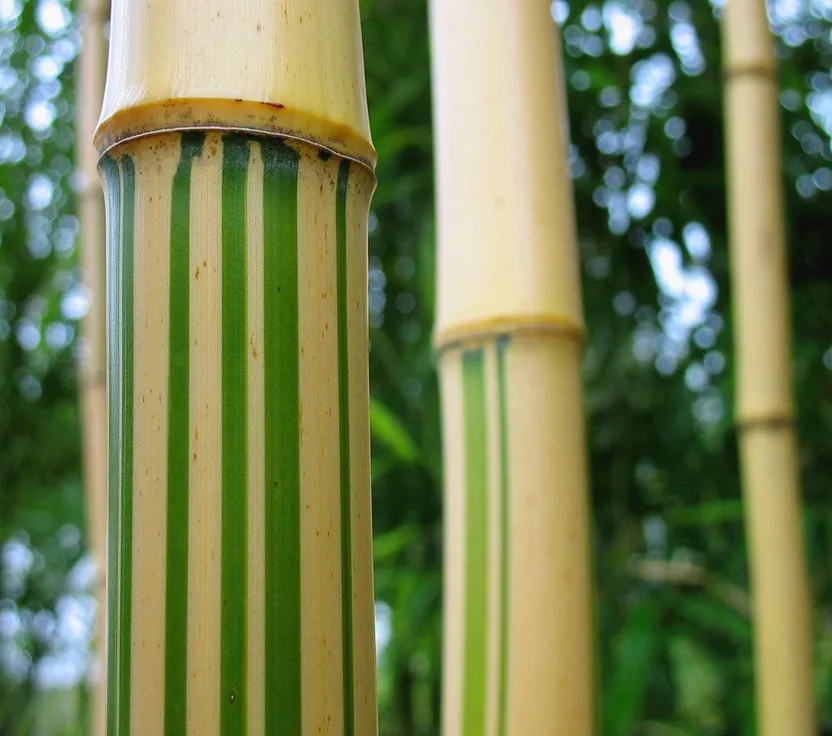
How to grow bamboo
'/%3E%3C/svg%3E)
Guide written on 6 February 2024 by:
John, Passionate gardener, Cambridge
Important features
- Growing method
- Varieties
- Care needs
- Treating bamboo
Best sellers in this category
Main characteristics of bamboo
Common name: bamboo.
Latin names: Phyllostachys, Fargesia, Semiarundinaria, Sasa, and so on (various species).
Plant type: woody perennial evergreen.
In the ground, in outdoor pots.
Height: 20 cm to over 10 metres.
Flowering: rarely or very little.
Soil / substrate: rich, loose and cool.
Temperature: cold-hardy, can cope with temperatures down to - 20 °C.
Sun exposure: sun, semi-shade.
Running bamboo and clumping bamboo
Bamboo can be split into two broad categories. Running bamboo has long and thin rhizomes that produce a large number of new shoots. This type of bamboo is very invasive and all the more so when the soil is poor and dry as the rhizomes will travel further in search of water and nutrients to feed off.
Paradoxically, the bamboo will be less invasive in rich, well-watered soil. Running bamboo propagates very quickly through its rhizomes. This makes it the ideal choice for hedges or privacy screens which will grow in no time at all, whether you choose to plant in the ground or in a large container or planter.
Clumping bamboo, on the other hand, has short rhizomes which are thick and dense. This makes it non-invasive and ideal for small gardens or in planters (Fargesia variety, for example). The growth of this type of bamboo can be kept under control by annual trimming.
Bamboo can also be categorised by height: the smallest dwarf varieties (such as Pleioblastus) will only reach about 10 cm while the largest can stretch to over 10 metres (such as Phyllostachys).
Planters
Best sellers in this category
Planting bamboo
Planting in the ground
While bamboo does prefer regions with mild winters, it can be planted in any type of climate. Bamboo is a cold-hardy plant able to cope with cool conditions. Some varieties are able to withstand temperatures as low as -20 °C despite having evergreen foliage (meaning the leaves won't fall off in winter). That said, bamboo will not be able to cope with intense frost when paired with windy conditions.
The soil must be fertile, rich in humus and supplied with a good amount of moisture all year round. While bamboo won't have any issue growing in lime-rich soil, it does prefer a slightly acidic soil. For clay-heavy soil, be sure to add some compost or fertiliser. A semi-shaded position will suit these plants very well.
Bamboo should ideally be planted at the end of summer or over the course of autumn while the earth is still warm. However, if you buy bamboo in a pot, you can put them in place any time of year (making sure to avoid any particularly cold spells in winter).
To keep on top of propagation and to avoid your bamboo getting too dense, you will need to install a rhizome barrier when you plant. Supplied as rolls of plastic film, rhizome barriers are positioned vertically in the soil to stop the rhizomes from spreading and taking over your entire garden.
These barriers can come in a range of designs. Bamboo is an essential part of any Zen garden. It is possible to plant a few different types of bamboo for a variety of leaf colours and shapes. You can even combine bamboo species of different heights to create a graduated effect.
How to plant a bamboo hedge
Choose a variety that will form a dense screen and bear in mind that the bamboo will stay green all year long! Phyllostachys bamboo features among the most commonly planted varieties. This type of bamboo requires little care and can climb up to 10 metres in height. That said, it does cope well with trimming if you want to keep your bamboo at a more modest height. The big drawback of this type of bamboo is that is is a running variety. You will therefore have to set up a rhizome barrier to limit the spread of bamboo.
Turn the soil over thoroughly, removing grass and stones. Dig a trench measuring around 70 cm in depth and width. At this point, you can install your rhizome barrier. Plant small bamboo varieties around 30 to 40 cm apart. Leave up to 2 metres between plants you expect to grow to be quite large. Medium-sized varieties should be spaced around 80 cm to 1 metre apart.
Before filling in your hole, mix the earth with some compost and add some roasted horn fertiliser. Pack down the earth well around the bamboo to stop the soil from blowing away. Don't forget to water well and keep watering throughout the first summer; bamboo loves water!
Growing in a container
As bamboo can also be grown in a container or planter it is commonly found on balconies and decks. The container must measure at least 50 cm in length and depth. Fill your container with a mixture of high-quality garden soil and fertiliser in equal parts.
Pick a variety that won't grow to over 4 metres, such as Fargesia. It is still possible to grow an attractive hedge with these smaller varieties for an original alternative to a trellis or another type of screen.
Planters
Bamboo care
Bamboo does not require any care once it is well-established. However, during the first year of planting, you will have to water your bamboo regularly and copiously. After the first year, only water during periods of drought.
Bamboo in containers or planters will need to be watered 2 to 3 times a week except during winter when it will only need watered once a month. Mulch the soil around the base of the bamboo over the summer to keep moisture in the soil.
Bamboo growing in the ground doesn't require a lot of compost or manure; sprinkle a little in September and add a little lawn fertiliser at the start of spring. Bamboo in pots should be given a bit of lawn fertiliser in spring and in autumn.
You will have to repot your bamboo once the plant becomes root-bound. Use a larger pot to replant the bamboo or one of the same size if you are dividing the plant into two pots.
Bamboo requires only basic pruning. Remove any dry stems by cutting them down to the ground. If your bamboo has become too dense, cut down some stems in order to thin out your bamboo growth and draw more attention to the colour of the leaves.
If you have grown a hedge, the tops of the bamboo can be trimmed down once the growth period is over. Once cut, the stems can be used as stakes.
Disease and pest control
Bamboo is very resistant to disease. If the leaves dry out, trim back any damaged parts at the start of spring. New shoots should emerge where you cut old growth. Yellowing leaves usually indicates a watering issue: you're either watering too much or too little.
Bamboo can sometimes fall victim to aphids, red spider mites or mealybugs. To deal with mealybugs, clean the stems with a little cloth or cotton bud soaked in a water and alcohol solution. If the problem is serious, you may need to remove the affected stems.
Red spider mites suck on the leaf sap of leaves that will turn yellow and fall from the plant. Spray these leaves with water; spider mites hate water! To deal with aphids, spray a black soap solution (made up of 2 tablespoons of soap per litre of water) onto the bamboo and repeat after a week.
You can also harness the power of nature to deal with aphids by releasing the larvae of specific predators such as ladybirds!
You may be also interested in these guides
Guide written by:
John, Passionate gardener, Cambridge
When I was young, I was already working in the family garden. Perhaps that is where my interest in plants and gardening came from. So, it was logical for me to study plant biology. At the request of various publishers I have, over twenty-five years, written many books on the subject of plants and mushrooms (a subject that is close to my heart). They were mostly identification guides at first, but shortly after they were about gardening, thus renewing the first passion of my childhood. I have also regularly collaborated with several magazines specialising in the field of gardening or more generally in nature. There is no gardener without a garden, I have cultivated mine in a small corner of Cambridge for the last thirty years and this is where I put into practice the methods of cultivation that will I advise you in as well.
'/%3E%3C/svg%3E)