How to lay a sheet vinyl floor in the bathroom
'/%3E%3C/svg%3E)
Guide written on 6 February 2024 by:
Kate, Flooring Expert, Swansea
Important features
- Take measurements
- Prepare the surface
- Lay the vinyl sheet floor
Best sellers in this category
What's the difference between vinyl and lino?
Be careful you don't fall into the common trap of mixing up vinyl and linoleum.
Linoleum, or lino for short, is a type of natural flooring and is actually very different to vinyl flooring. Lino is made up of a jute backing with a coating made of linseed oil, cork, wood flour and natural resins.
About 99% of the time when you hear of 'lino', the product in question is actually vinyl flooring. So, just to be clear, this tutorial refers to vinyl flooring!
Steps
Take measurements
Prepare the surface for the vinyl floor
Lay the vinyl floor
Flooring
1. Take measurements
Pick a vinyl floor that more or less matches the widest part of your bathroom and you'll avoid having to make complicated and messy cuts.
On the other hand, if the flooring you've chosen is much too wide, trim it down but make sure to leave some overlap on each side.
Ensure the floor overlaps by about 10 cm to be on the safe side and take all your measurements in place on the ground to avoid any surprises down the line when you realise your room isn't square!
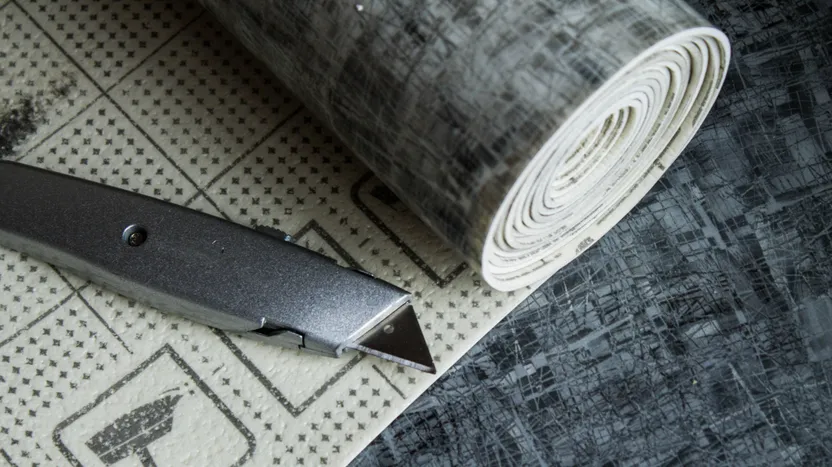
Cut the vinyl sheet using a utility knife on a flat surface to avoid marking the material.
Best sellers in this category
2. Prepare the surface for the vinyl floor
Just like when laying any other type of flooring, the first step here will be to prepare your surface. In no circumstances should you skip this step! Issues can often be traced back to a poorly prepared surface and once your floor is in place it's too late to do anything – you simply have to remove the vinyl and start again.
The surface must be dry, clean, flat and in good condition, which is generally the case for laying any type of flooring.
The most important factor to check when laying a vinyl sheet floor is that the surface is level. The level tolerance for vinyl is about 7 mm per 2 metres.
If you have a bumpy or uneven surface, these imperfections will show up within about two weeks of the floor being in place. Vinyl flooring is relatively thin meaning it will mould itself to any flaws in the surface.
For example, if you lay a vinyl floor over tiles (with grout lines of about 4 or 5 mm) you are sure to see the hollows through the vinyl and a floor with lines running through it won't be a great look!
If your surface isn't flat, you'll have to use a self levelling compound to even it out.
Even if you are laying the floor in a room that contains moisture, the surface must be absolutely dry before you start work. The humidity level of the surface mustn't exceed 4.5%.
The surface must be perfectly clean and dust-free.
Once your surface is ready, store the vinyl sheet floor in the bathroom the night before you plan to lay it. If this isn't possible, you'll need to store the flooring in a nearby room with similar temperature and humidity levels.
Be careful not to fold the vinyl floor, even for just a day. The vinyl will get marked right away and you won't be able to get it back to how it was.
3. Lay the vinyl sheet floor
Once the surface is prepared and cleaned, all that's left to do is to lay the vinyl sheet floor. The process should be fairly quick and easy.
Place your vinyl strip over the ground leaving a minimum of 5 cm of overlapping material around the perimeter of the room.
Mark the corners of the room using the back of a utility knife or a metal straight edge or even a vinyl smoother – the most important thing is to ensure the vinyl is marked clearly.
You can then cut along the length of the fold using a vinyl cutter. This tool is not strictly necessary but it is really handy for laying any type of flexible flooring. If you don't have a vinyl cutter, a very high-quality utility knife will do.
Remove half of the vinyl floor taking care not to fold it and apply double-sided vinyl floor tape around the perimeter of the room and every 50 cm across the room.
Lay the vinyl floor over the tape and smooth it out working from the centre of the room outwards in order to get rid of air bubbles and to ensure the floor is adhered properly.
The final step will be to install skirting boards or scotia beading around the room.
Adhesive tape
How to choose the right vinyl sheet flooring
Most vinyl sheet flooring is suitable for bathroom use as it is designed to be moisture-resistant.
Be sure to pick a floor that is wear- and impact-resistant as well as non-slip.
Working around sanitary ware
Unless your sanitary appliances are wall-mounted or straight, you will have to make round cuts around your basin pedestal, toilet bowl, bathtub or shower enclosure.
To transfer these shapes to the vinyl floor, you'll have to make a template using cardboard. Proceed as follows:
Start by making a rough cut to get the cardboard close the rounded shape you need to replicate.
Use a straight edge or skirting board offcut to mark out the contour (like a marking gauge) on the cardboard working in small sections.
Lay the cardboard over the vinyl floor and trace around it.
Toilets
How to lay a sheet vinyl floor in the bathroom
Required skills
Using double-sided vinyl tape is just about the easiest way to lay a vinyl floor. There's nothing too complicated about it but you do need to be meticulous and follow a few basic rules. Space is generally tight in the bathroom and you will probably have to make a lot of cuts. The only skills you'll need include knowing how to use a utility knife, taking measurements and being able to work on the floor.
Time required
Approx. 4 hours for 10 m²
Number of people required
1 person
Tools and equipment
Vinyl cutter
Vinyl flooring
Safety wear
Protective clothing
Please note: this is a non-exhaustive list; be sure to match your personal protective equipment to the job at hand.
Utility knives
You may be also interested in these guides
Guide written by:
Kate, Flooring Expert, Swansea
Flooring is my life. I love what I do, and I've been doing it for as long as I can remember. So, I'm not bragging when I tell you I know all there is to know about every flooring product. From laminate, parquet and linoleum to PVC, carpeting and tiling, my workdays are spent learning about manufacturing processes, composition, performance, laying techniques and maintenance methods. I've certainly seen my share of mistakes made on construction sites because of what was essentially a lack of information or understanding of the product. Flooring elements are constantly evolving and being improved upon - even us pros can find it hard to keep up! Some of us in the industry use language that is overly technical or loaded with jargon you'd have to be an expert to understand. What's more, flooring salespeople are often so focused on closing the sale that they don't take the time to explain the products in any detail. That's why I want to pass on my knowledge in a way that's clear and accessible, and maybe a bit fun too. Because flooring shouldn't be a chore!
'/%3E%3C/svg%3E)