Mortiser buying guide
'/%3E%3C/svg%3E)
Guide written on 6 February 2024 by:
Alizée, Furniture Maker
Important features
- Mortise bits
- Square chisel bits
- Chain mortisers
Best sellers in this category
What is a mortiser?
Mortiser
A mortiser is a woodworking machine designed to cut mortises. Mortises are round or rectangular holes used to make joints in wood with a corresponding tenon.
Mortise bit
Mortising bits look like flat wood drill bits without the point at the end. These bits are used to cut round mortises.
Square chisel bit
A square chisel bit is made up of two parts: the outer square-shaped hollow chisel (which is usually made of steel) and the centre drill bit. These bits are used to create square mortises.
Tenon and mortise joint
In woodworking, the tenon is the 'male' part that is designed to fit securely inside the mortise.
How to choose a mortiser
When choosing a mortiser, you'll have to think about how often you plan to use the machine and the size of the mortises you need to cut.
Mortises measuring 6 to 16 mm
If you only plan on using your mortiser occasionally for small to medium-sized mortises (6 mm to 16 mm, typically), a basic mortise or square chisel bit will do the trick. These bits can be used on a benchtop mortiser but can also be fitted to a drill press, which will save you the cost of buying a new machine.
Mortises measuring 16 to 20 mm
For medium-sized mortises (up to 20 mm in diameter), you can once again choose between a mortise or square chisel bit.
Mortises measuring 20 mm+
If you plan to cut mortises on a larger scale or on a more regular basis, go for a chain mortiser.
Chain mortisers
Best sellers in this category
Why and when to use a mortise bit
Got a few holes to cut for tenon and mortise furniture joints? If you have a drill press, it couldn't be easier: simply choose the right mortise bit for the size of the hole you want to cut (standard sizes tend to range from 6 to 16 mm), attach it to your drill and cut back and forth as much as required to cut your mortise.
These bits may be twisted (which helps to clear chips) or straight (stronger) or double-fluted. It's worth noting that bits with two cutting edges are able to turn in both directions: always make sure you're cutting in the right direction! The disadvantage of this type of bit is that the edges of the mortise are rounded. These drill bits can be installed on a mortising machine (which may be portable or free-standing) or a drill press.
Shop our pillar drills
Horizontal mortising machine
A horizontal (or slot) mortiser is equipped with depth stops and levers used to adjust the cutting height and depth. You simply insert the piece of wood and the machine takes care of the rest.
You will have to finish the edges of the mortise by hand using a wood chisel. Alternatively, you can round your tenons. This type of mortiser may be independent or integrated into a multi-purpose woodworking machine. Your mortises will, however, be limited to 20 mm in diameter.
Square chisel mortiser
Square chisel mortisers come in two basic types: professionally operated free-standing machines that require two people to move and bench-mounted models. A benchtop mortiser may weigh 20 to 40 kg.
These mortisers are used to cut square mortises measuring 6 to 20 mm on each side.
The drill bit is made up of two elements: the outer square-shaped part (which is usually made of steel) and a centre drill bit.
Equipped with depth stops and clamps to hold the workpiece, these mortisers work vertically like a drill press. Your mortises will be cut in several stages, depending on the size you want.
The main advantage of these machines is that the edges and base of the mortises produced will be very straight.
Chain mortiser
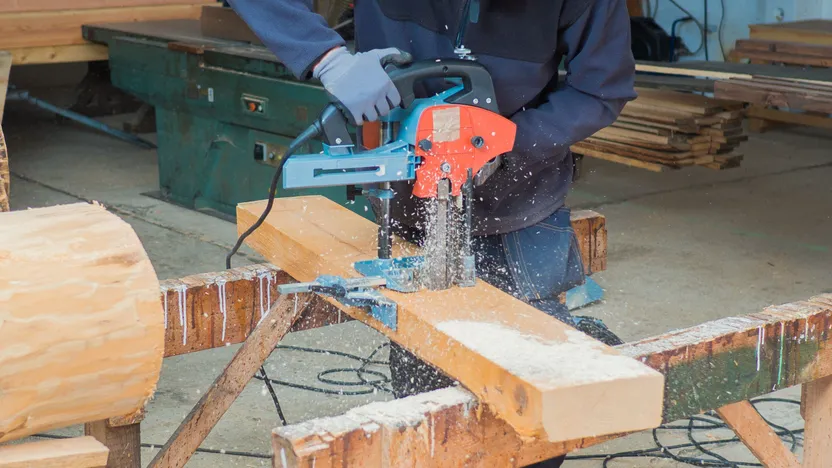
Designed for larger scale projects than a horizontal or square chisel mortising machine can handle, chain mortisers offer excellent performance. They are equipped with a guide and chain (a little like a chainsaw), and use cutters to create wide slots in wood.
Chain mortisers are generally equipped with a side fence to hold the workpiece in place.
These machines are both powerful and portable. Averaging around 15 kg in weight, they are particularly popular among carpenters who tend to work on job sites. Chain mortisers make quick work of mortises and offer a high degree of precision. The minimum width of the mortise will depend on the size of the chain and the bottom of the mortise will be semi-circular in shape.
Chain mortisers
3 tips for choosing the right mortiser
Remember:
If you have four small mortises to cut at home, a drill press equipped with a mortising bit will do the job just fine. It is also possible to find mortising attachments to turn your drill press into a mortising machine.
If you plan on woodworking on a regular basis in the workshop, go for a square chisel mortiser. Choose between a smaller benchtop model and a larger free-standing model, depending on your needs and the amount of space you have.
If you have a lot of mortises to cut into wood outdoors – for example on a job site or when dealing with large workpieces – go for a chain mortiser. These machines are ideal for working in all conditions.
Remember: you will have to clear the chips as you work and don't confuse your router with your mortiser! And finally, don't forget to wear ear defenders, safety goggles, a mask and a pair of gloves at all times.
You may be also interested in these guides
Guide written by:
Alizée, Furniture Maker
I have been crafty since my childhood, I have always been fond of new tools and other small practical machines. Beyond my interest in tools and materials, I am interested in building of all types. My professional experience as an artisan craftswoman, allows me to work with a material that’s both noble and common at the same time: wood. Surrounded by carpenters and other builders, I am constantly interacting with professional and amateur wood workers, but also various kinds of manufacturing. I am also an amateur gardener, I like to cultivate my vegetable garden. You could say that summer ends under the sign of ratatouille. So, with two passions, I hope to answer your questions.
'/%3E%3C/svg%3E)