Pool chlorine buying guide
'/%3E%3C/svg%3E)
Guide written on 6 February 2024 by:
Christelle, Micro-entrepreneur in the gardening sector
Important features
- Chlorine tablets
- Chlorine granules
- Chlorine sticks
- Liquid or gas chlorine
- Stabilised or unstabilised
- Multi-action chlorine
Best sellers in this category
How to choose pool chlorine
Chlorine is a chemical element known as a halogen. Upon contact with the water in your pool, it breaks down into many different chemicals to eliminate bacteria, viruses, fungi and microorganisms. A popular and effective disinfectant, chlorine is also the least expensive pool sanitiser on the market and comes in a number of different forms and types.
Your choice of chlorine will depend on the size of your pool and your needs. Tablets are generally the most common way to disinfect pools. They work slowly and need to be added to your pool on a regular basis. Granules can be used as a shock treatment to bring up the chlorine levels in your pool quickly and efficiently.
Chlorine sticks are generally unstabilised (meaning they haven't had cyanuric acid added to them) and come with their own set of pros and cons. Finally, chlorine can be purchased in liquid or gas form. However, these options are usually only used in public pools.
You'll have to choose between stabilised and unstabilised chlorine. Unstabilised chlorine will break down quickly whereas stabilised chlorine is designed to disinfect over a longer period of time.
Multi-action chlorine combines the action of several different products in one tablet.
Chlorine formats
Chlorine comes in various forms and it's important to pick the right type for the size of your pool and what you use it for.
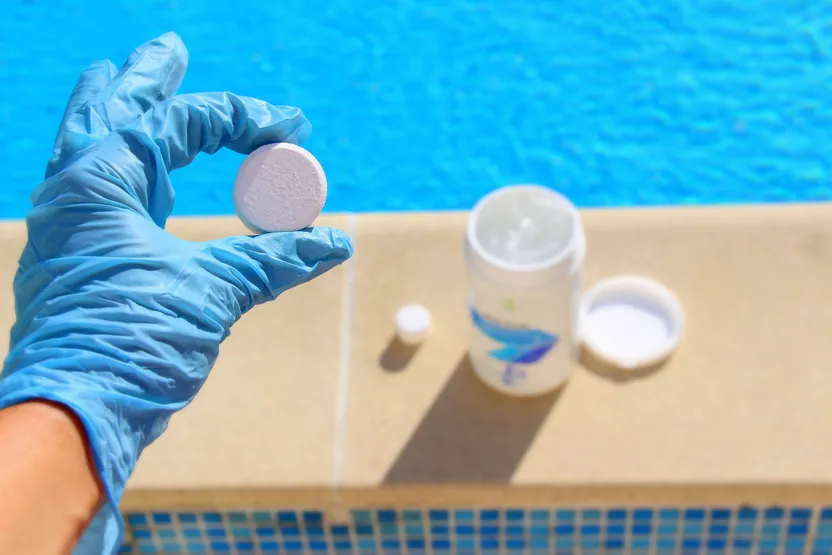
Chlorine tablets
This is the most popular choice for private pools. Chlorine tablets can be placed directly in the skimmer or in a floating dispenser, and are designed to break down slowly in the water to disinfect your pool for several days at a time.
Chlorine tablets also come in different sizes from those designed for small above ground pools to 500 g tablets for large pools. As a reference point, a 200 g tablet should be able to disinfect a pool with a volume of 25 m3.
Be careful not to confuse standard chlorine tablets with shock treatments as these products work in very different ways.
Chlorine granules
Also known as shock chlorine granules, this option is designed to be diluted in water and poured directly into the pool water where it will get to work very quickly. This type of shock treatment is used in above ground and in ground pools after the winter to treat water that has been affected by issue such as algae.
Shock chlorine can also come in tablet form.
Chlorine sticks
Chlorine sticks are made of unstabilised chlorine and are designed to be placed in the skimmer or in a floating dispenser. They are designed to break down slowly in your pool water.
Liquid chlorine
This type of product is designed to be placed directly into a chlorine regulator or dosing pump to be added gradually to the water. Liquid chlorine is most commonly used to sanitise public pools and is not usually used in private pools as it is complicated to dose accurately.
Chlorine gas
Chlorine gas gets to work quickly but is used almost exclusively by public pools.
Shop our swimming pool chlorin
Best sellers in this category
Stabilised chlorine vs. unstabilised chlorine
You will also have to choose between stabilised chlorine and unstabilised chlorine.
Stabilised chlorine
Stabilised chlorine has had cyanuric acid added to it. This acid works as a stabiliser to prolong the disinfecting power of the chlorine. This is the most popular sanitiser for private pools.
Unfortunately, unlike chlorine, stabilisers don't dissolve and will eventually build up in the pool, saturating the water and rendering the chlorine completely ineffective. To avoid this inconvenience, it is recommended to drain some of your pool water on a regular basis.
Unstabilised chlorine
Unstabilised chlorine does not contain a stabiliser. This type of chlorine breaks down quickly upon contact with UV rays and needs to be topped up frequently.
However, unlike stabilised chlorine, it won't have the effect of saturating your pool. It can also be used as a shock treatment to treat problems like green water. It is also possible to add a stabiliser to unstabilised chlorine to make it last longer. This way, you are able to add as much or as little stabiliser as you want. It is, however, not advisable to add unstabilised chlorine to hard water.
Sanitisers
Advantages of multi-action pool tablets
Multi-action, or multi-function, chlorine combines the action of several products in one. In addition to disinfecting the water, these tablets will work as a flocculant to improve pool filtration, an algaecide to remove algae, a limescale treatment to treat hard water and a stabiliser to protect the chlorine from UV rays. This type of chlorine usually comes in tablet form.
You may be also interested in these guides
Guide written by:
Christelle, Micro-entrepreneur in the gardening sector
From a background in waste transportation, I became a farmer specialising in organic gardening. A graduate of Horticultural Production, I tried for several years as a young farmer to settle in the beautiful region of Oxfordshire. After many disappointments, I finally started a small-business in home services, specifically in gardening, assisted by my loving, dear husband. Passionate about nature and wild edible plants, I am very attentive to ecological solutions and respectful of our environment in all aspects of my daily life. From the vegetable garden to the flower beds, from seed to harvest, I have all kinds of advice up my sleeve. Do not hesitate to ask me your questions.
'/%3E%3C/svg%3E)