Swimming pool test kit buying guide
'/%3E%3C/svg%3E)
Guide written on 6 February 2024 by:
Pauline, Self-taught DIYer, Leeds
Important features
- Manual
- Digital
- Parameters
- Solutions or tablets
Best sellers in this category
What is a swimming pool test kit?
Anyone who owns a pool needs to use a pool test kit. These kits are designed to monitor the quality of your swimming water. In turn, this allows you to use pool products more effectively to ensure your water stays clean and balanced.
Pool test kits allow you to check your water quality, measure the level of chlorine (or any other sanitiser you use), and ensure that the pH is at the right level to keep swimmers healthy and safe.
Some test kits go even further and will be able to analyse the total alkalinity and cyanuric acid levels of your pool. It's simply a case of deciding how vigilant you want to be about your pool water and what kind of parameters you are most interested in.
Here are the most commonly measured parameters:
sanitiser levels (chlorine, PHMB, bromine);
pH levels;
Total Alkalinity (TA);
Total Hardness (TH);
hydrogen peroxide;
pool stabiliser (helps chlorine to perform better);
water temperature.
Shop our swimming pool test kits
How often to test your pool water
With the exception of water temperature, you won't have to test every parameter on a daily basis.
Here's a rough guide on how often to analyse your water:
pH and sanitiser: once a week minimum (ideally every day)
TA and TH: once a month;
stabiliser level for chlorinated pools: twice per season.
It's important to check each parameter in the right order starting with the TH and pH levels of your pool.
Best sellers in this category
How to use manual test strips
Decided to use manual testing to monitor the quality of your pool water? Here's what you need to know. There are two types of manual pool water testing: pool water test kits and pool water test strips.
How do pool water test kits work?
Swimming pool water test kits can come with a range of accessories and may include all or some of the following:
phenol red solution to test pH;
orthotolidine, or OTO, solution to test free chlorine;
tablets to measure pH and chlorine levels;
a plastic pH and chlorine test tube with a graduated scale to measure results.
It's also possible to use 3-in-1 test vials to measure several parameters on one strip. Of course, you must always use a new strip every time you test the water.
How to test your pool water with a kit
If you've decided to use a kit to test your pool water, here are the six steps you'll have to follow.
Take some water from about 15 cm below the surface of your pool using the testing container.
Drop 4 to 5 drops of each product into the corresponding part of the container (i.e. phenol for pH and OTO for chlorine).
Close each bottle or test tube using the cap provided.
Shake the tubes to mix the water with the test solutions.
Wait for a few seconds.
Read the results.
Each test kit will come with its own set of instructions to refer to.
You should replace the testing solutions each year. It is advisable to dispose of used bottles responsibly at the end of each season as they cannot be used again the next year.
Please note: always keep pool test kits out of reach of children.
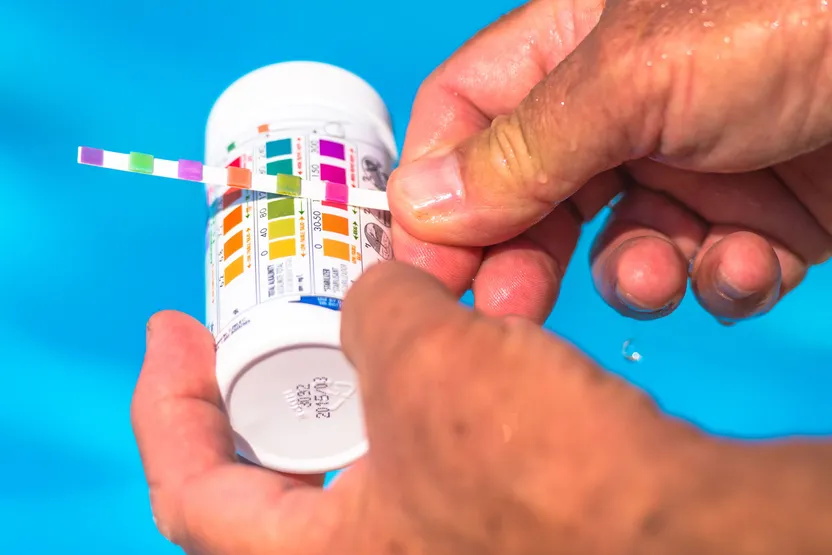
How to use pool water test strips
Pool water test strips can only be used once. Here are the steps to follow:
Remove the test strip from its packaging.
Dip the strip into the water around 15 cm from the surface.
Remove the strip and let it air dry.
Wait for the instructed time.
Compare the results to the colour chart provided.
For more reliable results, be sure to keep the strips in their original packaging in a cool and dry place, and to respect the use-by date on the box.
Digital pool testers
Digital pool testers are very accurate and don't leave any room for interpretation. You can choose to measure one parameter (such as chlorine levels) or to check several at a time. Some digital pool testers will offer more advanced features such as:
simultaneous readings of several parameters;
data memory;
auto turn-off.
These devices are equipped with a probe that works to analyse a sample of your pool water.
More advanced models can be connected to your phone to provide direct readings and analyses that can be registered on an app. The advantage of smart digital testers is that they will provide tips via notifications for optimal pool care.
Manual vs. digital pool testers
Everyone will have their own preference when it comes to choosing between a manual and digital pool water tester. If you want to feel like a chemist, manual test are for you! What's more, test kits or strips are really accessible in terms of price. If you're looking simplicity and 100% accurate results, it's best to go for a digital tester.
Here's a quick table to help you make the right choice.
Manual | Digital | |
Price | Inexpensive | A little more expensive to a lot more expensive (£100 to £400) |
Accuracy | Good | Very good |
Reliability of results | Involves some interpretation | 100% |
Results reading | Very easy Can be confusing | Easy |
Speed of results | A few seconds | Immediate |
Ease of use | Involves a few easy steps | Very easy |
A quick reminder of the key steps in monitoring your pool water:
take a pool water sample;
analyse the water using a manual or digital tester;
read and analyse the results;
deal with any issues.
If you have any doubts, don't hesitate to test the water again using the same method or use another method of testing the water. The product instructions will usually set out a concrete plan of action to help improve your pool water quality.
You may be also interested in these guides
Guide written by:
Pauline, Self-taught DIYer, Leeds
With a handyman-father, I grew up with the soft sound of the sander and hammer on weekends. I am both manual and cerebral, I learned the basics of DIY and the customisation of furniture because I was passionate. The salvage mentality is a true way of life that allowed me to know how to use all the tools and products needed to give something a second life, from a sander to varnish. I have two favourite activities: the transformation of old furniture and decoration tips. I am always ready to lend a helping hand to revamp a table or to restore a mirror that was intended for the tip that will become a friend’s centrepiece. I’m convinced that it’s possible to reinvent an interior by small, regular modifications and I constantly research low-cost ideas.
'/%3E%3C/svg%3E)