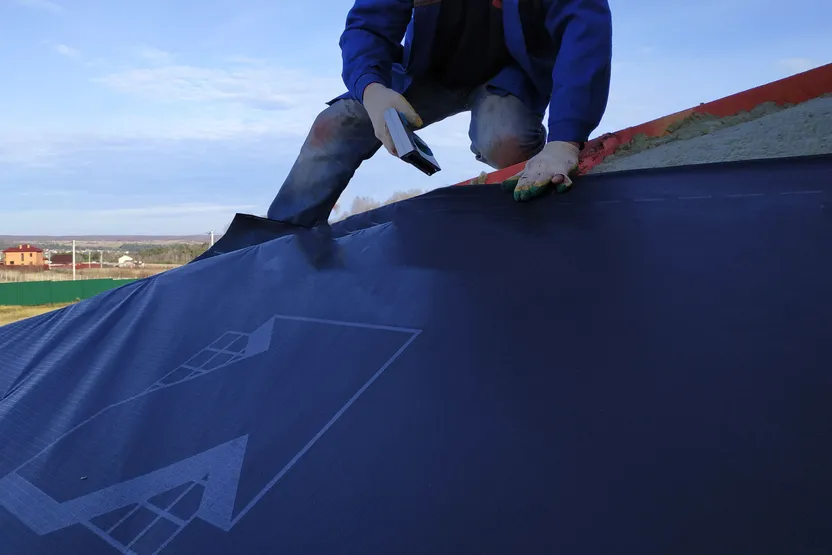
Roofing underlay and vapour barrier buying guide
'/%3E%3C/svg%3E)
Guide written on 6 February 2024 by:
Michael, Professional and passionate welder, Sheffield
Important features
- Membrane type
- Indoor climate
Best sellers in this category
Why install roofing underlay?
The roof of the home plays a crucial role in protecting and insulating the building from the outside which helps to improve its energy efficiency. With this in mind, a flexible membrane should be installed beneath the roof tiles or slates – i.e. on the cold side of the roof – to provide a secondary barrier against weather penetration that could otherwise damage the roof. Ideally, this material should also allow any water vapour produced in the home to escape. Otherwise, condensation will build up under the roof over time and damage your insulation.
The best practice is to ensure that there is a constant flow or air between the roof and the membrane used to protect it. Carefully positioned roof tile vents used alongside a correctly installed roof membrane will provide optimal ventilation and allow excess humidity to escape. You can opt to buy and fit the roofing underlay yourself or you can get someone to install it for you. Either way, let's start by having a look through the various options on offer.
Shop our roofing underlays
Breathable vs. non breathable roofing underlay
The British Standard BS 5534 (for slating and tiling) and BS 5250, (for condensation control) sets out two main categories of roofing underlays: high resistance and low resistance. High resistance underlays might also be referred to non-breathable underlays or non-vapour permeable underlays, which basically means that they do no allow water vapour to be carried out of the building. Low resistant underlays might be referred to as breathable or vapour-permeable membranes. These underlays are lighter than high resistance membranes and can be either vapour permeable or vapour and air permeable.
It's worth noting that a roofing membrane is designed to add an extra layer of protection and is not strictly 100% necessary. However, with weather conditions becoming increasingly unpredictable, installing a roofing underlay is highly recommended.
Shop our roofing underlays
Best sellers in this category
How to install a roofing underlay
Generally speaking, roofing underlay should be held in place by the tile battens. To prevent water ingress, each panel of underlay should overlap by:
150mm horizontally
and 100mm vertically.
It's also important to pay attention to the wind resistance of the material which will protect the material against tears. If you fail to do so, you may end up weakening the membrane which can lead to pockets of water building up beneath the roof.
Roofs must be impermeable to weather penetration which includes things like wind, rain and snow. If a roof tile or slate cracks, the roofing membrane must be able to send any incoming water towards the gutters. Roofing underlays must be installed in such a way as to direct water safely away from the roof to prevent water damage and mould growth.
Ideally, they should also be vapour permeable to prevent condensation build-up inside the home.
Shop our roofing underlays
Different types of roofing underlay
Roofing underlays can be made of various materials. The most common types include:
Bitumenous underlays
Synthentic underlays
Vapour permeable underlays
Bituminous underlays
Bituminous underlays are made up of fibres saturated with bitumen. They are designed to provide thermal insulation but are best used in areas that do not experience very hot summers. These underlays can be used for new builds or added to older buildings. Generally supplied in long rolls measuring 1 to 1.5 m in width, bituminous underlays can be wrapped lengthways across a roof. The mechanical properties of this material makes it better equipped to handle wind.
While this type of underlay is heavier than other options, its non-slip surface does make it easier to install. This type of underlay should be nailed to the tile battens. The most traditional option, bituminous underlays continue to be popular, but are not vapour permeable.
Synthetic underlays
These underlays are often made up of one or several lightweight layers of synthetic material. Polypropylene is most commonly used to make synthetic underlays. These membranes can be opaque or transparent and are often least expensive option. They are easy to install and can be vapour permeable or non vapour permeable..
If you choose a non vapour permeable membrane, it's important to leave a gap of at least two centimetres to allow for constant air flow and to allow water vapour to escape from the home.
Vapour permeable membranes
These days it is possible to find membranes that both allow water vapour to escape and protect your roof covering against water or snow infiltration.
Also known as breather membranes these layers reduce condensation and keep the cold out. Another benefit of this type of underlay is that it can be laid directly over insulation without any gap.
Reflective membranes
These specially designed membranes are vapour permeable and microperforated. The benefit of reflective membranes is that they offer more effective thermal insulation by retaining warmth in the winter and blocking heat in the summer.
Bear in mind that under no circumstances can a roofing underlay replace a high-quality roof covering. If installing a new roof, a roofing underlay cannot go for any longer than eight days before being covered by roof tiles or slates.
Tiles
Vapour barriers: protect your insulation
A vapour barrier should always be used where insulation is installed no matter where you live. There are many different types of vapour barrier and vapour control layer (VCL) which should be chosen to match the application at hand.
You can even carry out a moisture level test to define what kind of vapour barrier you need. For example, temperature variations in mountainous areas tend to create a lot of condensation.
Homes should be considered according to the level of moisture produced and their 'indoor climate.
Applications for vapour barriers
Building type |
Low humidity. e.g. garage or storage shed. |
Well insulated interior with low humidity e.g. Large office or shop space |
High humidity with inadequate ventilation e.g. Small poorly ventilated home |
High humidity zone e.g. Indoor pool, utility room, etc. |
Shop our insulation
What does a vapour barrier do?
A vapour barrier is supplied in rolls and can be made of materials like polyethylene film or Kraft paper. It is designed to be fitted on the warm side of the home to protect the insulation from the inside.
Its role is to prevent water vapour making its way into the insulation. As such, it should be fitted between insulation and the inner wall (e.g. plasterboard, etc.).
Water vapour permeability can be indicated as an Sd value: the higher the value, the less permeable the material. This type of vapour barrier must be used alongside a high-quality ventilation system such as a mechanical extract ventilation (MEV) system. There must be absolutely no gaps between the vapour barrier along the walls, under the floor and beneath the ceiling. All parts of the vapour barrier must be perfectly sealed together.
It is important to take care not to drill or tear the material when installing things like pipes or conduit or making new holes.
Special conduits and adhesives have been created to help you install these components seamlessly. Some types of insulation come with Kraft paper facing the vapour barrier already in place which works to seal the panels. Don't forget to place the Kraft paper face towards the inside of the house.
Shop our insulation
What tools do I need to install a roofing underlay?
An electric stapler or nailer or an air tool powered by compressed air or gas is usually the most common option when it comes to fitting a vapour barrier or roof underlay.
A hammer tacker can be really handy for fitting insulation in one go using just one hand and not too much energy!
Gas fuel cells can be used in staple guns and nail guns so you don't have to rely on another type of power. Don't forget to stock up so you have enough to finish the job.
An air compressor able to supply 100 litres a minute should be enough to power air staple and nail guns as long as they are not too powerful.
Ensure you have enough nails and staples on hand.
Staples for staplers
Safety and working at height
It is important to use the correct equipment to prevent any risk of falls.
A safety harness, fall arrestor and lifeline, as well as a temporary horizontal lifeline, are all essential accessories for moving around on a roof.
This type of equipment should be used in addition to the usual PPE such as head protection, workwear, safety shoes, protective gloves and safety goggles.
Harnesses
You may be also interested in these guides
Guide written by:
Michael, Professional and passionate welder, Sheffield
I was trained as a pipe worker and a pipe-welder and after having travelled for 35 years working around the UK, I became the head of a metal shop, then a designer and in the end the head engineer. I have designed and built a workshop where I make metal sculptures: I managed to find a piece of paradise where I can let my imagination run wild. Auctions and garage sales are no secret to me. I find unusual objects and old tools there that I collect or transform into works of art. I also like decoration, painting on canvas, and gardening. I am developing new technologies concerning tools. To share my passion and advise you in your choice of materials is a real pleasure.
'/%3E%3C/svg%3E)