Self-closing and sensor tap buying guide
'/%3E%3C/svg%3E)
Guide written on 6 February 2024 by:
Tess, Painting & decorating consultant, Brighton
Important features
- Spout height
- Water temperature
- Installation
- Push button or infrared sensor
Best sellers in this category
Automatic taps in the home
Ideal for public places and commercial use, a self-closing or sensor tap can also be a great option for a home bathroom. Available in a range of different shapes and designs, these taps can be chosen to match your décor but there are a few things to think about before purchase. Your tap should be chosen with the following factors in mind:
the height of the spout: tall or short;
the room in which it will be installed: determines whether or not you need warm water;
installation: countertop, in a vanity unit or inserted into the wash basin;
type of operation: e.g. timer delay, push button, infrared sensor and so on.
Shop our sensor taps
Choosing the right spout height
Whether you're after a self-closing or sensor tap, you will have to pick the right type of tap for your sink. If you have a small wash basin, it's not a good idea to go for a spout that is too tall or too deep at the risk of water splashing everywhere. On the other hand, a countertop sink requires a tall tap so the water is directed to the centre of the sink.
Best sellers in this category
Water temperature
In order to find the right self-closing or sensor tap for your home, you should think about the water temperature you require. You don't necessarily need hot water in every room.
In the bathroom it's best to connect your tap to hot and cold water lines to supply warm water for brushing your teeth or washing your hands and face.
However, in a small toilet or any other water point that will only be used for hand washing, you might want to connect the tap to your cold water inlet only. If doing so, you simply can block off your hot water line with a brass end cap.
How to install a sensor tap
Countertop or vanity unit installation
If you have a built-in or flush-mounted bathroom sink, you can install the tap on the countertop. The same goes if you have a wash basin built into a vanity unit. These taps are usually screwed into place using one or two threaded rods and tap nuts.
Wall-mounted installation
A great way to save space around the wash basin, wall-mounted infrared taps are the height of contemporary design. -
Sink-top installation
For a slick look, you can go for a fully flush-mounted tap. Only the spout of the tap protrudes from the wash basin or countertop alongside a separate push button while the tap body is installed beneath.
Tap operation
Once of the most popular features with these taps is that they do not allow the water to run endlessly. These taps can actually be very economical as they only use the minimum amount of water required for each use. What's more, they turn off by themselves so you don't have to worry about forgetting to turn the tap off or leaving it to drip. Sensor taps are also very hygienic as they don't require you to make any contact with them.
Both types of tap are suitable for those with reduced mobility.
Self-closing taps
These taps are generally turned on via a push button and automatically turn off after a certain time. The time delay can be adjusted on certain models. You can choose from a wide range of push button designs to match your tap to your sink including round or square buttons or even levers. The timer that controls the tap won't let it run for over 20 seconds.
Infrared sensor taps
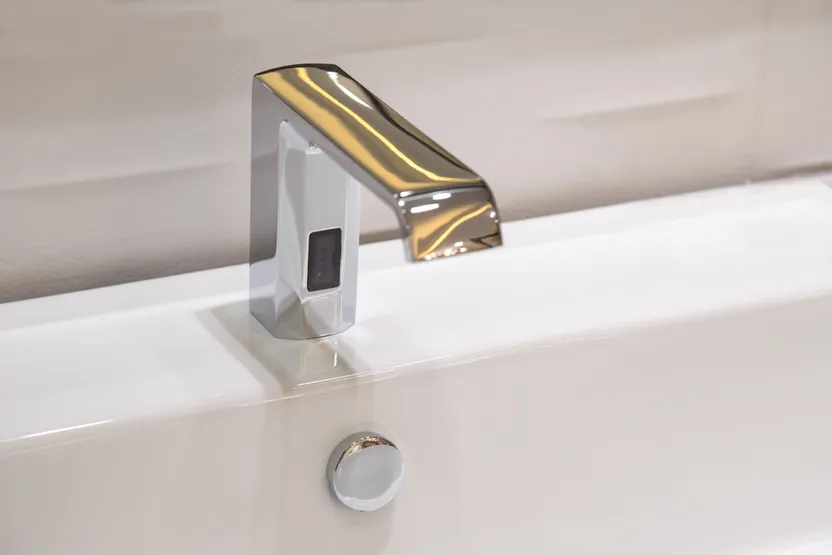
These taps come with an infrared sensor that detects the heat from your hands as they pass in front of it. The sensor will also turn the tap off when your hands are taken away. The only downside is that a lot of sensor taps require batteries. You will therefore need to have enough space under your sink or vanity unit to install the control box. Some sensor taps can be directly connected to your mains power which will require a bit more skill when it comes to installation.
Sensor taps
You may be also interested in these guides
Guide written by:
Tess, Painting & decorating consultant, Brighton
'/%3E%3C/svg%3E)