Solar water heater buying guide
'/%3E%3C/svg%3E)
Guide written on 6 February 2024 by:
Arnold, Researcher / handyman
Important features
- Tank capacity
- Thermosyphon solar water heater
- Integral
- Solar collectors
- Standards
Best sellers in this category
Installing a solar water heating system
Any type of new installation requires a cost and efficiency analysis and solar water heaters are no exception to the rule. In summary, you need to:
evaluate the number of sun hours where you live;
determine your hot water needs;
consider the number of solar collectors required;
choose the most suitable solar water heating technology for your home;
make calculations and compare solar water heating with other systems;
find out about any government grants that may be available to you.
Manufacturers often sell solar water heater bundles with solar collectors which makes it easy to calculate the number of collectors required. When it comes to judging the quality of the storage tank and anode rod, the criteria will be similar to any other water heater. That said, there is little difference in quality between solar hot water tanks themselves.
Many solar water heaters are fitted with an electric backup heater which is used to heat water when you can't rely on solar power alone. This could be due to inadequate sun expore or overuse – that said, always make sure to save water wherever possible!
How does a solar water heater work?
A solar water heating system produces domestic hot water from cold water using energy from the sun. Like most types of water heating systems, a solar water heater comprises:
a storage tank to store the hot water;
a heating system to heat up the water;
an expansion vessel which deals with variations in volume from your home water supply. The expansion vessel is also relied on to maintain pressure as water in the circuit cools down. This component is very important and it is essential not to scrimp on quality nor on maintenance as this will affect the service life of your tank;
solar collectors which are used to gather energy from the sun;
a circulating pump for active solar water heaters. This part works to circulate hot water from the solar collectors to the tank;
anti-freeze to transfer heat energy to cold water.
Expansion vessels
Best sellers in this category
Tank capacity and solar collectors: technical characteristics
To start, it is essential to work out the capacity of the storage tank and solar collectors in order to determine the correct size of domestic solar water heating system for your needs.
Storage tank volume
The tank capacity will of course depend on the number of people in your household. For two people, a 150-litre storage tank will largely suffice. You can work out the capacity of the tank just like you would for a standard hot water cylinder (meaning you need roughly 50 to 60 litres of water per person).
Solar collector size
The total surface of your solar collectors depends on a couple of factors:
the number of sun hours where you live;
the size of your storage tank.
You need a specific amount of solar energy to heat 200 litres of water up to an initial level of 10°C . This number is always the same, whether you live in the North Pole or Central Africa! The only thing that changes is the time it takes to gather this energy. You can reduce the amount of time required by increasing the size of your solar collectors.
Buffer tanks
Thermosyphon vs. integral collector solar water heaters
There are a couple of common types of solar water heater technology: thermosyphon water heaters and integral water heaters.
Thermosyphon solar water heaters
Thermosyphon solar water heaters are widely used in non-freezing climate areas. They can be installed in new builds or can be retrofitted, and are fully compatible with other heating systems. This type of solar water heater sometimes relies on passive natural circulation to move hot water to the storage tank above. However, passive indirect thermosyphon systems utilise anti-freeze (most commonly polypropylene glycol) which is directed towards the tank using a circulating pump and temperature controller which is guided by temperature differences between the solar collectors and hot water tank. If the tank temperature is higher than that of the solar collectors then the antifreeze stops circulating. In this case, the storage tank must be located higher than the solar collectors and the collectors mustn't be any further than two metres from the tank.
Integral solar water heaters
Integral solar water heaters work a bit differently. In this case, the hot water cylinder and the solar collectors are combined within one single unit. The solar collectors are located above the tank to take advantage of natural convection whereby hot fluids, which are less dense, naturally rise higher than cold water. This type of water heater is typically installed in areas with very high numbers of sun hours. It's worth noting that it is not possible to pair these solar water heaters with a backup water heater. So beware that your only source of water heating will be the sun! In this case, the tank can be located lower than the solar collectors (in a basement, for example). These solar water heaters are also more efficient than thermosyphon systems. For these two reasons, they are more expensive.
Different types of solar collectors
A domestic solar water heater can be fitted with various types of solar collector.
Glazed flat-plate solar collectors
These solar collectors are typically used in domestic solar water heating systems as they feature the most basic design. In this case, the flow tubes and absorber plate are contained within a metal box which is covered by a special type of glazing. These collectors are highly efficient in warm regions and they are affordable. However, their performance is limited since they can lose heat when the outdoor temperature dips too low.
Non-glazed flat-plate solar collectors
Non-glazed solar collectors function using the same basic idea as glazed collectors only they do not feature a glass covering. In short, these collectors feature a very similar design to the tubes that can be found behind a fridge! Unglazed solar collectors experience much greater heat losses than glazed collectors. However, they are also much lighter and less expensive.
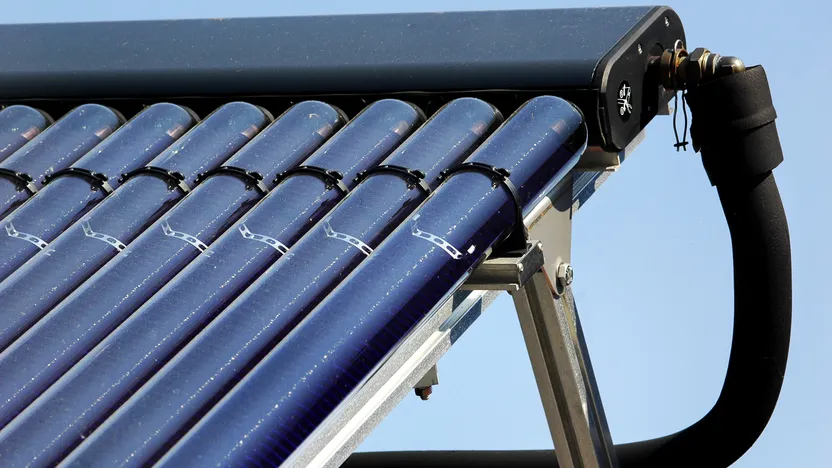
Evacuated tube solar collectors
These solar collectors comprise sealed glass tubes. It is possible to change the position of these collectors to meet your requirements. Evacuated tube collectors use a vacuum to limit heat loss meaning they perform better in colder or temperate regions. While they can be up to 20% more expensive than flat-plate collectors, they are more efficient making it possible to save money over time.
How many solar collectors do I need?
First of all, you need to consider the size and orientation of your roof. It goes without saying that you can't install 200 m2 of solar collectors on a 150 m2 roof. At the same time, if you have a south-facing roof, you won't need as many solar collectors as your neighbour with an east-facing roof.
Furthermore, you need to consider the number of sun hours per year, the solar collector technology and any potential shade that could be cast on your roof. For example, if you live next to a tall building, this may cast shadow over your house at certain times of the day which will cause you to lose sun exposure.
Finally, it is important to think about the number of people in your household to determine the size of the tank and therefore the volume of water that you require each day.
As a rough guideline, bear in mind that if you want to install a tank with a capacity of 150 to 200 litres for a house of two, then two or three m2of solar collectors should suffice.
Self-draining solar water heaters
It's also worth noting that you can get so-called self-draining solar water heaters which feature an automatic drainage system. Please note that these systems do not empty the hot water storage tank, but rather the solar collectors which are drained of antifreeze to prevent the fluid from stagnating. This type of system aims to make your system much easier to maintain.
Solar water heaters: government grants
Government schemes
Solar water heaters are highly technical installations that require a range of skills to install. Fitting solar panels demands knowledge about sanitary installations, electricity, heat transfer and even anti-freeze. It is therefore highly recommended that you get your solar panels installed by an experienced professional.
It is well worth finding out about any government grants that may be available to you to ease the cost of purchase and installation. It might interest you to know that solar panels will be VAT-free until 2027 as part of the UK government's plans to make it cheaper for homes to switch to renewable energy sources.
Solar water heater standards
The requirements on durability, reliability and safety for factory-made solar heating systems are defined under the European standard EN 12976. It is essential to choose a solar water heating system that has been tested to this standard.
More information
For more information on domestic water heating and equipment, check out the following guides:
For more advice on maintaining your water heater, check out the following guides:
For other domestic hot water solutions, check out these guides:
More information
You may be also interested in these guides
Guide written by:
Arnold, Researcher / handyman
A chemist by training and a self-taught handyman, I work in the pharmaceutical industry. As a young dad of 36 years, I am a jack-of-all-trades. To my credit, I have already completed 5 kitchen installations, renovated an appartment, and completed an extension of my own house. Over the last three years I have done everything: insulation, plasterboard, electrics, painting, parquet flooring, bathroom, tiles...in short, 60 m2, made entirely with my own two hands. Fortunately, I have my own personal decorator. I don’t worry about styles and colours. As they say: happy wife, happy life. My motto: good tools and good products are half the work, the rest is patience and attention to detail.
'/%3E%3C/svg%3E)