How to open your pool in spring
'/%3E%3C/svg%3E)
Guide written on 6 February 2024 by:
Michael, Professional and passionate welder, Sheffield
Important features
- Water and skimmer cleaning
- Filtration system maintenance
- Basin and liner cleaning
- Water top-up
- Water treatment
- Heating and covering
Best sellers in this category
Preparing to uncover your pool
So you've made it through the winter! If you've gone for the active method of winterising your pool, you will have been dutifully switching on your filtration system for a couple of hours each day throughout the cold season and your pool has been safely shielded from the elements beneath a pool cover. If you went for a more passive approach to winter care, you hopefully at least invested in some winter pool care equipment to prevent your pipes from freezing or getting clogged.
Now the nice weather is on its way, it's time to take stock of the condition of your pool before the summer fun begins. If you want months of carefree bathing, it's important to get into a good routine now. Let's roll back the cover and get your pool up and running!
Wintering pool care
Inspecting and cleaning your pool
Upon peeling back your pool cover, you're likely to find slightly discoloured water with the odd bit of debris floating around. First things first, clean your pool cover and store it safely indoors. Once that's out of the way, it's time to clean around the pool. This step is particularly important as you'll be clearing away any dust, leaves or other debris that will eventually end up in your pool. For this part, you can use a hose with a cleaning attachment. If you want to be more efficient — or your pool surround is particularly dirty — you can use a pressure washer.
Before you set about turning on your filtration system and treating the water, it's important to remove the worst of the debris from the surface of the water and the pool floor. Your skimmers and their filters have been doing their bit all winter long and now is the time empty them and clean them out. Only then can you get out your pool cleaning products and pool robot and get to work. To save you time, here's a quick list of the tools and equipment you might need:
Pool brushes
Best sellers in this category
When to open your pool after winter
No matter where your pool is set up, it's advisable to start getting it ready before the water temperature goes above a certain level. A good range to aim for is around 11 to 15°C.
Once the pool temperature reaches 15°C you run the risk of algae and bacteria setting in so it's important to start preparations early. Otherwise, you'll have a lot more work on your hands. If your pool is set up at a second home, make the most of the Easter break to carry out your pre-season preparations!
Shop our swimming pools
How to uncover your pool after winter
If your pool is covered with a tarpaulin or rigid pool cover, take it off.
8 steps for perfect pool prep
Clear the pool rim and pool surround of debris, leaves or any other matter that could fall into the water.
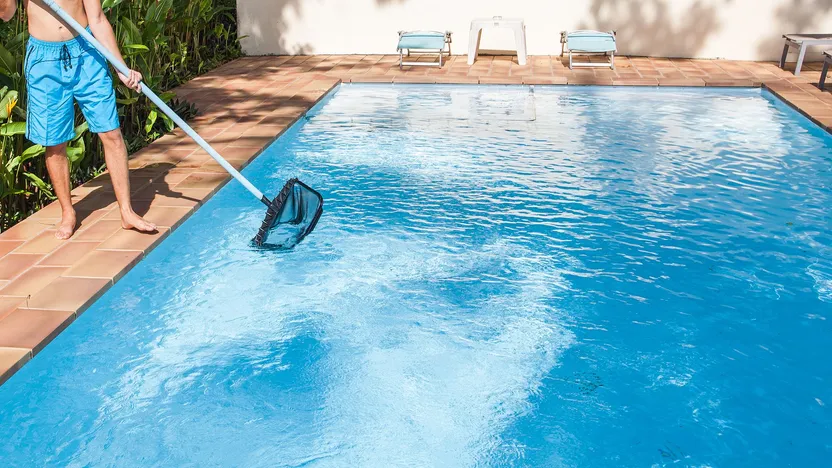
Use a skimming net to gather any floating debris and bin it.
Empty the skimmers.
Use a pool brush with a telescopic extension to scrub the pool walls and floor. This can be a tedious task and will require some elbow grease!
Remove any residue leftover from brushing using your pool vacuum. You can go ahead and get rid of this dirty water as it's always advisable to replace a portion of the pool water in the spring — about a third of the total volume should suffice.
The waterline is probably quite dirty at this point through contact with the stagnant water. Tackle this area using a sponge brush and a specially designed cleaning product that won't damage the pool liner.
Set up your pool robot to finish off cleaning the water.
Put your filtration system on backwash mode (if it offers this function) before turning it back on. If your pool has a cartridge filter, check that it is in good condition and clean or replace it as necessary.
See our pool filters!
Unclogging a pool filter
If your pool filter is blocked and no long performing as expected, it will need to be unclogged. Sand filters simply need to be removed and washed out in reverse using a hose or spray gun. The same applies to mineral Zeolite filters which are designed to offer superior filtering power.
If you have a cartridge filter, you can wash it out or replace the cartridge. The easiest way to check the condition of a filter is to check your pressure gauge. If its output pressure is weak, you've got a problem and it's time to descale the filter.
Some pool filtration systems have an automatic filter cleaning mode. In this case, just cut the output to the pool and set the filter to 'wash' position. After a few hours, put the filter back into filtration mode.
Paper or synthetic material
Treating your pool water in spring
You can now start to treat your water using the appropriate pool maintenance products. Start by topping up your water. After a few hours, check the pH, total hardness and total alkalinity of your water using a test kit. Adjust these levels as required, using the appropriate additives (e.g. pH increaser / reducer, flocculent, etc.).
Test your water again after treating and keep your filtration system running continuously — this will probably end up costing you less than having to keep topping up maintenance products.
If your pool has a heating system, test the temperature by letting it rise over the course of a few hours. If the pool isn't going to be used immediately, shut off the heating system and re-cover the pool.
Shop our swimming pools
Cleaning an above ground pool
Above ground pools are generally a bit trickier to clean as there's no pool edge for you to walk around. As far as manual cleaning goes, you can basically use the same tools as you would to clean an in ground pool. When it comes to treating the water, the following tools will come in handy:
Floating skimmers;
Pool ladders;
Maintenance kit;
Filtration kit;
Above ground pool vacuum.
Above ground pools are generally installed on lawns. A great way to avoid constantly having blades of grass in the water is to install the pool on top of a pool mat.
Shop our swimming pool surrounds
Fitting a bubble cover
Once your pool is clean and ready to go, you might want to consider investing in a bubble cover for your pool. These covers work just like standard covers with the added bonus of increasing the temperature of your pool by a few degrees. Remember — every little counts!
It's also worthwhile thinking about how you can heat your pool naturally (for example, by investing in a solar pool heater). Finally, don't forget to keep a close eye on the quality of your pool water: you're sure to reap the benefits down the line. Happy swimming!
Shop our swimming pool covers
You may be also interested in these guides
Guide written by:
Michael, Professional and passionate welder, Sheffield
I was trained as a pipe worker and a pipe-welder and after having travelled for 35 years working around the UK, I became the head of a metal shop, then a designer and in the end the head engineer. I have designed and built a workshop where I make metal sculptures: I managed to find a piece of paradise where I can let my imagination run wild. Auctions and garage sales are no secret to me. I find unusual objects and old tools there that I collect or transform into works of art. I also like decoration, painting on canvas, and gardening. I am developing new technologies concerning tools. To share my passion and advise you in your choice of materials is a real pleasure.
'/%3E%3C/svg%3E)