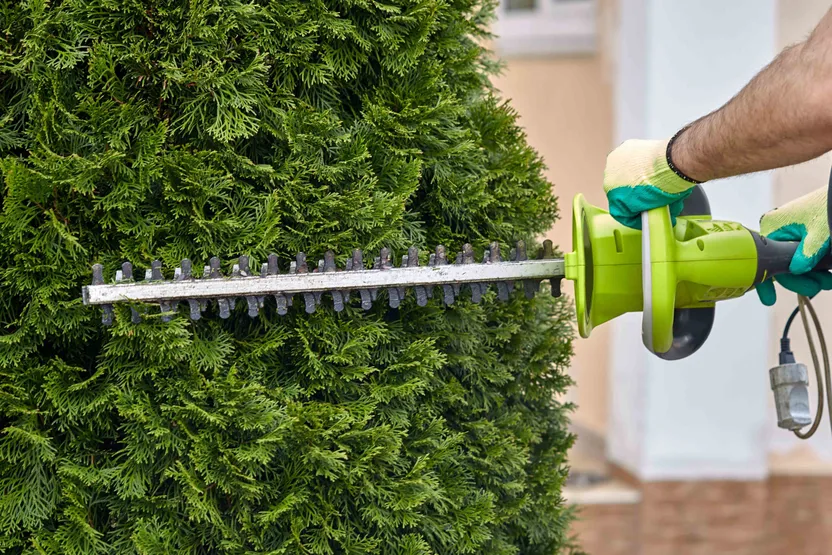
When and how to prune a thuja hedge
'/%3E%3C/svg%3E)
Guide written on 25 September 2026 by:
John, Passionate gardener, Cambridge
Important features
- Pruning periods
- Tools required
- Safety wear
- Pruning techniques
Best sellers in this category
When to prune a thuja hedge
If you want a beautiful hedge with a base that is as full as the top, you'll need to trim your thuja trees at least twice a year. This should also help to stop the hedge from growing too tall. Pruning should generally take place:
once at the start of May;
a second time at the end of summer from the end of August to the end of September.
In addition to these two main prunes, you can trim your hedge more often throughout the year as long as there is no frost and the weather isn't too hot.
Each type of prune will have a different effect on growth:
your spring prune is most effective for young thuja trees which will quickly put out new branches to fill in the hedge;
your end-of-summer prune, carried out as the sap is dropping, won't boost growth but it will help to maintain the shape of your trees.
It's important to prune young thuja trees even if they haven't yet reached your desired height. Start pruning as soon as possible after planting the trees – this will make it easier to grow a full hedge with no gaps.
Once your hedge has reached the desired size and you want to slow down its growth, you can do a harder prune in the spring. The hedge won't look as good for a while but the young shoots are quick to grow and will soon cover up any unsightly spots.
How to prune a thuja hedge
If you are experiencing dry spell, remember to water your trees a day or two before you start pruning the hedge. This additional moisture will help the tree to heal wounds and put out new branches. Don't forget to water again after each prune and to provide the tree with fertiliser to stimulate leaf growth.
Pruning the sides of the hedge
Start by pruning the vertical sides of the hedge. It's best to cut a slight bias into the hedge meaning it will be a little thicker at the base than at the top. This will help the foliage to get a little more sunlight which, in turn, should help it to grow healthily.
Prune from bottom to top. If you prune in the opposite direction, the branches at the top will sit on the base branches as you work. Cut back about two thirds of the length of any new growth.
Shears do require a bit of skill to use but allow you to cut with precision. Hedge trimmers produce a more even result and prevent holes in the hedge. It's important to keep the blade parallel to the hedge.
Be sure to pause from time to time and take a few steps back to make sure you are cutting evenly.
Pruning the top of the hedge
Once you've tackled the sides of the hedge, it's time to move on to the top. To do so, you need to mark out your cutting height. Plant a couple of stakes on each side of the hedge and stretch a length of string between the posts. If your hedge has another side at a right angle, plant a third stake in the ground.
Check the string is roughly level by looking at it. Alternatively, you can walk the length of the hedge with your arm outstretched against the string which should remain at arm or hand height. Bear in mind that any hedges bordering a neighbouring property should generally be kept to a height of about 2 metres.
It is much safer and more practical to use a work platform to cut a hedge rather than a ladder or stepladder. Often mounted on wheels, these platforms are really easy to move around, adjustable and stable.
Generally speaking, you should cut back around 30 cm in length each time you prune. You can cut straight across the top of the hedge but if you live in a region with heavy snowfall in winter, a rounded top is better as this shape prevents snow from building up and damaging the foliage.
Best sellers in this category
How to use hedge trimmings
Pruning a hedge will produce a lot of green waste. You have a few options for disposal:
spread the trimmings out as mulch around the base of the hedge or dry them out and use them to mulch another type of hedge or tree. The cuttings will break down slowly and will help to keep moisture in the soil;
break down the foliage in a garden shredder and use it to mulch crops or flowerbeds;
take the waste to a recycling facility or put them out with your green waste.
Beware that these cuttings are acidic and are best suited to mulching heath plants or any plants that enjoy a slightly acidic soil such as citrus fruits.
How to prune an overgrown hedge
The main problem with thujas and other hedge plants is that they can get overgrown if they aren't pruned regularly. However, you can remedy the problem if you act quickly.
If you haven't pruned for a while, avoid pruning too hard as your hedge will struggle to fill in any large gaps. Conifers in general (with the exception of yew) don't really enjoy hard pruning. If you are set on pruning extensively, the best case scenario will be that your thuja won't look much better after the prune. Worst case scenario, the branches will dry out and your thujas will start to perish. The most radical solution is to simply cut down the trees and plant other hedge plants in their place. If you do decide to start afresh, it's worth noting that you won't need to get rid of the tree stumps as they won't grow back and any new trees will eventually hide them away.
Conifers
How to prune a thuja hedge
Tools and equipment
Electric secateurs
Electric or petrol hedge trimmer
Stakes measuring over 2 metres
String
Stepladder or work platform
Safety wear
Please note: this is a non-exhaustive list; be sure to match your personal protective equipment to the job at hand.
To make the job easier, use a pole hedge trimmer. This will allow you to reach the highest parts of the hedge without having to climb up a ladder or work platform. Of course, you'll have much stronger footing on the ground than you would on a ladder or platform. You can also swivel the blade around to cut beneath the hedge.
You may be also interested in these guides
Guide written by:
John, Passionate gardener, Cambridge
When I was young, I was already working in the family garden. Perhaps that is where my interest in plants and gardening came from. So, it was logical for me to study plant biology. At the request of various publishers I have, over twenty-five years, written many books on the subject of plants and mushrooms (a subject that is close to my heart). They were mostly identification guides at first, but shortly after they were about gardening, thus renewing the first passion of my childhood. I have also regularly collaborated with several magazines specialising in the field of gardening or more generally in nature. There is no gardener without a garden, I have cultivated mine in a small corner of Cambridge for the last thirty years and this is where I put into practice the methods of cultivation that will I advise you in as well.
'/%3E%3C/svg%3E)