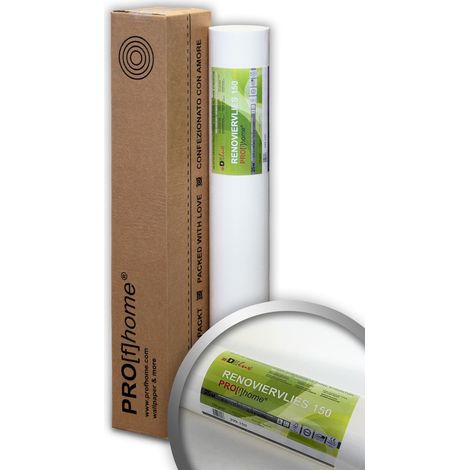
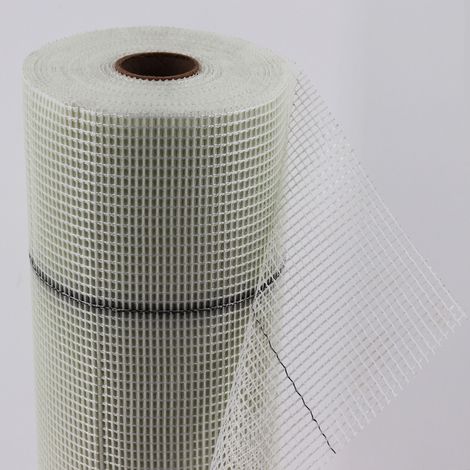
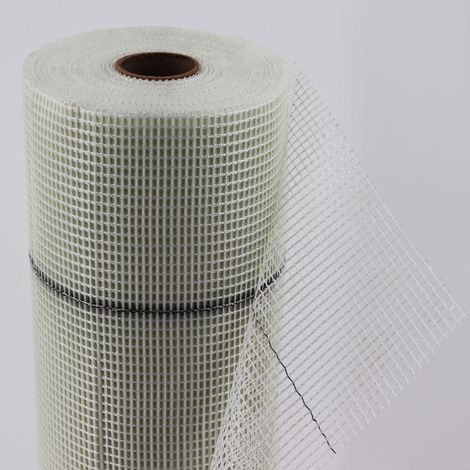
Glass fiber fabric or paintable wall covering is used to mask small defects present on a wall. They can then be coated with a finishing paint. Their manufacturing process also creates specific patterns that enhance the aesthetic appearance of the support.
Through its diamond, mesh, roughcast, or chevron patterns, glass fiber fabric gives an impression of relief and is perfect for personalizing wall decoration. It is available in various versions including:
- classic, to be applied on a glued wall;
- pre-glued, offering a considerable time-saving during installation;
- pre-painted, allowing the use of a single layer of acrylic for the finish;
- magnetic, avoiding nail or tack marks on the wall;
- sound-absorbing, also serving as an acoustic insulator.
A paintable wall covering is generally sold in rolls of varying lengths and one meter wide. It is particularly defined by:
- its weight (from 35 to 200 g/m²), indicating its strength and its ability to cover irregularities on the wall;
- its aesthetic, the visual effect achieved typically suits all styles but should be chosen based on the desired texture;
- the duration of implementation. It is better to opt for single-layer or pre-painted models to complete the work quickly. In this case, after installation, you only need to wait 24 hours before applying a coat of paint on the covering (compared to two coats of paint for the classic version).
The installation of this type of covering is similar to wallpapering. During the process, you only need to:
- apply the elements in panels and smooth them to avoid the formation of bubbles;
- use dedicated adhesives (useful for the versions to be glued and not necessary for the pre-glued model);
- cover the entire surface with two coats of paint (a single coat for pre-painted models), a primer (or base coat), and another as a finish.
A glass fiber fabric or paintable wall covering is chosen based on the desired visual effect and the condition of the wall. The more deteriorated the wall surface is, the higher the weight should be. The buyer's taste will then guide them towards their preferred weaving patterns (lines, diamonds, mesh, roughcast, chevrons...).



'/%3E%3C/svg%3E)
'/%3E%3C/svg%3E)