Air purifier buying guide
'/%3E%3C/svg%3E)
Guide written on 6 February 2024 by:
John, DIYer & IT developer, Brighton
Important features
- Operation
- Uses
- Filtration type
- Noise level
- Wattage and size
- Maintenance
Best sellers in this category
How does an air purifier work?
Air purifiers are fitted with a fan which draws in and circulates air through a set of filters. These filters use physical or chemical processes to either capture or transform airborne germs and bacteria into harmless substances.
The pre-filter is the first step in the filtration system and is used to capture dust, hair and other particulate matter to prevent the system from getting clogged. Once the air is free of these larger particles, it moves through a series of various filters within the purifier. The quality of the air purification depends on the combination of these different filters. Filters can deal with a range of airborne particles including bacteria, viruses and volatile organic compounds (VOCs). Some are able to filter particles as small as 0.3 microns (µm).
Air purifiers may also feature different filter technology including particle, ionic, air sterilising, photocatalytic and plasma filtration. Each filtration method is designed for a specific purpose to match the types of contaminants present.
Purifiers
Why purify air in the home?
The air in our homes can be polluted by various sources from the paint that covers our walls to the furniture that decorates our living rooms. You may also be exposed to things like fumes from a faux leather sofa or, if you live in the city, traffic pollution. Air purifiers are used to remove contaminants from the room in which they are installed in order to reduce our exposure to a range of pollutants, some of which can be carcinogenic.
Ozone production and health risks
Research concerning air purifiers often brings up articles on the dangers of ozone. According to the European Environment Agency, breathing in air that contains more than 120 micrograms per cubic metre (µg/m3) of ozone for eight hours a day can irritate the mucus membranes and respiratory system, which can worsen asthma symptoms. Some air purifiers feature a ozone generator, and can produce so much ozone that no one can be present in the room while they are being operated. However, most home air purifiers only produce ozone as a by-product on a very small scale.
The dangers of VOCs
Volatile Organic Compounds (VOCs) are emitted by products containing adhesives or solvents, or by burning certain materials. Chipboard and melamine furniture, laminate floors, faux leather, and sofa and mattress foam all emit formaldehyde which compromises air quality. Formaldehyde is classified as a carcinogen by a number of health agencies. It is therefore very important to limit the concentration of this chemical in the air.
Best sellers in this category
Air purifiers: what filters do I need?
Home air purifiers will often come with a range of different filters.
Particle filters
Particle filters are characterised by the smallest particle size they can capture which is indicated in microns (µm). The best option will be a HEPA filter (which stands for High efficiency particulate air [filter]). These filters are able to remove at least 99.7% of airborne particles as small as 0.3 µm. These fine particles include ash and pollen, as well as fine dust produced by tyres and brake pads, all of which can worsen the symptoms of respiratory conditions like asthma. It goes without saying that is essential to choose a high-quality filter. This is even more important if you have a pollen allergy, suffer from asthma or live next to a busy road.
Ionisation filters
Ionisation is the process of removing or adding electrons to an atom or molecule to modify its physical properties. This type of filter helps to remove electrons from particles and pollutants in the air and neutralises particulate matter to make it less harmful. These filters work by sending out negative ions which cause particles to stick to surfaces which have a positive electrostatic charge in a process that is a bit like magnetic attraction.
Heat sterilisers
In this case, bacteria, fungi and particles are burned upon contact with a surface which is heated to 200°C. The air is cooled before being released so as not to affect user comfort.
Photocatalytic filters
This type of filter focuses intense UV light onto a catalyst. This catalyst is designed used to speed up the process of oxidation using UV rays and is typically made of titanium dioxide. It breaks down pollution in the air into harmless substances like water and carbon dioxide (CO2).
Plasma filters
A plasma is a gas in which some or all of the atomic or molecular constituents have been ionised. A plasma air purifier works to send out positive and negative ions into the air. The ions then join around pollutants which get trapped in the plasma filter.
Air purifier filters
Air purifier noise levels
The noise produced by the flow of air and the fan may prove bothersome if the air purifier is set up in a living room, bedroom or in an office. It is therefore important to check the noise level of the device (indicated in decibels or db) before purchase. For reference, a noise level of 50 dB corresponds to a conversation at normal speaking volume, which is already quite loud for a bedroom. Models emitting 20 dB and below will be much more discreet. You can either choose a model with a low noise level or pick one with variable speed settings. In the latter case, the volume of air to be treated per hour can be decreased in order to limit noise or, conversely, it can be increased to quickly freshen up a room. This turbo mode is a great option for areas that require a high degree of air filtration on an occasional basis.
How to maintain an air purifier
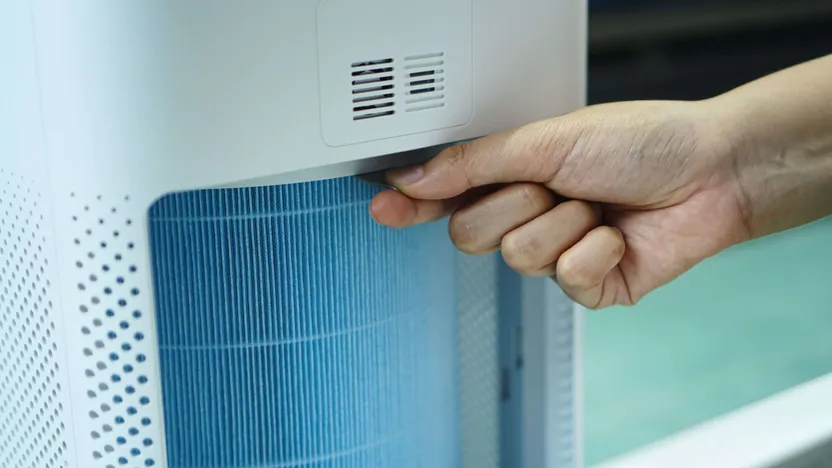
Each of the filters in an air purifier plays its part in the filtration process. If you want the air purifier to work well, it is essential to keep the filters in good condition. Start by removing any dust, hair or other debris from the pre-filter by hand or using a brush, then remove the pre-filter to gain access to the other filters.
Each type of filter requires a different type of care. Refer to the manufacturer's instructions to, first of all, find out if the filters can be cleaned and, if so, how to clean them. Handle the filters with care and follow the instructions to the letter to avoid damaging them. Most of the time, the process will consist in rinsing the filters under lukewarm water, wiping them with a damp cloth or soft brush and letting them dry fully before refitting them. Be careful not to touch any surfaces with special coatings directly, such as electrostatic collectors.
Disposable HEPA filters must be replaced periodically. It's important to check how often they need to replaced as well as the price of replacement filters to ensure you don't end up out of pocket. Maintenance-free parts, like heat sterilisers, should be replaced when they no longer work. Be sure to check the availability of spare parts to ensure your air purifier will have a long service life.
Air purifiers: size and power
What wattage do I need?
Air purifier power ratings determine how many watts they use for standard operation. When it comes to basic air purifiers with HEPA filters, a fairly low wattage is required to turn the fan.
UV and ionisation filters use a little more energy. Similarly, air purifiers with several settings can use about 100W. If you go for an air purifier designed to handle a large volume of air per hour, the wattage will be even higher.
What size of air purifier do I need?
It is generally agreed that an air purifier should be able to process the volume of the air in one room three to four times in one hour to produce high-quality air. Simply multiply the volume of your room in cubic feet by three or four, and you will get the required CFM (cubic feet per hour) rating you need. If you intend to set up the air purifier in a living room, you might want to go for a sleek design. If you are hoping to move the purifier around, a compact model weighing under 10kg will do the job.
How to control humidity with an air purifier
The humidity level within a home should sit somewhere between 30 and 70%. Any lower than this and the air is considered too dry which can trigger respiratory conditions. Additionally, viruses like the flu are more likely to spread in dry air. Any higher than the recommended level and excess humidity will build up as condensation on any cold surfaces. This moisture can lead to mould growth on walls, clothes or leather items. In addition to emitting an unpleasant small, the spores released by mould can cause respiratory issues, particularly among the most vulnerable.
Air purifiers with humidifiers or dehumidifiers
An air purifier-humidifier will deal with air that is excessively dry. If, on the other hand, you have condensation on your windows or external walls, then an air purifier-dehumidifer is what you need. Bear in mind that using these combination devices will save you having to buy a separate humidifer or dehumidifer.
More information
You may be also interested in these guides
Guide written by:
John, DIYer & IT developer, Brighton
Since I was a child, I was always interested in manual and technical work. Always fascinated by woodworking, I took advantage of my first flat as a playground. On the cards: electricity (of course, safety first!) and some partition walls; but also decorating with the help of the missus, made-to-measure furniture and little tricks to optimise the space, all the while remaining as original as possible. When the little one arrived, I started building bits and pieces for him! Lacking space, I have not got a permanent workshop and certain tools I dream about are not part of my collection. Not to worry, I already know a lot about DIY and I have a high-tech profile that I hope will guide you in your decisions!
'/%3E%3C/svg%3E)