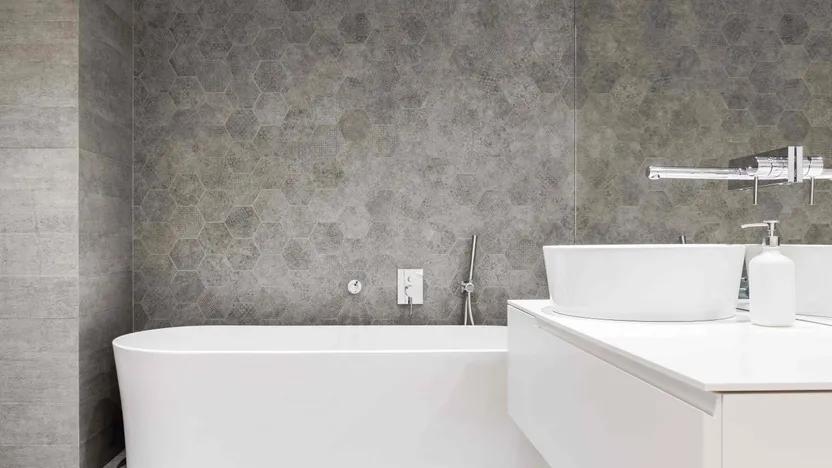
Bathroom wall covering buying guide
'/%3E%3C/svg%3E)
Guide written on 25 September 2026 by:
Kate, Flooring Expert, Swansea
Important features
- Wall tiles
- Ceramic tiles
- PVC wall panelling
- Epoxy resin
- Wallpaper
- Bathroom paint
Best sellers in this category
How to decorate bathroom walls
Bathrooms are often small rooms which makes them difficult to decorate, especially since they also have to deal with moisture. For this reason, not all types of wall covering are suitable for bathroom use.
Luckily, we're here to help you find the best option to cover your bathroom walls whether you're renovating or starting from scratch. First things first, painted timber cladding without appropriate treatment and standard wallpaper should be avoided at all costs as these options are not suitable for rooms containing moisture.
It's also important to consider the condition of the surface – are the walls smooth or covered with imperfections? Is there already a wall covering in place?
Think carefully about the budget you want to devote to the project and the type of surface you want to cover. For example, you may find yourself having to make a lot of cuts to match the space.
Finally, think about care requirements and whether or not your chosen wall covering will also need to line the inside of your walk-in shower, for example.
Shop our wall tiles
Wall tiles: a classic bathroom choice
Porcelain and ceramic tiles are probably the most common options for bathroom walls. No surprise there as tiles are very well suited to coping with humid environments.
It's worth noting that if you choose tiles, most floor tiles can also be used on walls as long as they measure less than 60 x 60 cm. This way, you can match your floor tiles to your wall tiles.
However, it can be tricky to line up the grout if you don't mention that you want the same grout line for all tiles. Otherwise, you can go for rectified tiles which require a smaller grout width of 2-3 mm.
If you choose to go for glazed ceramic, you will save money but you must be aware that these tiles can only usually be used for walls. Do not be tempted to lay them as floor tiles as they may not stand up to the challenge!
6 advantages of bathroom wall tiles
There is an enormous range of tiles on the market to match all tastes, and as many formats as there are finishes and materials! From traditional tiles to contemporary designs, there's truly a wall tile out there for every bathroom.
However, it's important to pay attention to tile formats in bathrooms. If you are working in a small space, go for small tiles to avoid having to make too many cuts.
Μatch your wall tiles to your floor tiles and you'll get a seamless result!
Very good wear resistance compared to other options.
Very moisture-resistant: tiles can even be fitted in showers.
Easy to clean and no particular care is required.
How to choose bathroom wall tiles
Tiles are the most common wall and floor covering for bathrooms so you'll have a huge variety of options to choose from.
Porcelain square (20 x 20 cm up to 60 x 60 cm) and rectangular tiles (30 x 60 cm, for example) come in all finishes including stone, concrete, textile, marble, assorted colours, etc.
Faux wood planks: there's nothing stopping you from installing wood effect tiles for a cladding effect that is guaranteed to keep the water out!
Ceramic square (20 x 20 cm or 30 x 30 cm) and rectangular (20 x 40 cm, 20 x 50 cm or 30 x 60 cm) tiles also work really well for bathroom walls.
Border tiles: bathrooms are often decorated using border tiles which come in a wide variety of patterns. But beware – border tiles are often sold individually and will increase the price of your wall covering considerably.
Mosaic: an on-trend option, mosaic tiles are also quite expensive. You'll have to pay by the room which can cause costs to mount quite quickly!
Tiling is a perfect option for shower walls but it is essential to seal your shower carefully anywhere that will have to deal with water splashing.
Best sellers in this category
PVC wall panelling
Another option is to fit special bathroom cladding as an alternative to tiles.
This type of wall panelling can be installed in different ways. For example, it can be glued in place (not recommended for showers) or simply slotted together like traditional cladding.
PVC wall panelling can also be made to look just like wood, concrete, and so on. You'll find a variety of different finishes on the market even though you will have less choice compared to traditional panelling or other types of wall covering.
Be careful – not all PVC cladding is suitable for bathroom use so be sure to check this before purchase. It must be waterproof and rot-resistant.
This type of product is ideal for bathroom renovations as cladding can be used to cover a damaged or uneven wall. It's worth noting that wall panelling can be used for bathroom ceilings as well as walls. The format of the planks allows you to install them horizontally or vertically – the choice is yours!
No matter which type of cladding you go for, bathroom PVC wall panelling will always be cheaper than tiling. It is also easier and quicker to install than tiles so you'll save money on installation if you are calling in tradespeople. What's more, it's very straightforward to clean and features a wear layer so it is durable.
Wall panelling
Epoxy bathroom walls: waterproof and stylish
Another option for decorating bathroom walls is decorative resin.
Ideal for renovating old walls, epoxy resin is great for covering up old tiles that no longer match your tastes. What's more, you don't even need to remove the tiles first!
However, it's important to make sure you use the right type of resin to prevent issues related to waterproofness or premature wear. Resin that is resistant to water or moisture is called 'epoxy resin'.
The durability of epoxy is all about its wear layer which dictates how well it stands up to bathroom use.
Resin comes in a multitude of colours and can even be used to create a faux concrete effect. It is relatively easy to apply, but costs can quickly build up! If you have a tight budget, it is best to use this option for smaller areas.
Bathroom wallpaper: vinyl-backed and waterproof
The advantage of wallpaper is that it can be used to cover up surface imperfections which is great for bathrooms with walls that aren't quite smooth. The main downside of wallpaper is that the bathroom has to be very well ventilated to stop the wallpaper from peeling prematurely.
When it comes to hanging wallpaper in a bathroom you will have less choice as the wallpaper you choose needs to be designed for this purpose. Vinyl-back wallpaper is ideal for high-moisture rooms.
The wallpaper you choose must be washable and usually cannot be hung in a shower. Choose between individual strips and rolls of waterproof wallpaper.
Shop our wallpapers
Bathroom paint: high moisture resistance
Bathrooms are high-moisture environments. Any type of wall covering, including paint, must be come with a label confirming its suitability for bathroom use. In no circumstances can you use an ordinary wall and ceiling paint at the risk of the paint chipping or peeling prematurely.
Special bathroom paint is designed to prevent mould growth and is usually a water-based emulsion. Easy to apply, you do have to prepare the surface by applying a suitable moisture-resistant undercoat.
The risk of Volatile Organic Compounds (VOCs) shouldn't be overlooked – it is highly recommended to wear a mask when applying these paints. Bathroom or kitchen paint are washable and require very little care. But beware – these paints still probably shouldn't be used in the shower!
Bathroom paints come in a limited range of colours. With this in mind, you might want to mix your own colours to get as close as you can to the colour you want.
Wall panelling
You may be also interested in these guides
Guide written by:
Kate, Flooring Expert, Swansea
Flooring is my life. I love what I do, and I've been doing it for as long as I can remember. So, I'm not bragging when I tell you I know all there is to know about every flooring product. From laminate, parquet and linoleum to PVC, carpeting and tiling, my workdays are spent learning about manufacturing processes, composition, performance, laying techniques and maintenance methods. I've certainly seen my share of mistakes made on construction sites because of what was essentially a lack of information or understanding of the product. Flooring elements are constantly evolving and being improved upon - even us pros can find it hard to keep up! Some of us in the industry use language that is overly technical or loaded with jargon you'd have to be an expert to understand. What's more, flooring salespeople are often so focused on closing the sale that they don't take the time to explain the products in any detail. That's why I want to pass on my knowledge in a way that's clear and accessible, and maybe a bit fun too. Because flooring shouldn't be a chore!
'/%3E%3C/svg%3E)